

Quick answer
A company director deciding how to take value from a business usually has more than one route. Salary, bonuses, dividends and employer pension contributions each serve a different purpose. The right mix starts with the company’s obligations and the household’s needs, not with one headline tax rate.
This guide explains a practical planning framework for Irish company directors. It is general information, not tax or legal advice. Your accountant should confirm payroll, distributable reserves, deductibility and timing before any payment is made.
Start with the difference between company money and personal money
Cash in a company bank account belongs to the company. It may be needed for VAT, payroll, Corporation Tax, loan repayments, suppliers, capital expenditure and a trading reserve. Accounting profit can also differ from cash available today.
A useful first step is to separate essential business commitments from genuinely surplus cash. Only then can the director compare remuneration, pension funding, reinvestment and distributions. This protects the business from making a personal payment it cannot sustain.
How salary and bonuses work
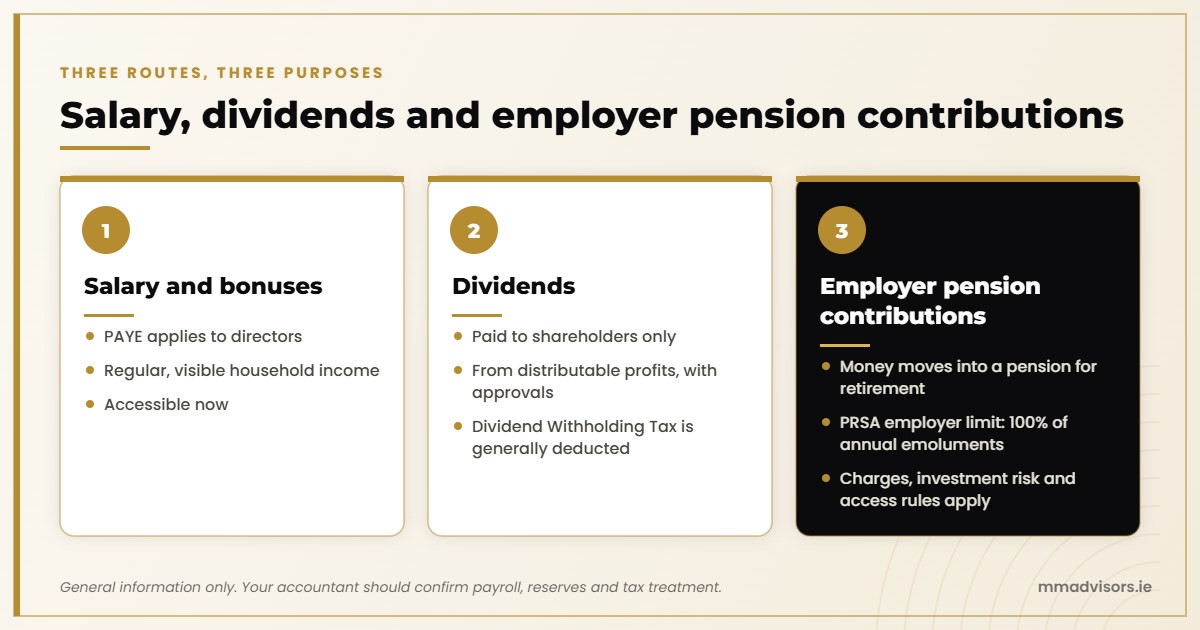
Revenue applies PAYE to payments made to directors. A proprietary director is also a chargeable person and must complete an Income Tax return. Salary gives the household regular, visible income and may support day-to-day affordability and mortgage evidence.
Salary is accessible now, which matters when the family has a mortgage, childcare costs or other commitments. It also creates remuneration that may be relevant to pension funding. However, the gross salary is not the same as the amount the household keeps after Income Tax, USC and PRSI.
Questions to ask before increasing salary
- Can the company maintain the payment in a quieter trading period?
- What net amount will reach the household after payroll deductions?
- Will the payment weaken the tax reserve or working capital?
- How will it affect pension funding, mortgage planning and other income?
How dividends differ
A dividend is a payment to a shareholder because they own shares. It is not available to a director who has no shareholding. It must come from distributable profits and follow the required company approvals and records.
Irish Dividend Withholding Tax is generally deducted before a resident shareholder receives the payment. The dividend must still be included in the individual’s tax position, with credit for tax withheld where applicable. Unlike salary, dividends are not payroll remuneration and are not a substitute for regular income where business profits fluctuate.
Dividends may suit a profitable company with distributable reserves, but they should not be described as automatically more tax efficient. Share ownership, total household income, PRSI treatment, the company’s tax position and future cash needs all matter.
How employer pension contributions differ
An employer contribution moves money into a pension for retirement rather than into the director’s current account. That can help build wealth outside the business, but the money is not available for current household spending. Charges, investment risk and pension access rules apply.
For a PRSA, Revenue states that the employer limit from 1 January 2025 is 100% of the employee’s annual emoluments from that employer. A contribution above the limit creates a benefit-in-kind charge on the excess. The limit is tested by reference to remuneration, not the company’s retained profits or bank balance.
Occupational pension arrangements have different funding rules. Existing benefits, service, remuneration and the chosen structure can affect the appropriate contribution. A director should not apply the PRSA rule to every pension arrangement.
Why a blended approach may be more useful
One route does not need to do every job. A director may need regular salary for household costs, a dividend where lawful and appropriate, and pension funding for later life. Accessible personal savings can also provide flexibility before pension benefits become available.
The planning objective is to connect business resilience with personal security. Taking the largest possible payment today may leave the company exposed. Locking too much into a pension may leave the household short of accessible cash.
A five-step director remuneration review
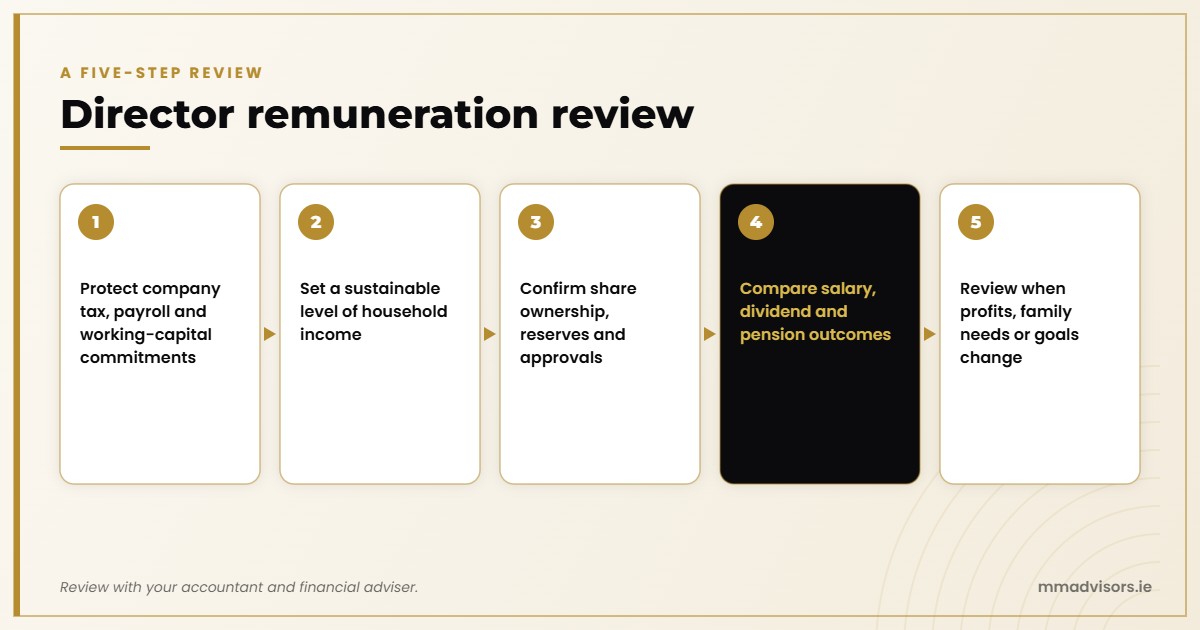
- Protect company tax, payroll and working-capital commitments.
- Set a sustainable level of household income based on actual spending.
- Confirm share ownership, distributable reserves and company approvals.
- Compare salary, dividend and pension outcomes with the accountant and financial adviser.
- Review the plan when profits, family needs or retirement goals change.
Illustrative planning example
An owner-director has a profitable year but expects to recruit an employee and replace equipment. The household also wants predictable monthly income and a stronger retirement plan. Rather than treating the full bank balance as available, the company first protects tax, payroll and investment reserves.
The director and accountant then assess sustainable salary and whether a lawful dividend is appropriate. A financial adviser reviews pension options and accessible savings. The result is a coordinated plan, not a claim that one extraction method is always best.
Common mistakes to avoid
- Treating the company account as a personal account.
- Comparing only tax rates without considering access and business cash flow.
- Assuming every director can receive dividends.
- Assuming all retained profits can be paid into a PRSA.
- Using an old pension rule after legislation has changed.
- Making a large year-end payment before tax and affordability are confirmed.
Bring the company and household into one plan
A director remuneration decision affects more than this year’s tax bill. It can change mortgage evidence, pension capacity, personal liquidity, business reserves and the timing of retirement. The best review uses the same facts across the accountant, financial adviser and, where required, solicitor.
MM Advisors helps company directors connect business income, pensions, cash flow, investments, protection and family goals. To discuss your position, book a director financial planning consultation at https://financial-planning.mmadvisors.ie/.
How to prepare for an adviser review
Bring the latest company accounts, current management figures, payroll information and an estimate of tax due. Include the director’s other income, existing pensions, household spending, debts and planned major purchases. A decision made with partial information can improve one tax line while weakening the wider plan.
Set out the minimum reliable household income and distinguish it from discretionary spending. Then list the company costs that must be protected. This makes it easier to see whether a regular salary, a one-off bonus, a lawful dividend or a pension contribution is serving a genuine need.
Ask for side-by-side outcomes in euro terms. These should include the company cash cost, the director’s accessible net amount, the amount committed for retirement and any effect on reserves. The figures should use the director’s actual position rather than an illustrative marginal rate.
Agree who will confirm each action. The accountant should confirm payroll, distributable profits, tax and deductibility. The financial adviser should confirm pension suitability, charges and investment risk. The board should record the required approvals. Review the arrangement when remuneration, ownership or family needs change.
Frequently asked questions
Is salary always better than a dividend?
No. Salary and dividends have different legal, tax and planning consequences. The answer depends on ownership, profits, other income, payroll, cash needs and the director’s wider goals.
Can every director receive a dividend?
No. A dividend is paid to a shareholder. It also requires distributable profits and the appropriate company process.
Can the company pay into a director’s PRSA?
Potentially. Revenue’s current employer limit is 100% of annual emoluments from that employer before a benefit-in-kind charge arises on an excess contribution.
Can pension funding replace salary?
Not for current spending. Pension money is intended for retirement and access restrictions apply.
Who confirms the tax treatment?
The company’s accountant or tax adviser should confirm payroll, deductibility, reserves and tax treatment. A financial adviser can assess the pension and wider financial planning implications.
Company directors
Book a director financial planning consultation
Related guides
- Financial planning for company directors
- Directors pension options
- PRSA versus company pension guide
Sources
Important information
General information only. Tax treatment depends on individual circumstances and may change. Investments can fall as well as rise, and you may get back less than you invest. Pension access restrictions apply.