
Quick answer
Yes, other pension rights may affect the maximum retirement lump sum available for your current employment. But the value of another pension fund or its yearly income is not automatically the amount deducted. For Irish public-sector employees considering a last-minute AVC, retained benefits and the separate lifetime tax-free lump-sum allowance need to be checked before estimating the remaining cash shortfall.
What are retained pension benefits?
Retained benefits are pension rights from another employment or pension arrangement that may need to be considered when calculating the maximum retirement lump sum available under the rules for your current employment. The impact depends on the type of pension, the benefits available and the rules that apply to your circumstances.
This matters if you changed jobs, worked in the private sector before entering public service, or have a separate pension from an earlier role. The fact that you expect to draw the earlier pension later does not necessarily mean it can be ignored today. Ask your pension administrator or qualified adviser to confirm whether an adjustment applies.
A pension fund value is not automatically a cash deduction
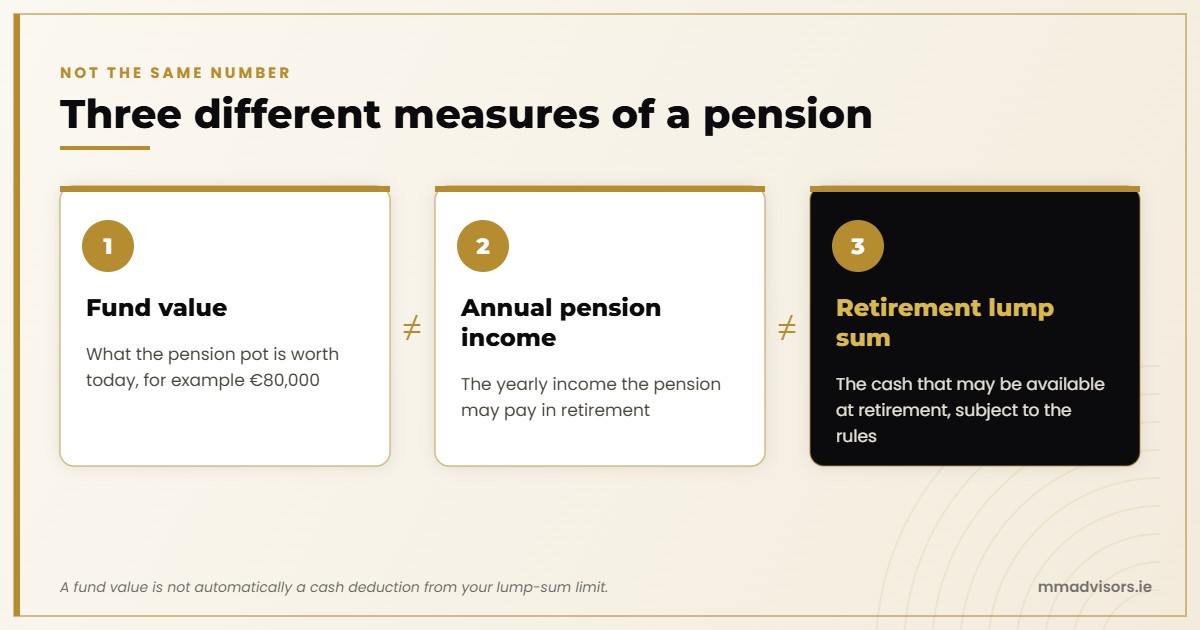
Suppose a public-sector employee has a private pension with a fund value of €80,000. It would be wrong to assume, without checking the rules, that €80,000 must simply be subtracted from the employee’s public-sector lump-sum limit. A fund value, an annual pension income and a retirement lump sum are different measures.
Where the type of pension permits a fund-based lump-sum option, a 25% illustration may sometimes help estimate possible retirement cash. But that is only a starting point. The option must be confirmed for that arrangement, and the resulting amount is not automatically all tax-free or automatically a retained-benefits deduction. Do not apply this approach indiscriminately to salary-based public-sector pensions, AVC PRSAs, ARFs, overseas pensions or benefits already drawn.
Worked scenario: a public servant with an older pension
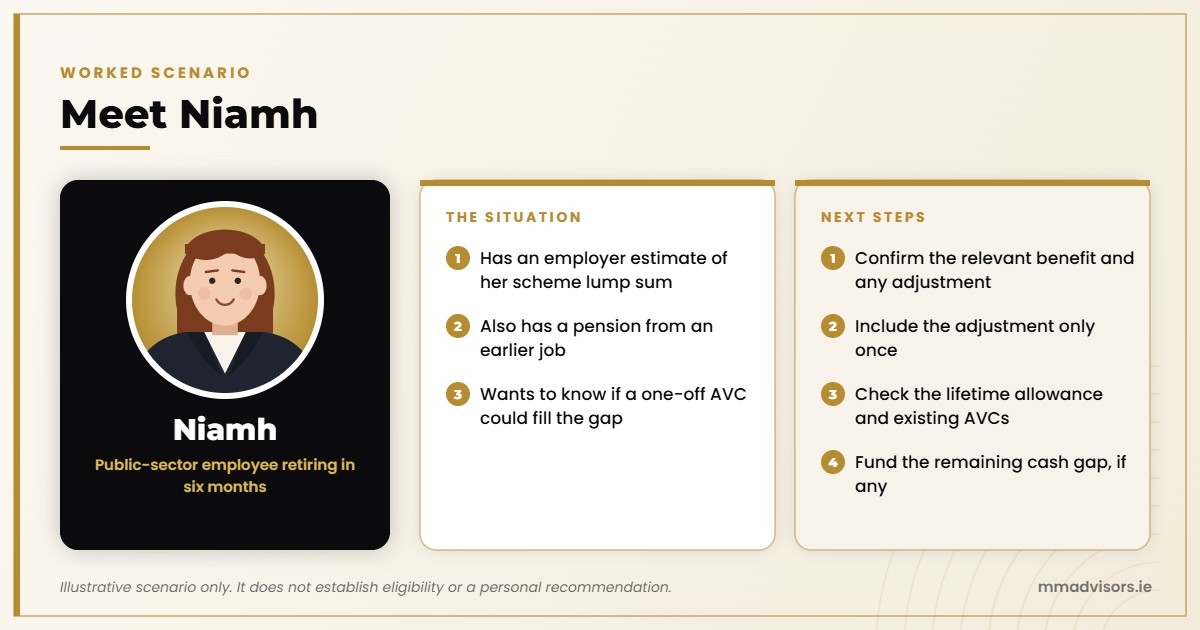
Imagine a public-sector employee, Niamh, plans to retire in six months. Her employer has provided an estimate of the scheme lump sum, and she also has a pension from an earlier job. Niamh wants to know whether a one-off AVC could fill the difference between her scheme lump sum and the permitted maximum.
The right next step is not to deduct the entire earlier pension fund. Niamh should ask the administrator or adviser to establish what retirement benefit is relevant under the rules and whether a retained-benefits adjustment applies. The confirmed adjustment should be included once in the calculation, or treated as already included if the confirmed maximum already reflects it.
Only after that check should Niamh consider the separate lifetime tax-free lump-sum allowance, existing AVC savings and any contributions already planned. The remaining cash gap, if any, is the potential funding target. This scenario is illustrative and does not establish eligibility or a personal recommendation.
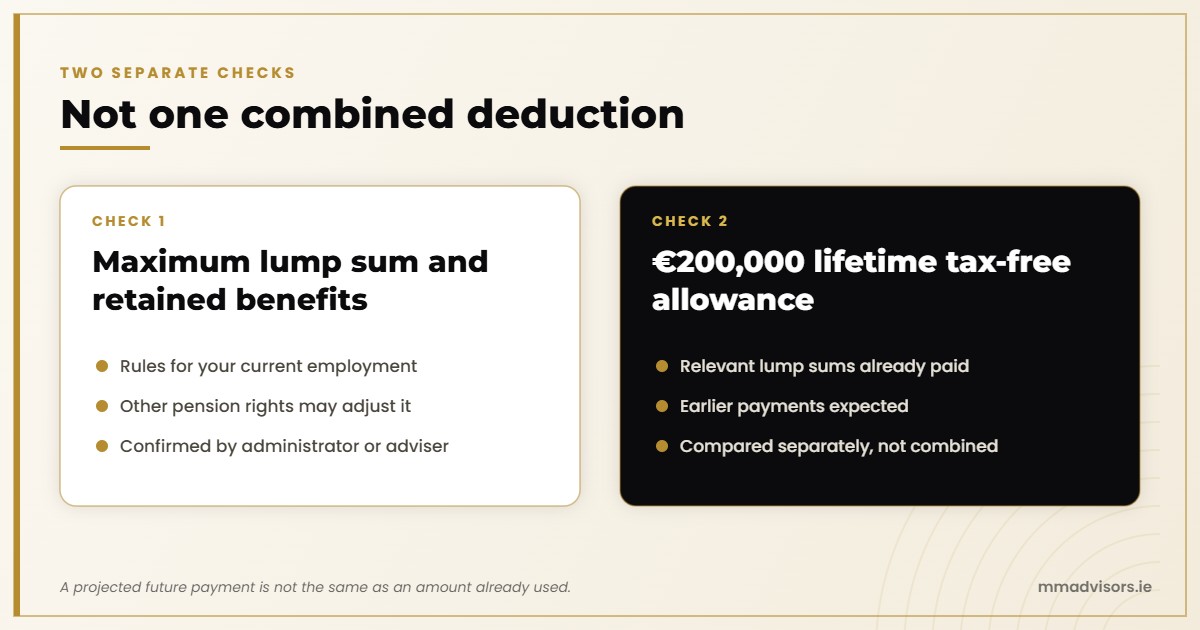
Retained benefits and the €200,000 lifetime tax-free allowance are different checks
The supplied review material identifies a separate €200,000 lifetime tax-free allowance for relevant retirement lump sums. This needs to be considered independently from the maximum lump sum permitted under the scheme and retained-benefits rules.
Relevant gross lump sums already paid, including any taxable part, and earlier payments expected may need to be reviewed. A projected future payment is not the same as an amount already used. The limits should be compared carefully, not combined as if they were two identical deductions.
How does this change a last-minute AVC target?
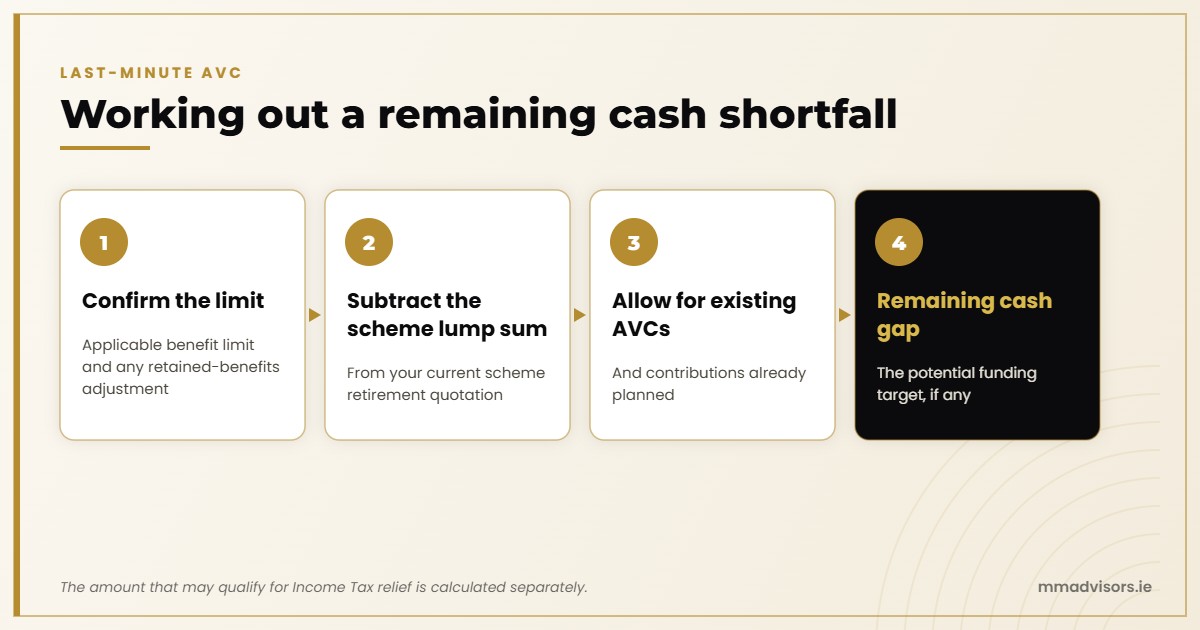
Once the applicable benefit limit and any retained-benefits adjustment are confirmed, subtract the scheme lump sum and allow for existing AVCs or contributions already planned. That helps establish whether a remaining cash shortfall exists.
The amount that may qualify for Income Tax relief is calculated separately. A €10,000 cash shortfall does not automatically mean that every euro of a €10,000 contribution will qualify for relief. Age-related contribution limits, qualifying earnings, existing pension contributions and the individual’s tax position must be checked. Investment values and charges can also affect the amount ultimately available.
What to gather before asking for a calculation
Bring your current scheme retirement quotation, details of the earlier pension, any lump-sum statements, your existing AVC valuation and your expected retirement date. Ask which figures are confirmed and which are only estimates. If the earlier pension provider has not confirmed the available benefit options, label the estimate as provisional rather than treating it as fact.
Retirement lump sum review
Check your lump sum before you pay an AVC
Frequently asked questions
Does having a private pension automatically reduce my public-sector lump sum?
Not automatically by the full fund value. The type of pension and the relevant benefit rules need to be checked to establish whether a retained-benefits adjustment applies.
Should I subtract the full value of my other pension fund?
No. A fund value is not the same as a lump sum. Ask the administrator or adviser to confirm the relevant retirement benefit and any adjustment.
Is the €200,000 lifetime tax-free allowance the same as the maximum lump sum?
No. They are separate checks. The permitted benefit ceiling and the lifetime tax-free allowance can affect the outcome in different ways.
Should I pay an AVC before checking my other pension?
It is safer to confirm the relevant figures first. An AVC should be considered against a verified shortfall, contribution limits, charges, timing and your circumstances.
Related guides
- Public Sector AVCs: for readers reviewing a potential public-sector AVC shortfall.
- AVC pensions in Ireland: for general AVC rules and contribution limits.
- Approaching retirement financial planning: for broader retirement income and benefit planning.
Sources
Money Maximising Advisors Ltd is regulated by the Central Bank of Ireland. C154250.