Quick answer
Your AVC provider or scheme administrator arranges payment after the required checks, forms and benefit instructions have been completed. The permitted tax-free cash is limited by the pension and tax rules, and the whole AVC fund is not automatically tax-free. Your AVC payment and employer lump sum may arrive separately. If the fund exceeds the cash you are allowed to take, ask the provider how the surplus can be treated under the rules that apply to your arrangement.
Who arranges the AVC payment?
Before retirement, contact your AVC provider or adviser and your employer’s pension administrator. Confirm your retirement date, request the employer’s pension and lump-sum quotation, and ask the provider what forms and final figures it needs.
The supplied FAQ says occupational AVC benefits linked to the same employment must be taken with the main scheme benefits. This does not mean that both payments will necessarily reach your bank account on the same day. Ask who will make each payment, the expected method and timing, and whether any further documents are outstanding.
How much of the AVC can be taken as tax-free cash?
Only the amount allowed by the applicable benefit and tax rules can be taken as tax-free cash. The size of the AVC fund alone does not determine how much is permitted. The calculation may depend on the scheme lump sum, the relevant Revenue maximum, other pension benefits, the lifetime tax-free allowance and existing AVCs.
That is why the shortfall should be calculated before a last-minute contribution is made. A contribution target should relate to the confirmed remaining cash gap, not simply to the maximum contribution that might qualify for Income Tax relief.
Scenario: an AVC fund is larger than the remaining cash gap
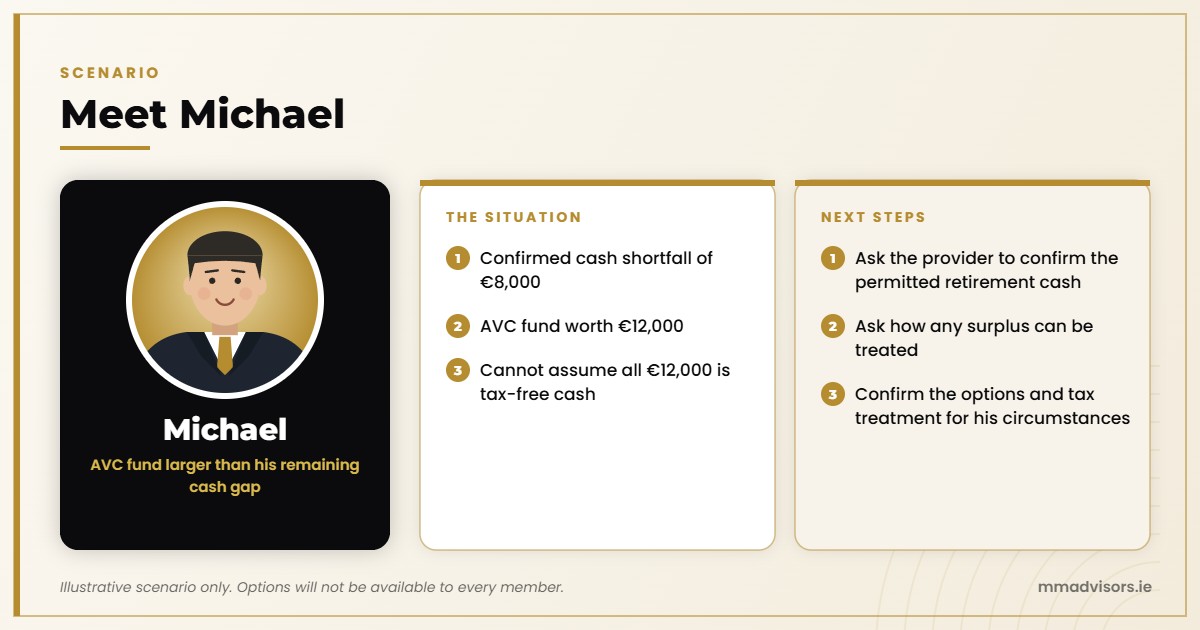
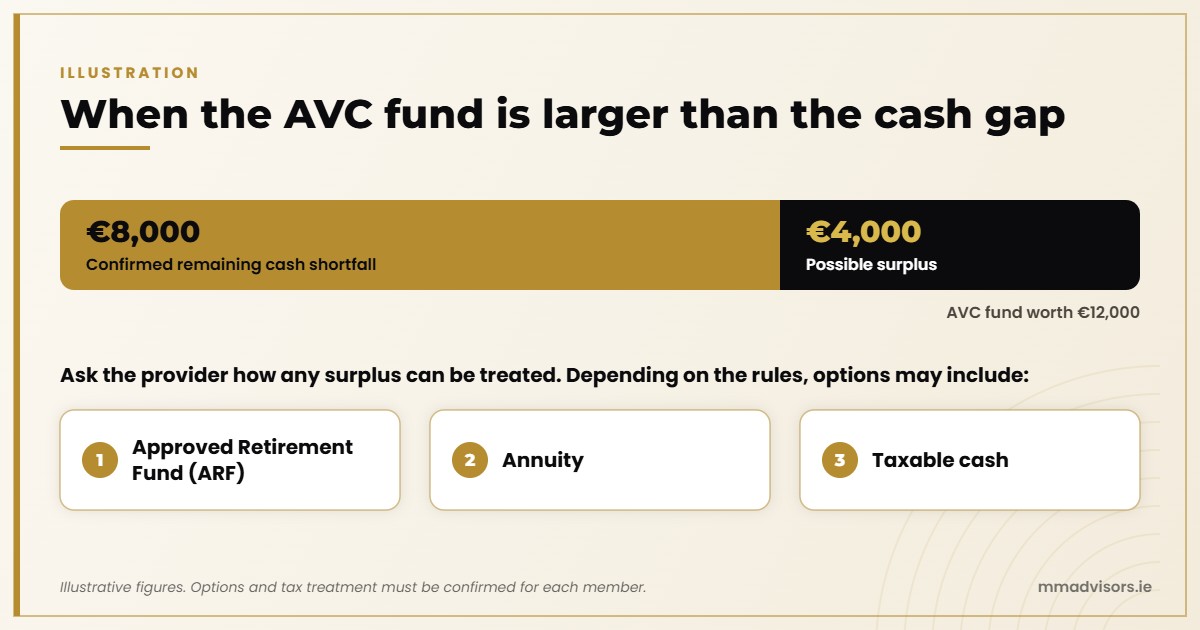
Suppose Michael’s confirmed retirement cash shortfall is €8,000 after his scheme lump sum and existing AVCs are considered. His AVC fund is worth €12,000. It would be unsafe to assume that all €12,000 can be taken as tax-free cash just because it is in his AVC account.
Michael should ask the provider to confirm the amount permitted as retirement cash and the treatment of any surplus. Depending on the arrangement and applicable rules, options may include an Approved Retirement Fund (ARF), an annuity or taxable cash. The available options and their tax treatment must be confirmed for his circumstances.
This is an illustrative scenario, not a statement that a particular option will be available to every member. It also illustrates why contributing more than the verified shortfall is not automatically beneficial.
What if the AVC and employer lump sum arrive at different times?
Separate payments do not necessarily indicate a problem. The provider and scheme administrator may have different checks, forms or settlement processes. Ask each organisation for its own expected timetable and whether any action is still required from you.
Do not commit the expected money to a bill or purchase until you know when it is likely to be available. The supplied FAQ specifically advises confirming settlement timing and payment arrangements in writing rather than assuming immediate access.
Check the gross contribution and relief separately
The AVC contribution, retirement payment and claim for Income Tax relief are three separate steps. If you paid a one-off contribution directly, keep proof of payment and request the provider’s certificate or detailed receipt. Check whether relief was already applied through payroll before making a separate claim.
Eligible relief depends on the relevant limits and your tax position. It does not guarantee a refund or mean that the entire AVC will be tax-free at retirement. Charges and investment changes may also affect the value available.
Questions to ask your provider
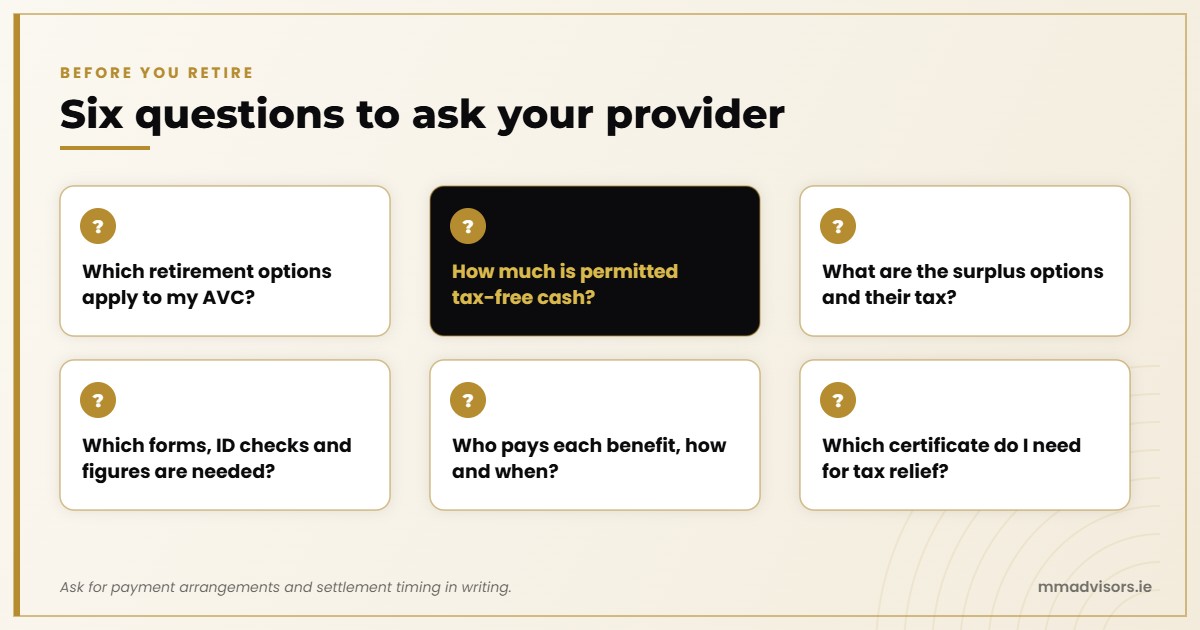
- What retirement benefit options apply to my exact AVC arrangement?
- What amount can be taken as permitted tax-free cash, after all relevant checks?
- If there is a surplus, what options are available and how is each taxed?
- What forms, identity checks and employer figures are still needed?
- Who pays each benefit, by what method and on what expected timetable?
- What contribution certificate or receipt will I need for any tax-relief claim?
Frequently asked questions
Will my entire AVC fund be paid tax-free?
Not automatically. The permitted tax-free cash depends on the applicable scheme and tax rules. Ask the provider to confirm the amount for your circumstances.
Will my AVC and employer lump sum arrive together?
Not necessarily. Confirm the payment arrangements and expected timing with both the scheme administrator and AVC provider.
What happens to an AVC fund above the permitted cash amount?
Ask the provider about the options available under your arrangement. These may include an ARF, annuity or taxable cash, depending on the rules and your circumstances.
Should I contribute more than my estimated shortfall?
Do not assume that doing so is beneficial. Confirm the shortfall, limits, charges, investment risk and retirement options before making a payment.
Related guides
- Public Sector AVCs: for the public-sector shortfall context.
- AVC Personal Retirement Bonds: for readers who need to understand this specific option.
- Approaching retirement financial planning: for wider retirement income and drawdown planning.