
PENSIONS | SELF-ASSESSMENT | TAX DEADLINE 2026
Quick answer
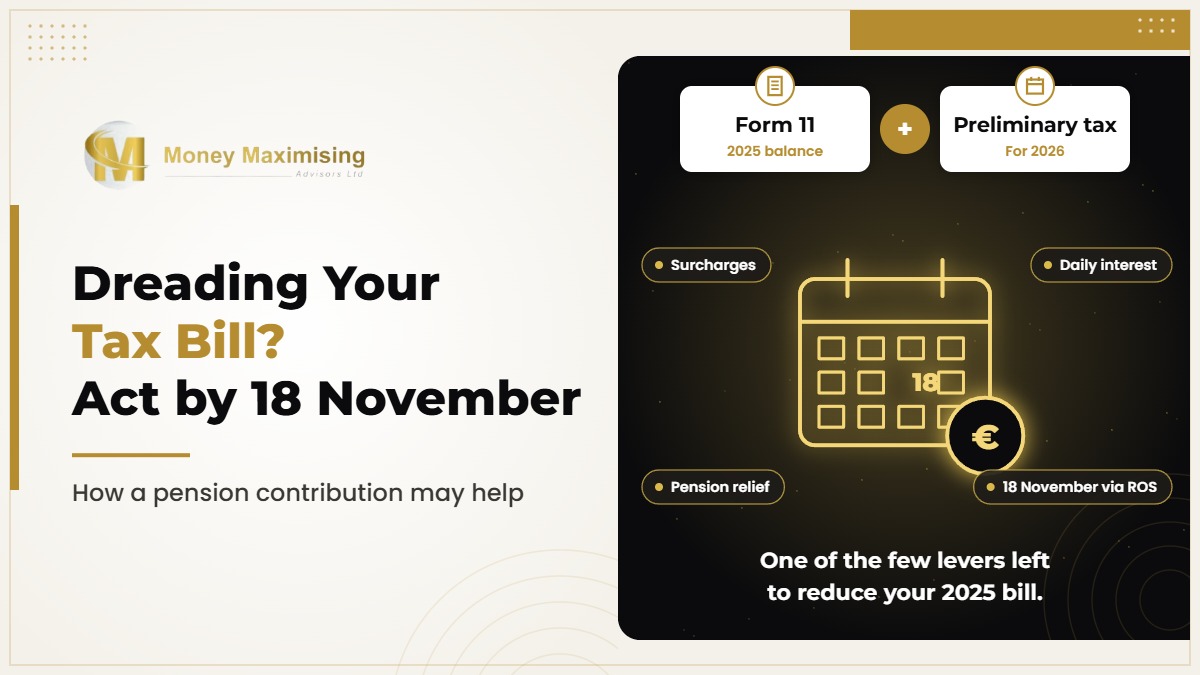
Every autumn, thousands of self-assessed taxpayers discover their Form 11 balance and their preliminary tax bill at the same moment. The panic is expensive. A qualifying pension contribution made before the deadline is one of the few levers that can still reduce the 2025 bill.
Why October catches so many people out
Self-assessment asks you to do two things at once. You file a return and settle the balance for the year that has already ended, and you pay preliminary tax for the year you are currently in. For the 2025 return, both happen together in late 2026.
When income arrives through invoices, rent or a second job rather than a payslip, there is no employer quietly deducting tax every month. Unless money has been set aside along the way, the true number is often unknown until an accountant finishes the return, and by then the options are limited.
A useful planning question
Do not ask only, “How much do I owe?” Also ask, “Is there anything I can still do before the deadline that legitimately reduces what I owe for 2025?” For many people, the answer is a pension contribution.
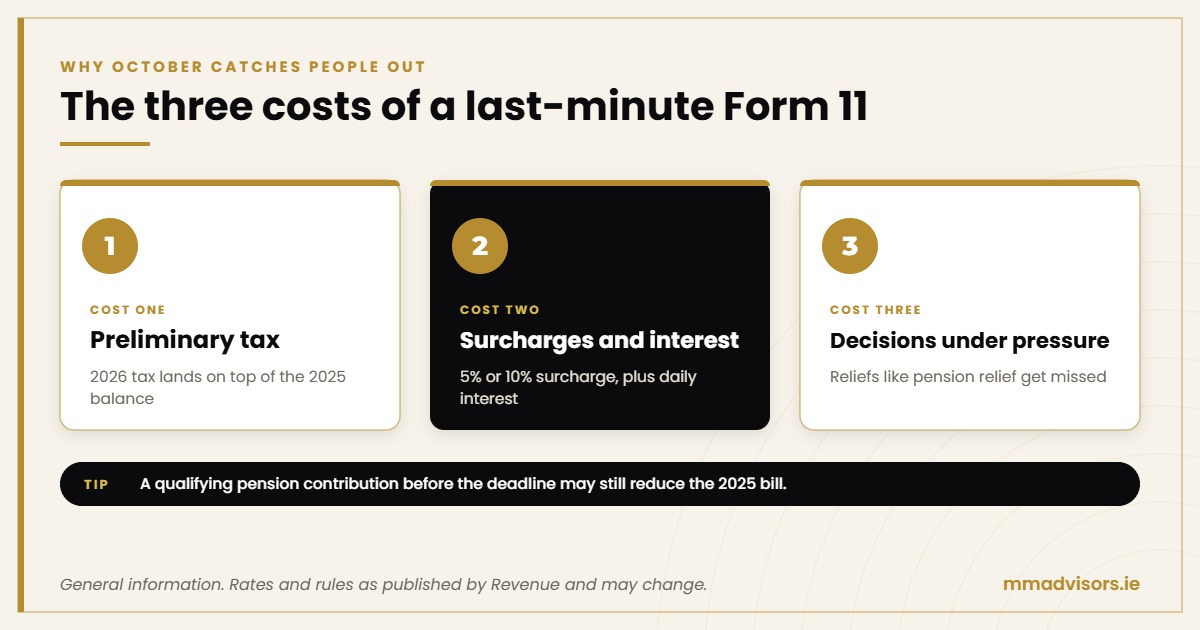
Cost one: preliminary tax lands on top of the balance
Preliminary tax for 2026 is paid with the 2025 return. Most taxpayers base it on 90% of the expected 2026 liability or 100% of the 2025 liability. Taxpayers paying by direct debit can generally use 105% of the liability for the year before last instead.
In the first full year of self-assessment, this can feel like paying close to two years of tax in one go. Because one common basis is 100% of last year’s liability, anything that lawfully reduces the 2025 liability can also reduce the preliminary tax figure calculated from it.
Cost two: surcharges and interest for missing the date
Filing late attracts a surcharge on the full liability for the year, and paying late attracts daily interest. These charges are separate and can apply together.
| Late filing or payment | Typical charge |
|---|---|
| Return filed within two months of the deadline | 5% surcharge, max €12,695 |
| Return filed two months or more after the deadline | 10% surcharge, max €63,485 |
| Tax paid late | Interest at 0.0219% per day |
Illustration: on a €12,000 liability, a 5% surcharge is €600, and 30 days of late-payment interest adds roughly a further €79. Rates are as published by Revenue and may change.
Cost three: decisions made under pressure
A last-minute rush tends to produce the most expensive outcomes: borrowing on a credit card to pay Revenue, paying an accountant to reconstruct a year of records, or simply not having time to consider reliefs that were available. Pension relief is the one most often left on the table, because it needs a provider, paperwork and a payment before the deadline, not after it.
How a pension contribution can still reduce your 2025 bill
Revenue allows a qualifying pension contribution paid after the end of a tax year, but on or before that year’s return filing date, to be treated as paid in the earlier year. The election is made on the return itself. That means a contribution paid now can still be claimed against 2025 income, provided it is paid and elected within the deadline that applies to you.
For the self-employed, the contribution is usually made to a PRSA or personal pension and is measured against net relevant earnings. For employees, an AVC or PRSA AVC linked to the employment works in a similar way. In both cases the relief is against Income Tax at your marginal rate; it does not reduce USC or PRSI.
The age-related pension contribution limits
The percentage is applied to the lower of your relevant earnings and the annual earnings cap of €115,000. Existing personal or employee pension contributions for the year use part of the available allowance.
| Age at end of tax year | Maximum qualifying percentage |
|---|---|
| Under 30 | 15% |
| 30-39 | 20% |
| 40-49 | 25% |
| 50-54 | 30% |
| 55-59 | 35% |
| 60 or over | 40% |
Worked example: a sole trader in October
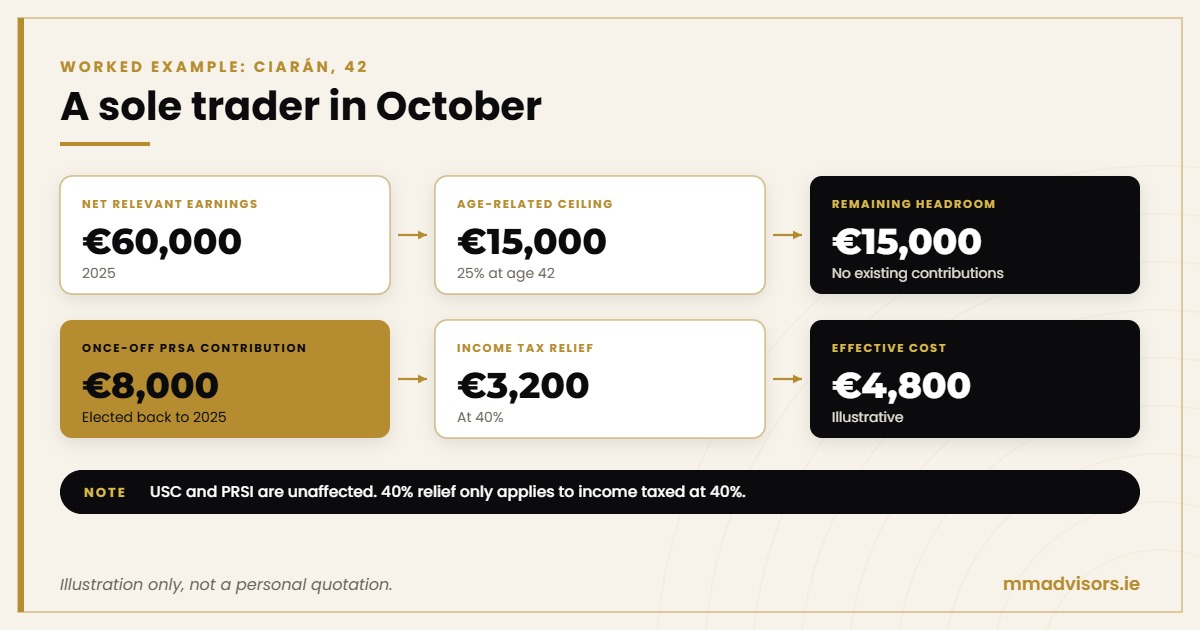
Ciarán is 42, single and self-employed. His net relevant earnings for 2025 were €60,000, part of which is taxed at the 40% higher rate. He made no pension contributions during 2025 and has just seen his draft Form 11.
| Net relevant earnings for 2025 | €60,000 |
| Age-related ceiling at 25% | €15,000 |
| Less existing contributions | €0 |
| Illustrative remaining headroom | €15,000 |
| Once-off PRSA contribution, elected back to 2025 | €8,000 |
| Potential Income Tax relief at 40% | €3,200 |
| Illustrative effective cost of the contribution | €4,800 |
The €3,200 relief reduces Ciarán’s 2025 Income Tax. If he calculates his 2026 preliminary tax on the 100% of prior-year basis, that figure may also be lower. USC and PRSI are unaffected. The contribution only receives 40% relief to the extent his income is taxed at 40%.
What the example does – and does not – mean
- The money stays in Ciarán’s pension, invested for retirement; it is not a refund he can spend now.
- The relief limit is based on net relevant earnings, not on the size of the tax bill.
- Relief at 40% only applies to the portion of income taxed at the higher rate.
- Pension benefits are generally accessible from age 60 onwards, subject to the rules of the product.
- Charges, investment risk and the retirement plan should be compared before contributing.
Ready to speak with an advisor?
Or
Call us now (9am to 5pm, Mon to Fri)
The deadlines for the 2025 return
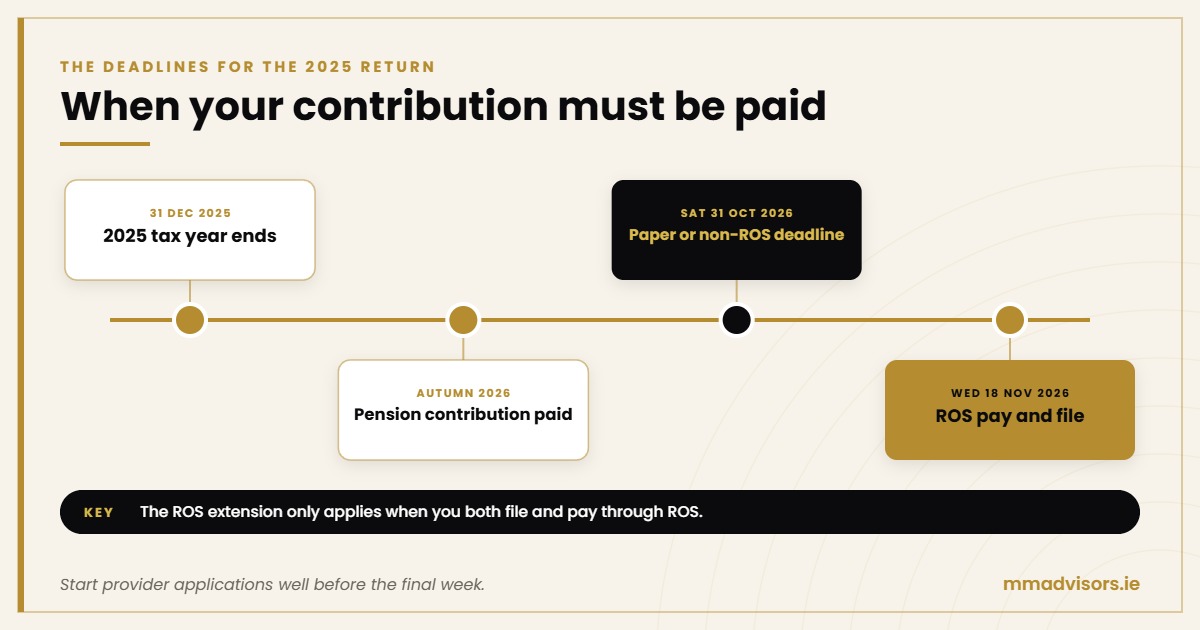
| Item | Date |
|---|---|
| Paper or non-ROS filing and payment | Saturday 31 October 2026 |
| ROS pay and file extension | Wednesday 18 November 2026 |
| Pension contribution to be elected back to 2025 | Paid on or before your filing deadline |
The ROS extension only applies when you both file and pay through ROS. If only one is done online, the 31 October date applies to both. Provider applications, identity checks and fund transfers take time, so contributions should be started well before the final week.
How the relief is claimed on Form 11
Revenue’s Form 11 guidance directs AVC claims through the PAYE/BIK/Pensions panel, while PRSA and personal pension contributions that are not AVCs are generally entered through the Charges and Deductions panel. Keep the contribution certificate and share it with your accountant or tax adviser so the election is reflected correctly in the return.
How to avoid next year’s October panic
- Set aside a fixed share of every invoice or rent payment in a separate account.
- Keep records monthly so your accountant’s fee reflects advice, not bookkeeping.
- Estimate your liability at mid-year, not at the deadline.
- If you have PAYE income as well, remember part of your rate band and credits are already used.
- Consider regular monthly pension contributions instead of one rushed lump sum.
- Do not use cash needed for tax, business costs or emergencies.
Frequently asked questions
Is it too late to make a pension contribution for 2025?
Not necessarily. A qualifying contribution paid on or before your 2025 return filing date can be elected back to 2025. For ROS pay-and-file users, that is 18 November 2026; otherwise it is 31 October 2026.
Does a pension contribution reduce my preliminary tax?
It may. If your 2026 preliminary tax is based on 100% of your 2025 liability, reducing the 2025 liability reduces that figure too. If you use the 90% of current-year basis, it depends on your 2026 position.
Does pension relief reduce USC or PRSI?
No. Relief on personal pension contributions applies to Income Tax only.
How much can I contribute?
Up to the age-related percentage of your net relevant earnings, capped at earnings of €115,000, less any contributions already counted for that year.
I am an employee with rental or side income. Does this apply to me?
Potentially. Your limit is based on your employment earnings rather than rental income, but the relief can still reduce your overall Form 11 balance. See our guide to AVCs for employees with rental income.
What happens if I miss the deadline?
A late return attracts a surcharge of 5% or 10% of the liability, late payment attracts daily interest, and the option to elect a contribution back to 2025 is lost.
Before the 18 November deadline
Facing a Form 11 bill this autumn?
Find out how much you can contribute and how it may reduce your 2025 tax bill.
Sources and important information
Important: This article is general information, not tax, legal or investment advice. Tax relief depends on individual circumstances, Revenue rules and limits. Tax treatment may change. Pension investments can fall as well as rise, and retirement access rules apply.
Money Maximising Advisors Limited | Central Bank of Ireland C154250 | 091 393 125 | office@mmadvisors.ie