PENSION TAX RELIEF | IRELAND | TAX RETURN GUIDE 2026
Quick answer
Your pension contributions could do more than help you prepare for retirement. Depending on the type of pension you have, how you make contributions and your individual circumstances, you may be entitled to Income Tax relief that reduces the tax you pay.
Whether you are a PAYE employee, a public-sector worker, a sole trader or a self-employed professional, understanding how pension contributions appear on your tax return can help you claim the relief available to you.
How do pension contributions affect your tax return?
Qualifying pension contributions may reduce the income on which you pay Income Tax, subject to Revenue’s rules and limits. The way you receive relief depends on your pension arrangement and how your contributions are paid.
For example, contributions to an occupational pension scheme are often deducted through payroll, meaning the tax relief is usually reflected in your pay. If you make personal contributions to a PRSA or a Retirement Annuity Contract (RAC), you may need to claim the relief directly through Revenue.
The important point is that paying into a pension does not automatically mean every contribution will receive tax relief. You must meet the relevant conditions, stay within the available limits and claim relief through the correct process.
How pension tax relief works in Ireland
Income Tax relief on qualifying pension contributions is generally available at your marginal Income Tax rate, which is the highest rate of Income Tax that applies to you.
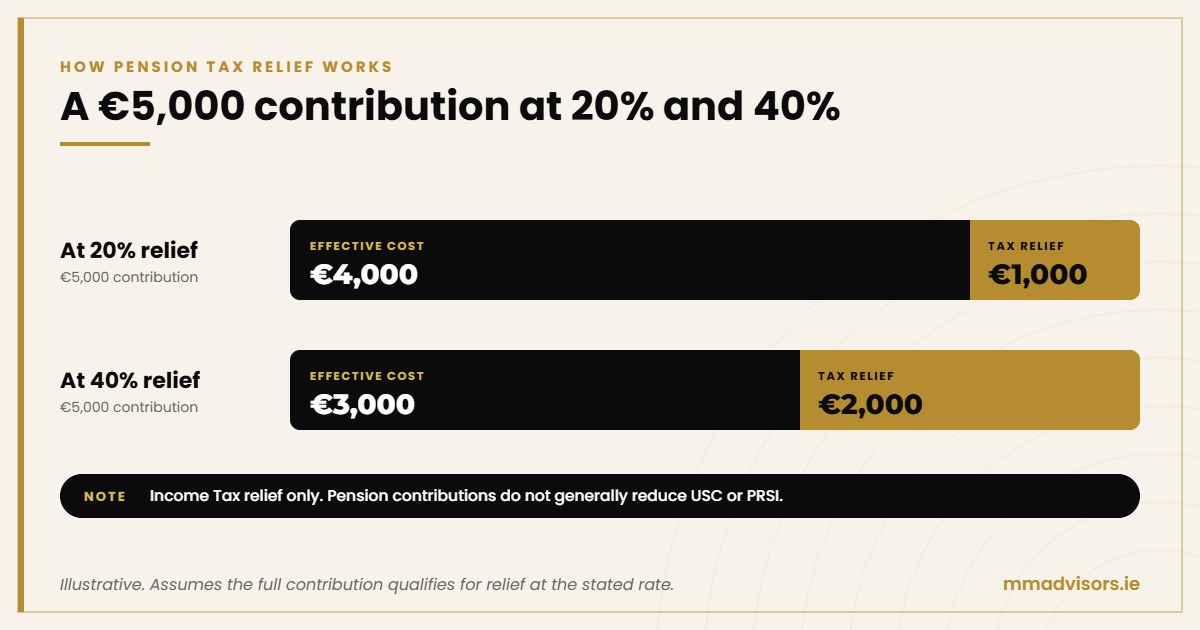
For example, suppose you make a qualifying personal pension contribution of €5,000.
| Illustrative calculation | At 20% relief | At 40% relief |
|---|---|---|
| Pension contribution | €5,000 | €5,000 |
| Potential Income Tax relief | €1,000 | €2,000 |
| Illustrative effective cost | €4,000 | €3,000 |
These figures assume the full contribution qualifies for relief at the stated rate. Your actual relief depends on your taxable income, contribution limits and individual circumstances.
Pension contributions do not generally qualify for relief from Universal Social Charge (USC) or Pay Related Social Insurance (PRSI). The examples above therefore show Income Tax relief only.
How to claim pension tax relief on your tax return
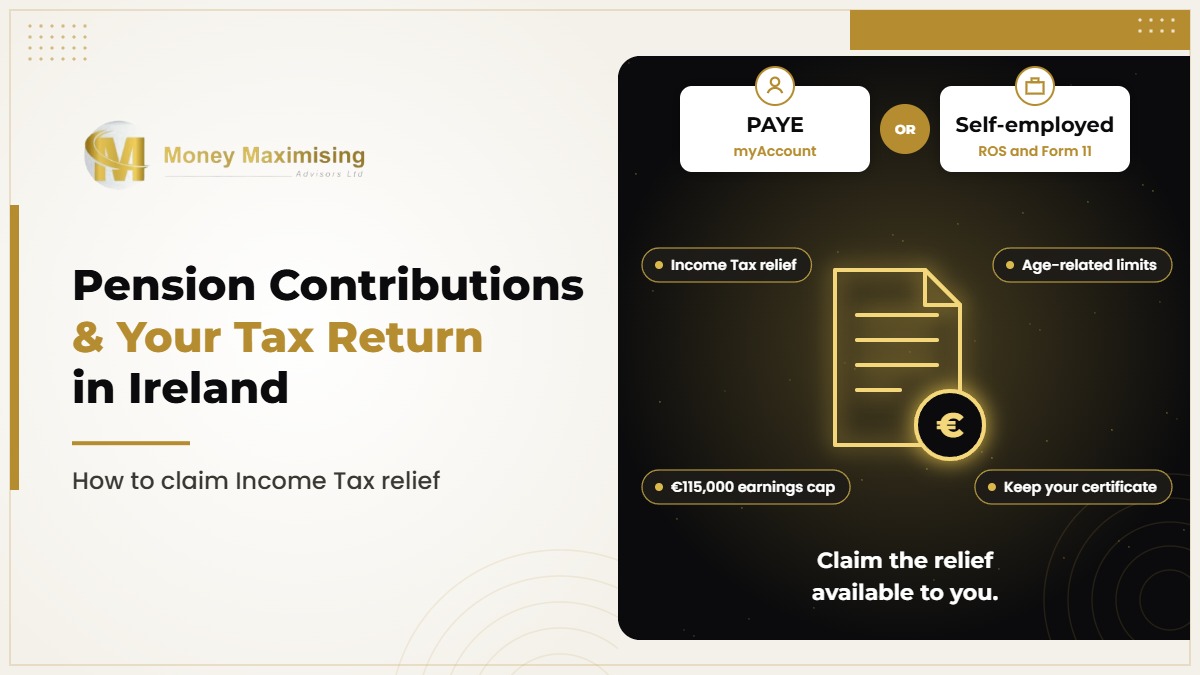
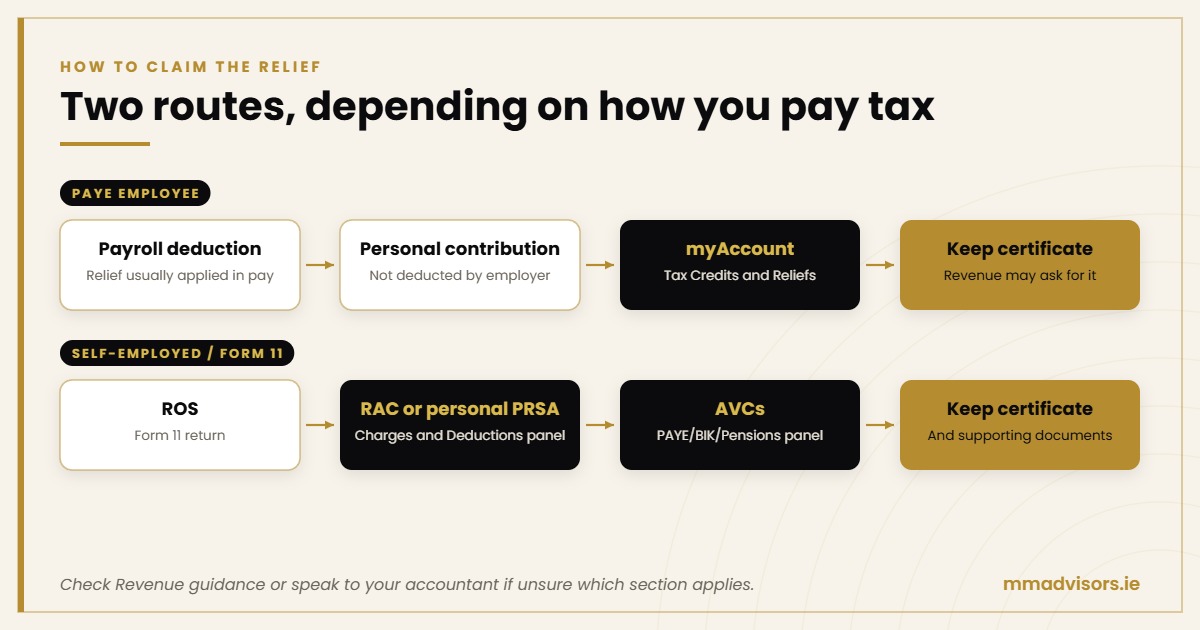
The process depends on whether you pay tax through PAYE or submit a self-assessment return using Revenue Online Service (ROS).
1. If you are a PAYE employee
If your pension contributions are deducted directly from your salary through an eligible payroll arrangement, the tax relief is generally applied through payroll.
However, if you make qualifying personal pension contributions that are not deducted by your employer, you may need to claim the relief through Revenue’s myAccount service.
The general process is:
- Sign in to myAccount.
- Open PAYE Services and select Review your tax for the previous 4 years.
- Request a Statement of Liability for the relevant year.
- Select Complete Income Tax Return.
- Go to Tax Credits and Reliefs.
- Under the relevant job section, select the appropriate pension contribution category, such as AVCs or PRSAs.
- Enter the required details and submit your return.
Keep your pension contribution certificate or receipt, as Revenue may require supporting documentation.
2. If you are self-employed or file Form 11
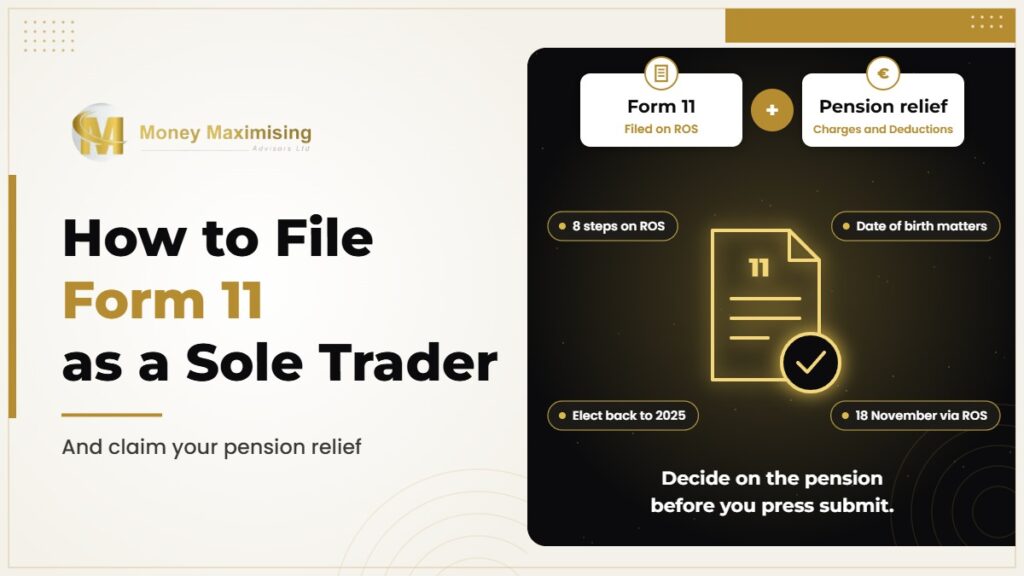
If you are self-employed and submit an annual Income Tax return, you generally claim qualifying pension contribution relief through ROS when completing Form 11.
The relevant section depends on the type of pension contribution you made:
- Retirement Annuity Contract (RAC) or personal PRSA contributions: Revenue directs these claims to the Charges and Deductions panel.
- Additional Voluntary Contributions (AVCs): Revenue directs these claims to the PAYE/BIK/Pensions panel.
Make sure you select the correct category, enter your contribution details accurately and retain your supporting documents.
If you are unsure which section applies to your pension, check Revenue’s guidance or speak to your accountant or tax adviser before submitting the return.
Which pension contributions may qualify for tax relief?
Different pension arrangements have different rules. Common arrangements that may qualify for Income Tax relief include:
- Occupational pension schemes: Workplace pension arrangements where contributions may be deducted through payroll.
- Additional Voluntary Contributions (AVCs): Extra contributions made to increase retirement benefits under an occupational pension arrangement.
- Personal Retirement Savings Accounts (PRSAs): Personal pension arrangements that may suit employees and self-employed individuals, depending on their circumstances.
- Retirement Annuity Contracts (RACs): Personal pension arrangements commonly used by self-employed people and those with relevant earnings.
The relief available depends on the arrangement, eligible earnings, age-related limits and contributions already made. Not every payment into a pension automatically qualifies for tax relief.
How much pension tax relief can you claim?
Revenue limits the amount of personal pension contributions that can qualify for Income Tax relief. The maximum percentage is based on your age at the end of the tax year.
| Age at the end of the tax year | Maximum qualifying percentage |
|---|---|
| Under 30 | 15% |
| 30–39 | 20% |
| 40–49 | 25% |
| 50–54 | 30% |
| 55–59 | 35% |
| 60 or over | 40% |
These percentages generally apply to qualifying earnings, subject to an annual earnings limit of €115,000. The earnings used for the calculation depend on the type of pension and the relevant rules.
Existing qualifying contributions may also use part of your available limit. For employees, the calculation can depend on contributions already made to their occupational pension scheme and any AVCs. For self-employed people, relevant earnings and existing personal contributions must be considered.
Your maximum contribution and your actual tax relief are not necessarily the same thing. The contribution must qualify under the applicable rules, and the rate of relief depends on your Income Tax position.
Worked example: how a pension contribution could affect your tax bill
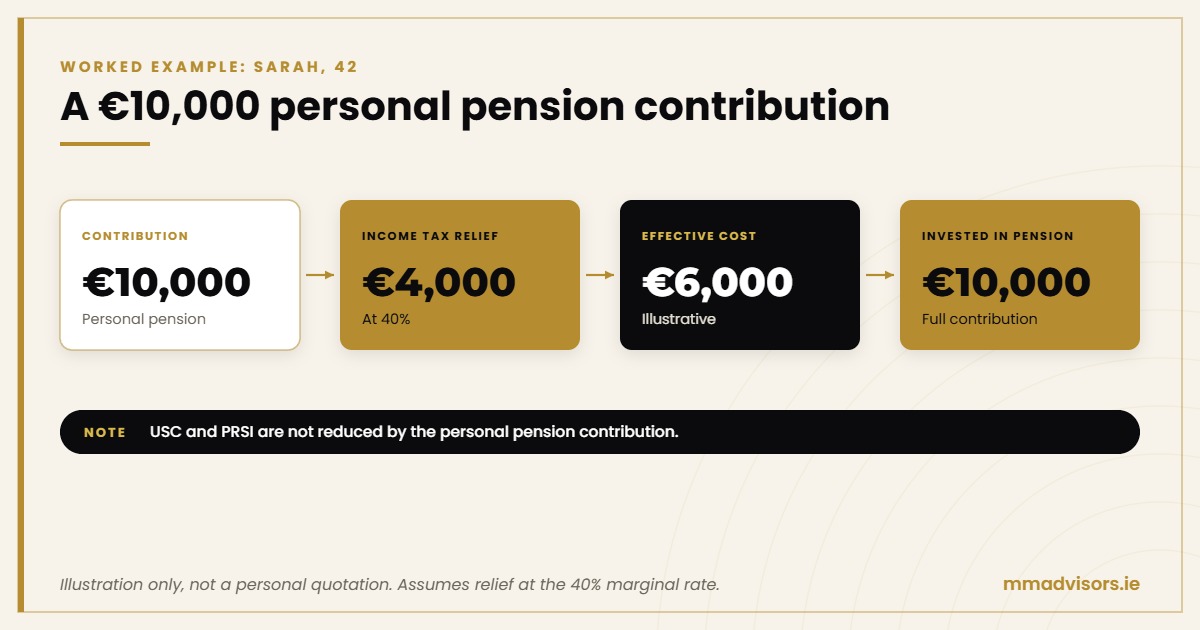
Consider Sarah, a 42-year-old consultant who makes a qualifying personal pension contribution of €10,000. For illustration, assume she has sufficient eligible earnings and available contribution capacity, and that the full contribution qualifies for relief at the 40% marginal Income Tax rate.
| Calculation | Amount |
|---|---|
| Personal pension contribution | €10,000 |
| Potential Income Tax relief at 40% | €4,000 |
| Illustrative effective cost | €6,000 |
Sarah could receive €4,000 in Income Tax relief while €10,000 is invested in her pension.
This is an illustration, not a personal quotation. Her actual relief depends on her earnings, age-related limit, existing pension contributions and tax position. USC and PRSI are not reduced by the personal pension contribution.
Ready to speak with an advisor?
Or
Call us now (9am to 5pm, Mon to Fri)
What if you have already paid tax on your salary?
You may still be able to claim relief on qualifying personal pension contributions that were not already relieved through payroll.
For example, an employee may pay into a personal pension separately from their workplace pension. If the contribution qualifies and the relief has not already been applied, they may be able to claim it through myAccount.
Depending on the individual’s overall tax position, the claim may reduce the Income Tax payable or result in a refund.
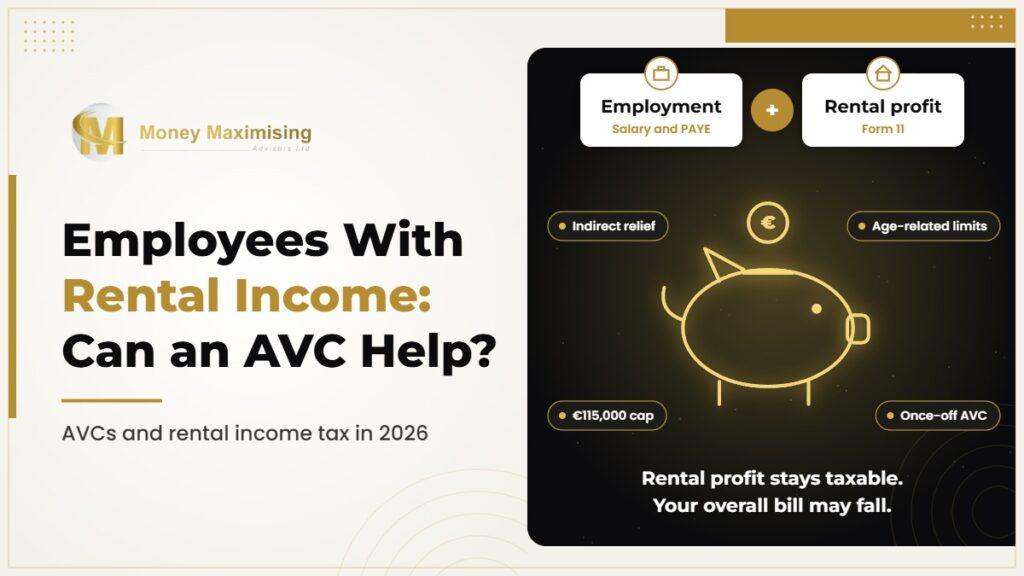
If you have rental income or other income in addition to your salary, pension relief may affect your overall Income Tax calculation. However, this does not mean the pension contribution is deducted directly from rental profit, and rental income does not automatically increase the pension contribution limit associated with employment.
It is important to report all income correctly and claim pension relief in the appropriate section of your return.
Can you claim pension tax relief for a previous tax year?
In certain circumstances, a qualifying pension contribution paid after the end of a tax year can be elected back to that earlier year, provided the contribution and the required election are completed within Revenue’s applicable deadline.
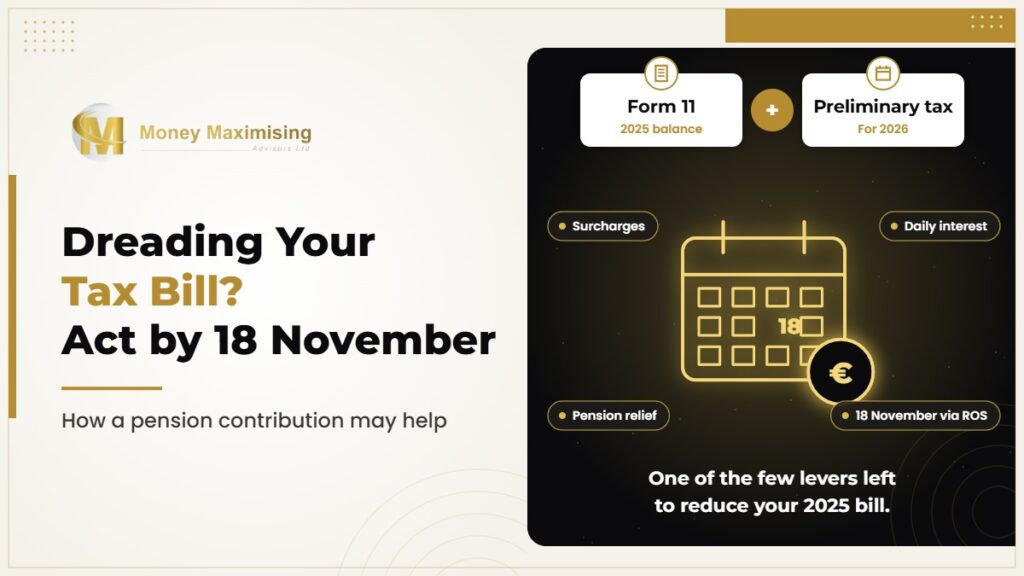
For the 2025 tax year, the standard Pay and File deadline is 31 October 2026. Revenue has confirmed an extended deadline of 18 November 2026 for qualifying taxpayers who both pay and file through ROS.
If you are considering a once-off contribution for 2025, do not wait until the final day. The pension arrangement may need to be established, payment must be processed, and the required election must be made on time. Check the applicable Revenue rules and your provider’s processing times before proceeding.
Common mistakes when claiming pension tax relief
Avoid these common errors when completing your tax return:
- Assuming relief is automatic: Personal contributions not relieved through payroll may need to be claimed directly from Revenue.
- Entering the contribution in the wrong section: AVCs and personal PRSA or RAC contributions may need to be entered in different Form 11 panels.
- Claiming relief twice: Do not claim relief again for contributions that have already received the appropriate tax treatment through payroll.
- Ignoring contribution limits: Age, eligible earnings and existing pension contributions can restrict the amount that qualifies.
- Expecting USC or PRSI relief: Personal pension contribution relief generally applies to Income Tax only.
- Forgetting supporting documents: Keep contribution certificates, receipts and relevant pension details.
- Leaving the claim until the deadline: Allow time to check your eligibility, gather records and complete the required steps.
Frequently asked questions
Do pension contributions reduce the tax I pay?
Qualifying pension contributions may reduce your Income Tax liability, subject to Revenue’s limits and conditions. They do not generally reduce USC or PRSI.
Do I need to claim pension tax relief separately?
Not always. Contributions deducted through an eligible payroll arrangement usually receive relief through payroll. If you make qualifying personal contributions outside payroll, you may need to claim relief through myAccount or ROS, depending on your tax status.
Where do I enter pension contributions on Form 11?
Revenue directs AVC claims to the PAYE/BIK/Pensions panel. Claims for a Retirement Annuity Contract or a personal PRSA generally go through the Charges and Deductions panel. Check the current Revenue guidance for your specific arrangement.
Can I claim tax relief if I already have a workplace pension?
Potentially, yes. Additional qualifying contributions may receive relief if you have sufficient available contribution capacity. Your existing pension contributions must be included when calculating your limit.
Can pension contributions reduce USC and PRSI?
No. Personal pension contribution relief applies to Income Tax, not USC or PRSI.
What documents should I keep?
Keep your pension contribution certificate or detailed receipt, payment information and policy details. Revenue may request supporting evidence when processing your claim.
What if I have missed claiming relief in a previous year?
You may be able to review a previous year’s tax position and make a claim where permitted. Revenue generally allows PAYE Income Tax returns to be submitted within four years after the end of the relevant tax year. Check the rules that apply to your specific claim and tax status.
Make sure you claim the relief available to you
Understanding how pension contributions affect your tax return can help you avoid missed relief and make more informed retirement-planning decisions.
Money Maximising Advisors can help you review your pension arrangements, understand your available contribution capacity and explore the options that may suit your circumstances.
Pension tax relief review
Book a free initial consultation
Check your available contribution capacity and make sure you claim the relief available to you.
Money Maximising Advisors Limited is regulated by the Central Bank of Ireland. Reference: C154250.
Sources and important information
Important: This article is general information and is not tax, legal or investment advice. Tax relief depends on individual circumstances, the pension arrangement, Revenue rules and applicable limits. Tax treatment may change. Pension investments can fall as well as rise, and retirement access rules apply.