Every Irish parent saving for their child’s education is building toward a specific moment. The day the CAO offer arrives. The day rent is paid on the first student flat. The day tuition hits the account. Between now and then is 10, 15, or 20 years of life. And life has a way of throwing curveballs.
Building the education fund is only half the job. Making sure it survives whatever life throws at your family is the other half. This guide from Money Maximising Advisors shows you the four protections Irish parents put in place to keep an education plan alive, no matter what happens.
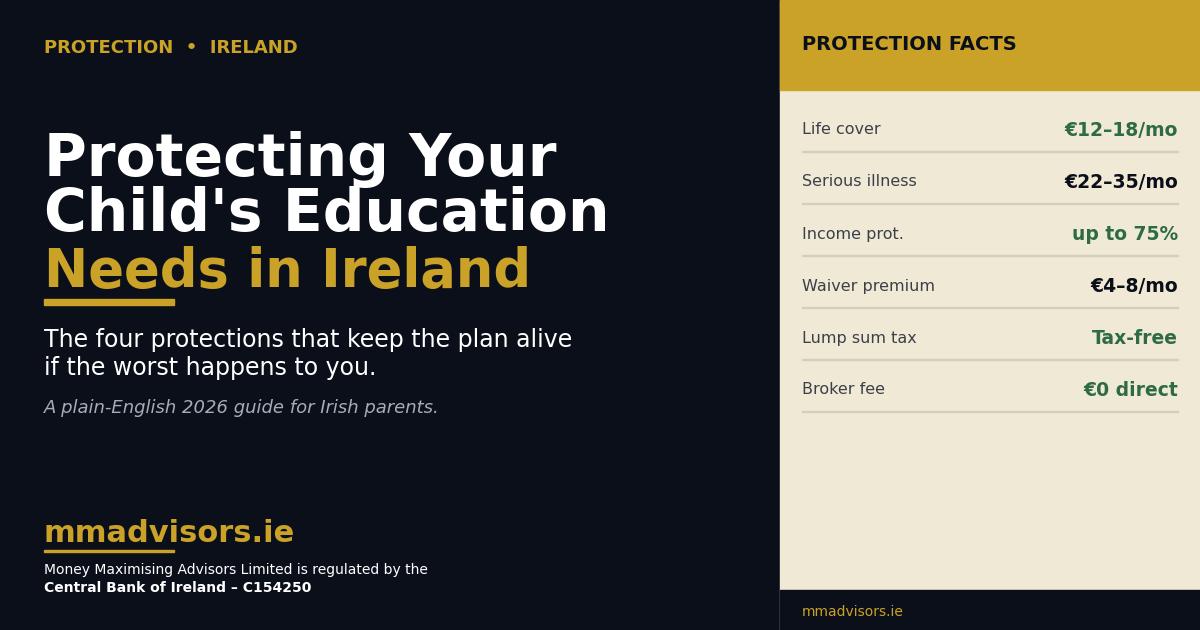
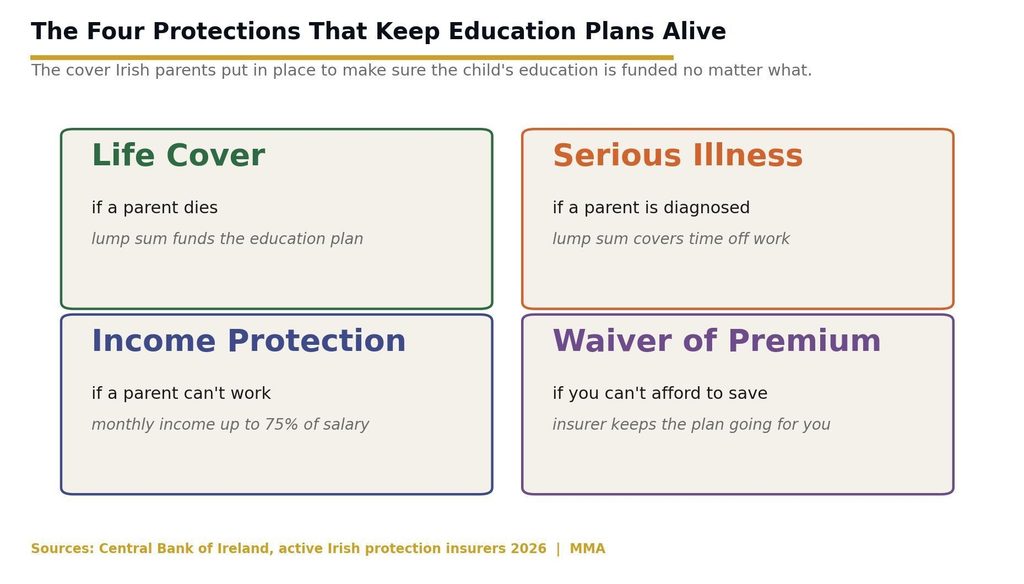
| QUICK ANSWER: Irish parents protect a child’s education savings plan with four core covers: Life Insurance (a lump sum if a parent dies, funding the education plan in one payment), Serious Illness Cover (a tax-free lump sum on diagnosis of specified conditions), Income Protection (up to 75% of salary if you can’t work for an extended period), and Waiver of Premium (the insurer pays your monthly savings contribution if illness or disability stops you working). A typical 35-year-old couple can protect an €80,000 education target for around €38–61 per month on top of their €300/month savings contribution. |
Why protection matters as much as saving
Most Irish parents concentrate hard on the savings side of the equation. How much to put away each month. Which savings vehicle to use. Whether to invest for growth or stay in cash.
All of that matters. But it assumes the parents are alive, well, and earning throughout the entire saving journey. That’s a big assumption when you’re planning 15 or 20 years ahead.
The three things that can derail an education plan
First, the death of a parent. Household income drops sharply. Saving for education often stops entirely as the surviving parent focuses on immediate costs.
Second, serious illness. Time off work, medical costs, and household disruption can pause saving for years. The education pot stops growing at the exact moment it needs to compound.
Third, long-term inability to work. A bad back injury, a mental health crisis, a chronic condition, any of these can end the savings plan without warning.
Protection cover exists specifically to answer these three risks.
What happens without protection
Consider a fairly typical scenario. A 35-year-old couple starts saving €300 per month for their new-born child’s education. Their plan is to build €80,000 by age 18.
The plan runs on rails for 8 years
By the time the child is 8, roughly €30,000 has been contributed and the investment has grown to around €36,000. Everything on track.
One parent gets a serious illness at 43
The higher-earner spouse is diagnosed with cancer. They’re out of work for 14 months during treatment. Household income effectively halves.
The savings plan is paused. Not cancelled, just paused. But when things stabilise 18 months later, the family is playing catch-up on mortgage, bills, and household costs. The pause becomes permanent.
The compounding math is brutal
The plan that would have hit €80,000 now peaks at €55,000. The child either takes on more debt to cover college costs, or scales back their choices.
Serious Illness Cover of €50,000, taken out at age 35, would have paid out tax-free at age 43. That single lump sum would have covered the household disruption AND kept the education plan on track.
The four protections explained
Protection 1: Life Insurance
Life insurance pays a lump sum to your family if you die during the term of the policy.
For education planning, the sum insured is usually sized to complete the education savings target in one payment. If your plan is to build €80,000 by age 18 and you’re currently 8 years in with €30,000 saved, life cover of €50,000+ would fund the remainder.
Typical costs for term life cover through our Life Insurance brokerage: €10–20 per month for a healthy 35-year-old buying €150,000 of cover over 17 years.
Protection 2: Serious Illness Cover
Serious Illness Cover (sometimes called Specified Illness or Critical Illness cover) pays a tax-free lump sum if you’re diagnosed with one of the specified conditions listed in the policy.
Typical conditions covered: cancer, heart attack, stroke, major organ transplant, multiple sclerosis, kidney failure, and dozens of other specified conditions.
The lump sum is paid to you, not to a hospital, not to a bank. You choose how to use it. Cover treatment costs, replace lost income, or protect the education savings plan.
Typical cost through our Serious Illness Cover brokerage: €20–35 per month for a healthy 35-year-old buying €50,000 of cover over 17 years.
Protection 3: Income Protection
Income Protection replaces up to 75% of your salary if you can’t work for an extended period due to illness or injury.
Unlike a lump-sum policy, this pays a monthly income until you return to work or reach retirement age. It’s the one cover specifically designed for long-term earning capacity.
For a parent whose salary funds the education savings contribution, this is often the most important cover of the four. If your income continues, the savings plan continues.
Typical cost through our Income Protection brokerage: around 1–2% of salary for standard cover, tax-relief eligible at your marginal rate.
Protection 4: Waiver of Premium
A quiet but powerful add-on to your savings plan itself. Waiver of Premium means that if illness or disability stops you working, the insurer pays your monthly savings contribution for you.
The savings plan keeps going. Contributions keep landing. The child’s education fund continues to grow, exactly as if you were still earning.
Typical cost: €4–8 per month on a standard regular saver investment plan. Small money, big consequence.
Ready to build your family's 4-layer plan?
Book a free 30-minute family education planning consultation, or send us your details and we'll be in touch.
Money Maximising Advisors Limited is regulated by the Central Bank of Ireland – C154250
Worked example: the cost of protecting an €80,000 education fund
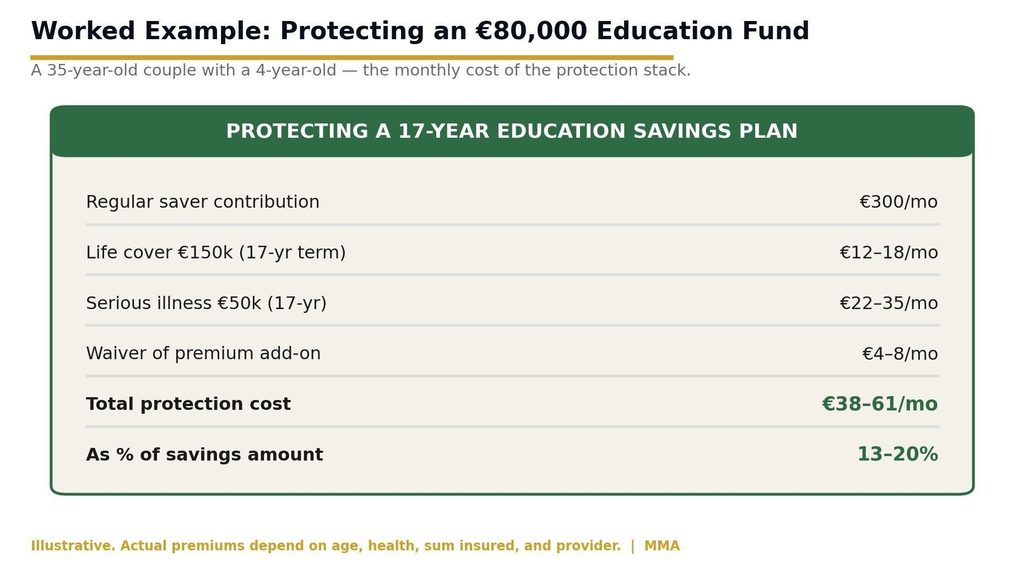
Meet Emma and John. Both 35. Their daughter Sophie is 4.
They want to build a €80,000 fund by the time Sophie hits 18, enough for four years of college with her living away from home.
The savings side
A monthly contribution of €300 into a Regular Saver Investment Plan, at an assumed 5% average annual growth over 14 years, builds roughly €72,000. Combined with a small annual grandparents’ contribution using the Small Gift Exemption, they hit their €80,000 target comfortably.
The protection side
On top of the €300 monthly savings, Emma and John add three layers of protection.
Life cover of €150,000 on each parent, 17-year term to cover the full savings period. Combined cost: roughly €24–36 per month.
Serious Illness cover of €50,000 on the higher-earning parent (with existing employer benefits factored in). Cost: roughly €22–35 per month.
Waiver of Premium on the education savings plan itself. Cost: €4–8 per month.
The total picture
Total monthly commitment: €300 savings + €50–80 protection = €350–€380 per month. The protection cost is roughly 15–25% of the savings contribution.
For that additional €50–80 per month, they’ve protected the entire €80,000 target against death, serious illness, and disability. Sophie’s education plan now survives whatever life throws at Emma and John.
How the four protections work together
Each cover answers a specific risk. The strength is in the combination.
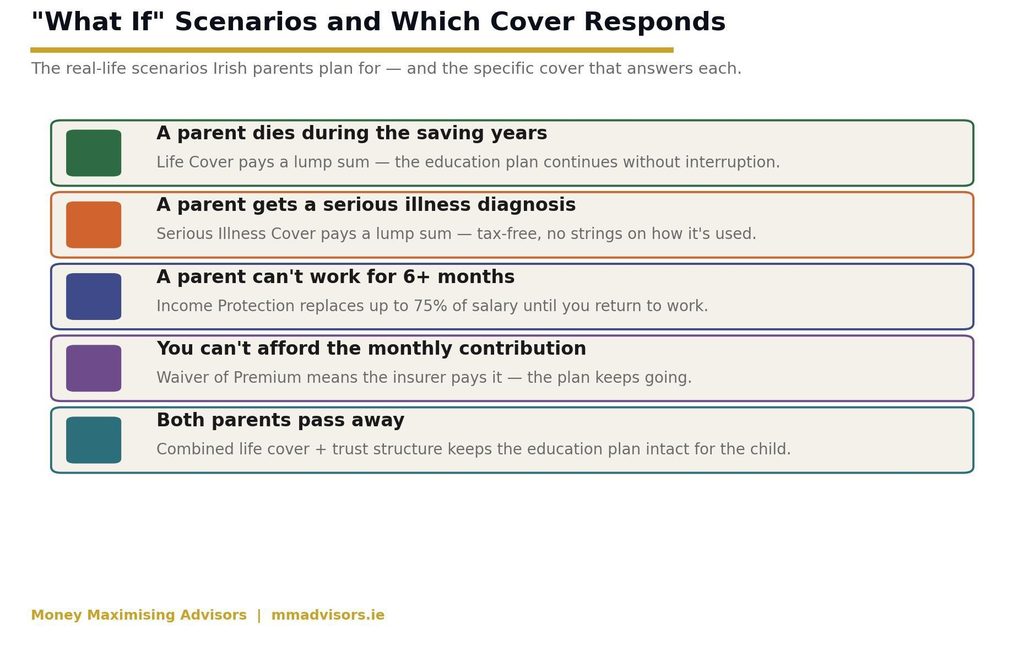
Death, Life Cover responds
Life cover pays a lump sum. The surviving spouse invests it in the child’s plan and the education target is met without further contributions needed.
Serious diagnosis, Serious Illness responds
The tax-free lump sum bridges the household during treatment. The savings plan continues untouched. If the household recovers financially, the lump sum can top up the education pot ahead of schedule.
Long-term inability to work, Income Protection responds
Monthly income replacement keeps the household running. The savings contribution continues from that replacement income. Long-term plans stay intact.
Any of the above, Waiver of Premium responds
The insurer takes over the monthly savings contribution. This is the safety net beneath the other three. Even if a specific cover doesn’t pay out for a specific event, waiver of premium can still keep the plan alive.
What Irish parents commonly get wrong
- Focusing only on the savings side. A savings plan without protection is a plan that only works if nothing goes wrong. Statistically, something goes wrong for a lot of families over a 17-year period.
- Assuming employer benefits are enough. Employer life cover often ends the day you leave the job. If you’re changing employers before your child hits 18, personal cover is essential.
- Only insuring the higher earner. If the lower earner dies, the higher earner still often has to cut hours to cover childcare. Both parents matter to the family’s economics.
- Ignoring Waiver of Premium. For €4–8 per month, it’s the cheapest protection on the market by far. Almost every education savings plan should include it.
- Buying single-life instead of joint or dual. For couples with children, dual-life cover (which pays on the first death) is usually the right structure. Joint-life may be cheaper but pays only once.
- Not reviewing every 3 years. Circumstances change. Another child. A bigger mortgage. A promotion. All of these change the cover you need.
Ready to build your family's 4-layer plan?
Book a free 30-minute family education planning consultation, or send us your details and we'll be in touch.
Money Maximising Advisors Limited is regulated by the Central Bank of Ireland – C154250
How to build your family’s protection stack
Step 1: Calculate your education target
Decide what you want to fund. Full college costs (€70k–€95k for a 4-year degree living away). Partial contribution (€30k–€50k). Just a deposit for a first home (€15k–€25k).
Step 2: Set the savings plan
Choose the right vehicle. A Regular Saver Investment Plan for the main monthly contribution. The Small Gift Exemption Savings Plan for grandparents’ annual gifts.
Step 3: Add Waiver of Premium
The cheapest cover in the stack. Add it to the savings plan itself, at setup. Retrofitting later is often not possible.
Step 4: Add Life Cover
Sized to complete the education target in one payment. Term should match the savings period (typically 15–20 years).
Step 5: Add Serious Illness Cover
Sized to bridge the household during treatment plus protect the savings plan. Often around 50–100% of the higher-earner’s annual salary.
Step 6: Consider Income Protection
For the parent whose salary funds the savings contribution, income protection is often the most valuable single cover. Especially for self-employed and contract workers.
Special situations to plan for
Single-parent families
Protection matters even more when one adult is doing everything. Life cover and serious illness cover are essential. Consider higher sum insured amounts to compensate for the absence of a second earner.
Cohabiting parents (unmarried)
Cohabiting couples don’t have the same automatic legal protections as married couples. Cover should be set up carefully with proper beneficiary nominations. Trust arrangements may be worth considering.
Blended families
Where step-children are involved, ensure the cover clearly names the intended beneficiaries. Older children from a previous relationship may have different rights to insurance proceeds than the current partner.
Grandparents contributing
Grandparents gifting under the Small Gift Exemption should consider their own life cover if the gifts are a promised part of the plan. If a grandparent dies without cover, the gifts stop, and the plan target may not be reached.
Where MMA fits in
Money Maximising Advisors is a Central Bank regulated financial broker based in Galway. When protecting a child’s education plan, two things matter:
First, our advice services are delivered directly by our qualified team. Money Management Advice builds a complete family plan combining savings and protection.
Second, we are a multi-agency broker for the underlying products. We compare life cover, serious illness cover, income protection, and education savings plans across Ireland’s leading providers to find the right fit.
The result: an integrated family plan, not four separate policies bought at different times from different providers.
Frequently asked questions
How can I protect my child’s education savings plan?
Combine four protections: Life Insurance (pays a lump sum if a parent dies), Serious Illness Cover (tax-free lump sum on diagnosis of specified conditions), Income Protection (replaces up to 75% of salary if you can’t work), and Waiver of Premium (the insurer pays your monthly savings contribution if illness or disability stops you working). Each answers a specific risk, the strength is in the combination.
What is Waiver of Premium and do I need it?
Waiver of Premium is a low-cost add-on to your savings plan or protection policy. If you can’t work due to illness or disability, the insurer pays your monthly contribution for you. Typical cost is €4–8 per month. For education savings plans covering 15+ years, it’s one of the most cost-effective protections available and should almost always be included.
How much life insurance do I need for education planning?
Size the sum insured to complete your education savings target in one lump-sum payment. If your target is €80,000 and you’ve saved €30,000 so far, cover of €50,000+ would fund the remainder. Many parents opt for higher amounts to also cover mortgage or family support needs.
Is Serious Illness Cover tax-free in Ireland?
Yes. The lump sum paid out under a Serious Illness (Specified Illness) policy is completely free of income tax, USC, PRSI, and Capital Gains Tax in Ireland. You choose how to use it, treatment costs, income replacement, or protecting long-term savings goals like education.
Is Income Protection tax deductible in Ireland?
Yes. Premiums for standard Income Protection policies (also called Permanent Health Insurance) qualify for income tax relief at your marginal rate, up to 40% for higher-rate taxpayers. This effectively reduces the net cost of cover significantly.
Can I get protection cover if I already have a health condition?
Often yes, though terms vary. Some conditions attract loaded premiums (higher cost). Others may result in specific exclusions. A broker with access to multiple insurers can typically find cover even where a single-insurer application would be declined. Always disclose full medical history, non-disclosure can invalidate the entire policy at claim stage.
Reviewed by our protection team
This guide was prepared and reviewed by the protection team at Money Maximising Advisors, drawing on Central Bank of Ireland consumer guidance, active Irish protection insurer product terms, and daily family protection planning work. MMA is regulated by the Central Bank of Ireland (C154250).
Ready to protect your child’s education plan?
Whether your child is a newborn or already in secondary school, our team maps the right combination of life cover, serious illness, income protection, and waiver of premium to protect the education savings you’ve built. Book Now for a free 30-minute family protection review, or Enquire Now, we reply within one working day.
Ready to build your family's 4-layer plan?
Book a free 30-minute family education planning consultation, or send us your details and we'll be in touch.
Money Maximising Advisors Limited is regulated by the Central Bank of Ireland – C154250
| Important information: Zurich Ireland’s Cost of Education Survey figures cited are the published 2025 figures and are updated annually. Life cover, serious illness cover, and income protection premiums vary widely by age, smoker status, health history, occupation, and cover level. Investment values can fall as well as rise. Income protection tax relief and CAT thresholds are those in force in Ireland at time of writing (2026) and are subject to change with each Finance Act. Rates, thresholds and rules referenced are correct at time of writing and are subject to change. Money Maximising Advisors Limited is regulated by the Central Bank of Ireland (C154250). This article is for general information only and does not constitute personalised financial, tax or legal advice. You should always speak to a Qualified Financial Advisor before making any decision. |