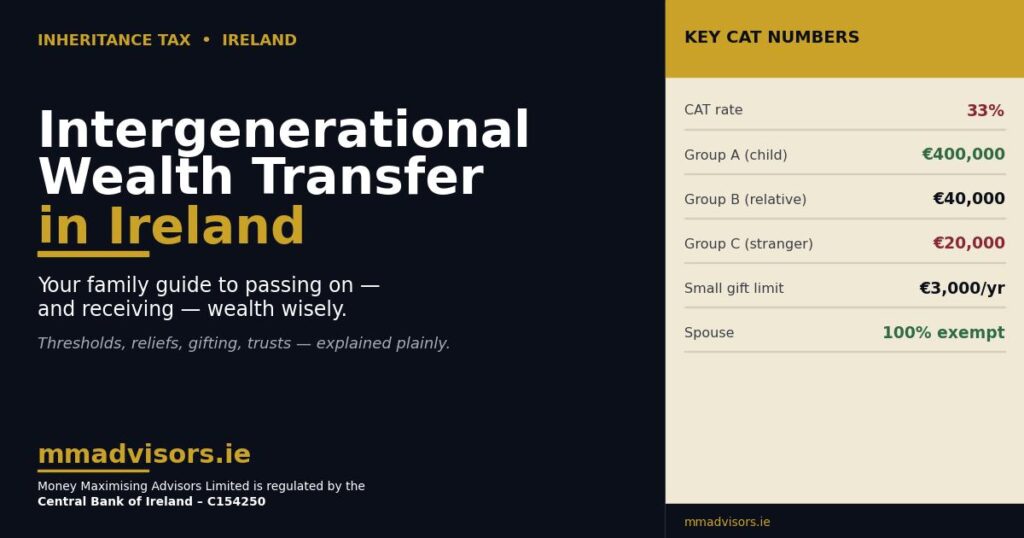
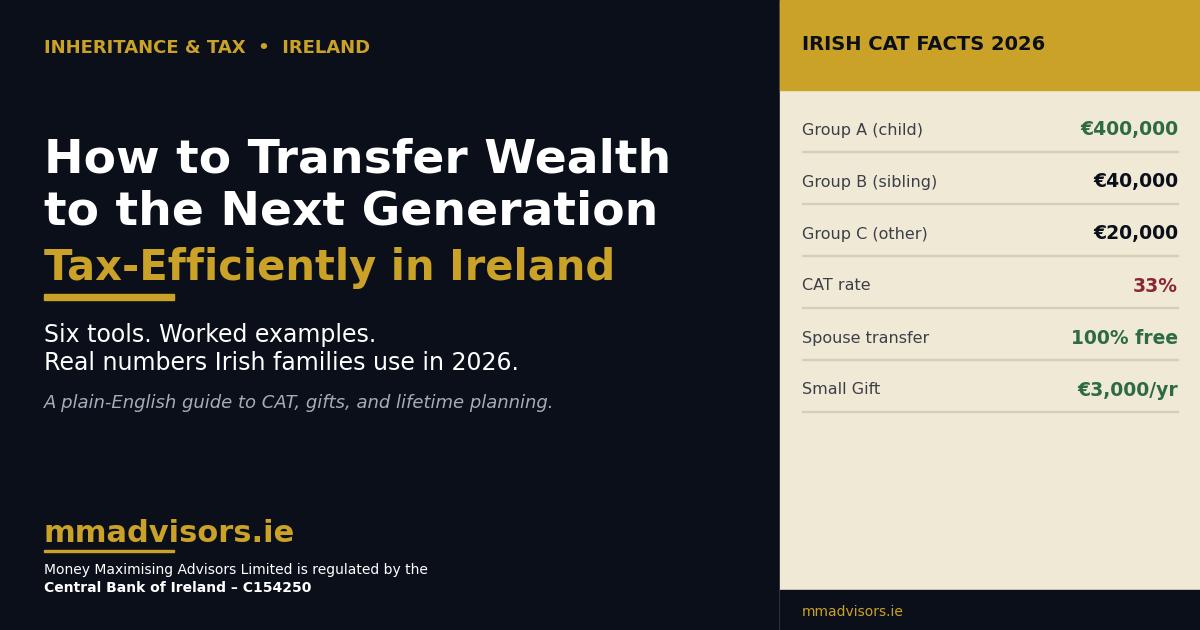
For most Irish families, passing wealth to the next generation is one of the most rewarding things you’ll ever do. Done well, it changes your children’s lives. Done badly, up to a third of what you leave behind goes to Revenue instead.
This guide from Money Maximising Advisors walks you through the six main tools Irish families combine to move wealth tax-efficiently, with real numbers and a worked example that shows just how big a difference planning makes.
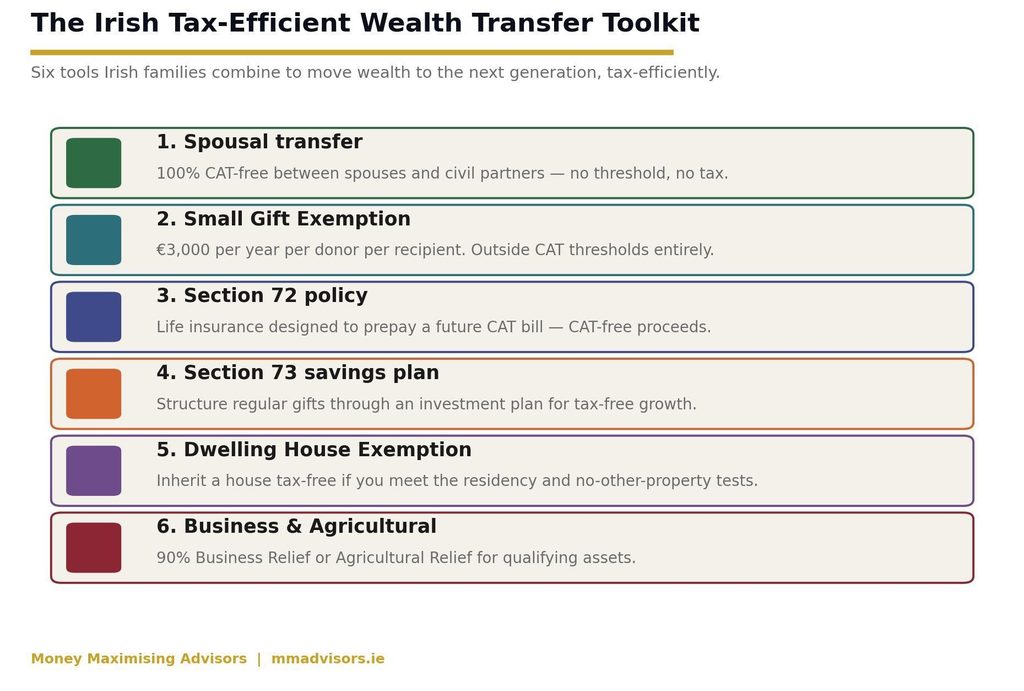
| QUICK ANSWER: Irish families can transfer wealth tax-efficiently using six main tools: 100% CAT-free spousal transfers, the €3,000 annual Small Gift Exemption per donor per recipient, Section 72 life insurance policies that prepay a future CAT bill, Section 73 savings plans for structured lifetime gifting, the Dwelling House Exemption (which can pass a family home tax-free), and Business or Agricultural Relief (a 90% reduction in taxable value on qualifying assets). The single biggest lever is starting early, lifetime gifting compounds far more than one-off inheritance planning. |
Why tax-efficient planning matters
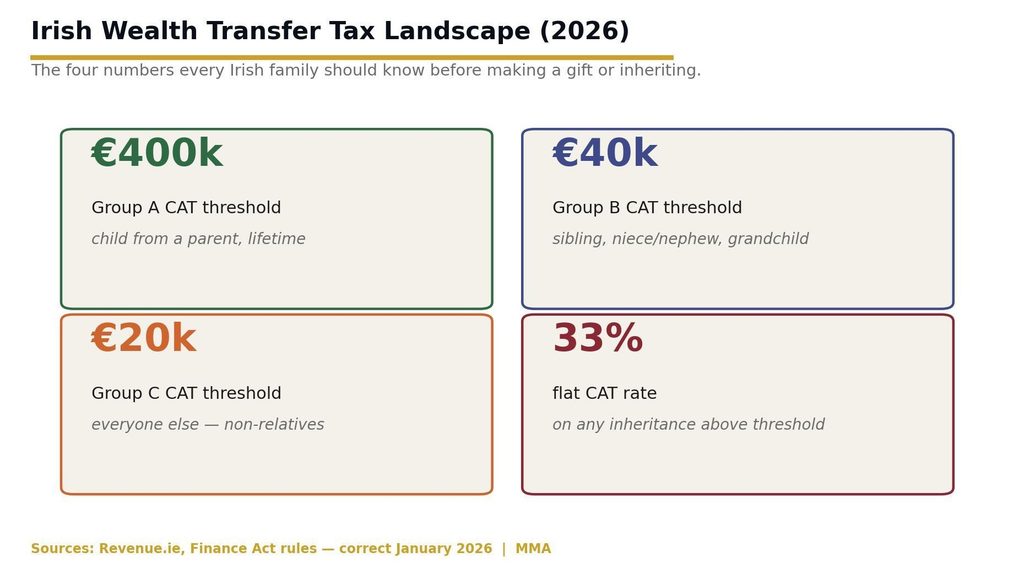
Irish Capital Acquisitions Tax (CAT) is 33% on anything above the relevant threshold. That’s a big number.
On a €1 million estate passed to two children with no planning, up to €132,000 goes to Revenue. With planning, that same estate can pass with zero tax due.
The difference isn’t magic. It’s using the tools the tax code actually gives you.
The CAT thresholds explained
Every recipient in Ireland has a lifetime threshold for gifts and inheritance. The threshold depends on who the giver is.
Group A: €400,000
Applies to children inheriting from a parent (including stepchildren and, in some cases, foster children). This is the largest threshold in the Irish system.
The €400,000 is a lifetime cumulative amount, not per gift or per year. Every gift or inheritance from a parent chips away at it.
Group B: €40,000
Applies to grandchildren, siblings, nieces, nephews, and lineal ancestors. Much smaller than Group A.
This is where planning matters most for aunts, uncles, and grandparents wanting to pass meaningful sums.
Group C: €20,000
Everyone else. Cousins, friends, unmarried partners, in-laws. The smallest threshold.
If a cohabiting partner (not married or in civil partnership) inherits, this is the threshold that applies. It’s a common shock.
The six tax-efficient tools Irish families use
Tool 1: The spousal transfer
Transfers between spouses and civil partners are 100% CAT-free. No threshold. No tax. Ever.
This is the single biggest tax planning advantage in Irish law. Assets move freely between you, during lifetime, or on death.
Important limitation: this only applies to married couples and civil partners. Cohabiting couples do not qualify, which is a critical planning point for unmarried partners.
Tool 2: The Small Gift Exemption
Every person can give any other person €3,000 per year completely tax-free.
This exemption applies per donor and per recipient. Two parents can give each child €6,000 per year. If four grandparents also give, that’s €18,000 per child per year, all tax-free.
Crucially, these gifts do not eat into the recipient’s Group A/B/C threshold. That threshold remains intact for later inheritance.
Over 20 years, a couple with two children can move €240,000 tax-free using just this exemption. Over 30 years with grandparents contributing too, the number rises dramatically.
Tool 3: Section 72 policy
A Section 72 policy is a whole-of-life insurance policy specifically designed to prepay your family’s future CAT bill.
The policy pays out on death. The proceeds are used to pay the CAT bill on your estate. Revenue treats these specific proceeds as exempt from CAT themselves, provided the policy is set up correctly and premiums are paid regularly.
Our Section 72 Policies service brokers the right policy across Ireland’s leading life insurance providers.
Tool 4: Section 73 savings plan
A Section 73 policy is a structured savings plan designed for regular lifetime gifting.
The parent (or grandparent) pays regular premiums. The plan grows tax-efficiently. The proceeds pass to the beneficiary under specific tax treatment.
Used correctly, this vehicle lets you channel the Small Gift Exemption through an investment plan, compounding tax-free growth on top of the annual gift itself.
Tool 5: Dwelling House Exemption
A specific relief that can allow a beneficiary to inherit a house completely CAT-free.
Strict conditions apply. The beneficiary must have lived in the property as their main home for at least 3 years before the inheritance. They must own no other residential property. And they must live in the property for 6 years afterwards.
Where it applies, it can be transformative; a €500,000 family home can pass to an adult child who has been living there, with zero CAT.
Tool 6: Business Relief and Agricultural Relief
Qualifying business assets can pass with a 90% reduction in their taxable value. Farm assets have a similar 90% Agricultural Relief.
These are the mechanisms that allow family businesses and family farms to pass through the generations without a punitive tax charge that would force a sale.
The qualifying rules are technical, minimum ownership periods, active business or farming tests, and continued qualifying use after transfer. Get specialist advice before relying on either relief.
| Want your family’s plan mapped? Book Now for a free 30-minute inheritance tax review, or Enquire Now; we reply within one working day. |
Worked example: passing €1.2m to two children
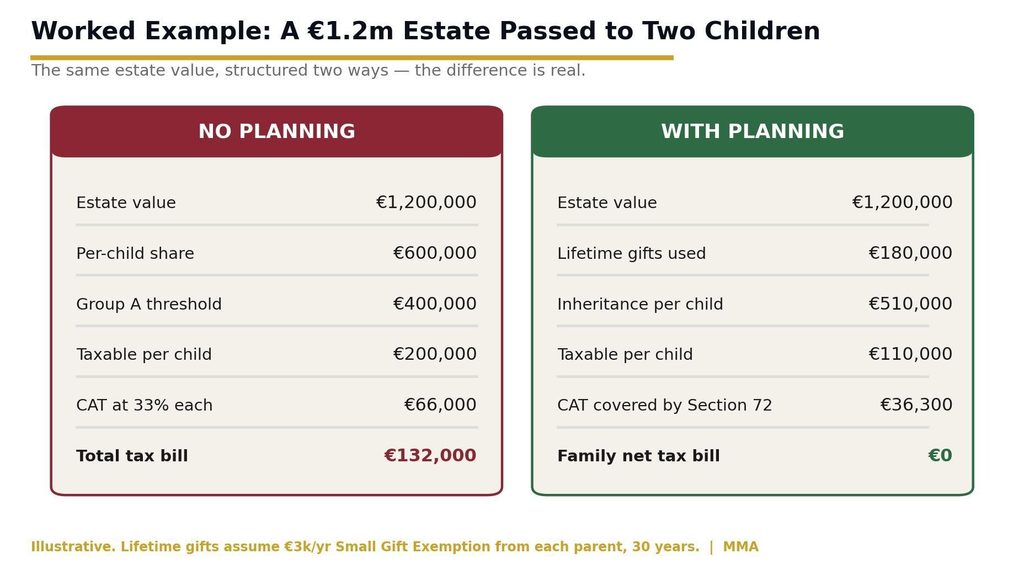
Meet Aoife and Diarmuid. They have two adult children, Sean and Niamh. Their combined estate is worth €1.2 million, a home worth €600,000, pensions, investments, and cash.
Scenario A: no planning
They do nothing during their lifetime. On second death, the full estate passes equally to the children.
Each child inherits €600,000. The Group A threshold is €400,000. Taxable amount per child: €200,000.
CAT bill per child: €200,000 × 33% = €66,000. Total family tax bill: €132,000.
Scenario B: lifetime planning
They start structured planning 30 years before death. Each parent uses the Small Gift Exemption to give each child €3,000 per year, €12,000 total per year for the family.
Over 30 years, they gift €360,000 tax-free, €180,000 per child. This never touches the Group A threshold.
Each parent takes out a Section 72 policy sized to cover the eventual CAT bill. Premiums are paid from surplus income during retirement.
Scenario B result
On second death, each child inherits €510,000 (the remaining estate value after lifetime gifts, split two ways). Taxable per child: €110,000. CAT bill per child: €36,300.
The Section 72 policy pays out. It covers both children’s CAT bills entirely. Net family tax bill: €0. Total transferred to next generation: €1.2m + investment growth on the lifetime gifts.
The rules on lifetime gifts vs inheritance
Irish CAT treats lifetime gifts and inheritance under the same rules, both count toward the recipient’s lifetime threshold.
Gifts during your lifetime
A gift over the Small Gift Exemption uses the recipient’s threshold. A €50,000 gift from parent to child uses €50,000 of the child’s €400,000 Group A threshold.
The advantage of lifetime gifts: they let you see the impact. And they take the growth on those assets out of your estate.
Inheritance on death
Same threshold rules. Same 33% rate above threshold.
The disadvantage of leaving everything until death: you lose the opportunity to combine lifetime gift exemptions with the eventual inheritance.
The 5-year clawback
If you make a large gift and die within 5 years, Revenue looks back at that gift when calculating your estate. This makes lifetime planning more effective when started early, not on your deathbed.
Ready to map your family’s tax-efficient plan?
Ready to map your family's tax-efficient plan?
Book a free 30-minute inheritance tax review, or send us your details and we'll be in touch.
Money Maximising Advisors Limited is regulated by the Central Bank of Ireland – C154250
Special situations that need planning
Cohabiting couples
Unmarried partners fall into Group C (€20,000 threshold). If one dies and leaves the other the family home worth €500,000, the survivor could face a CAT bill of over €158,000.
Solutions: getting married or entering a civil partnership, joint tenancy structure, Section 72 policies sized to the exposure, or the Dwelling House Exemption where it applies.
Second marriages and blended families
Assets left to a spouse pass tax-free. But if the surviving spouse then leaves those assets to their own children (not the deceased’s), the tax treatment can become very complex.
Structured wills, trust arrangements, and clear allocation of specific assets to specific beneficiaries all become more important in blended families.
Family businesses
Without Business Relief, a family business worth €2 million passing to a child faces CAT on €1.6 million, a €528,000 tax bill that could force a sale.
With Business Relief applied correctly, taxable value drops by 90%. The CAT bill drops to a fraction. But the qualifying tests are strict, specialist advice is essential.
Family farms
Agricultural Relief works similarly, 90% reduction in taxable value. But the beneficiary must qualify as a “farmer” for CAT purposes and must retain the land for at least 6 years.
Common wealth-transfer mistakes
- Waiting until it’s too late. Lifetime planning started at 65 has a much bigger impact than at 80. Every year of Small Gift Exemption used compounds.
- Not knowing the threshold history. A child who received a large gift 15 years ago may already have used part of their Group A threshold. Track it.
- Assuming spouse transfer covers everything. It only defers the tax problem. The next generation still faces CAT when they inherit from the second spouse.
- Ignoring Section 72 because premiums feel expensive. The CAT bill would be far more expensive. Model the numbers before dismissing.
- DIY inheritance planning. Small mistakes on Business Relief, Section 72 setup, or Dwelling House Exemption can invalidate the relief entirely. Get specialist advice.
- Not updating your will. Life changes, marriage, divorce, births, deaths, house moves. Review your will every 5 years and after any major event.
- Assuming cohabiting = married for tax. It doesn’t. This is one of the biggest planning gaps we see in Ireland.
Where MMA fits in
Money Maximising Advisors is a Central Bank regulated financial broker based in Galway. Two things matter for wealth transfer planning:
First, our advice services are delivered directly by our qualified team. Our Inheritance Tax Advice service maps every option, spousal transfer, gift exemptions, Section 72 sizing, and Business Relief to your specific family situation.
Second, we are a multi-agency broker for the underlying products. We compare Section 72 policies, Section 73 savings plans, and life insurance across every active Irish provider and help you access the one that fits.
The result: independent advice, wide product access, and no direct fee to you for the arrangement itself.
Also Read,
Frequently asked questions
How can I transfer wealth to my children tax-efficiently in Ireland?
The most effective approach combines three things: use the €3,000 annual Small Gift Exemption every year from each parent (and grandparent) to each child; structure your estate so each child’s inheritance stays as close as possible to the €400,000 Group A threshold; and take out a Section 72 life insurance policy sized to cover any expected CAT bill. Starting early is the biggest lever, lifetime gifting compounds far more than one-off inheritance planning.
How much can I gift tax-free in Ireland?
The Small Gift Exemption is €3,000 per year, per donor, per recipient, with no lifetime limit. Two parents can give each child €6,000 per year tax-free. If four grandparents also gift, a child can receive €18,000 per year tax-free. These gifts do not use any of the Group A/B/C lifetime threshold.
What is the CAT threshold in Ireland?
Three thresholds apply based on the relationship between giver and recipient. Group A (children inheriting from parents): €400,000 lifetime. Group B (siblings, nieces, nephews, grandchildren): €40,000 lifetime. Group C (all other relationships, including cohabiting partners not married or in civil partnership): €20,000 lifetime. Above these thresholds, CAT is charged at 33%.
Is a Section 72 policy worth it?
For families with an expected CAT bill above roughly €30,000–€50,000, a Section 72 policy typically saves the estate money. Premiums are paid from surplus income over the working life or retirement. The policy pays out on death, and Revenue treats those specific proceeds as CAT-exempt when used to pay the CAT bill, provided the policy is set up correctly and premiums are paid consistently.
Can cohabiting couples transfer wealth tax-free in Ireland?
No. The 100% CAT-free spousal transfer only applies to married couples and civil partners. Cohabiting partners fall into the Group C threshold of €20,000, meaning most transfers between them are heavily taxed. Cohabiting couples with significant shared assets should seriously consider marriage, civil partnership, joint tenancy structures, or Section 72 policies as planning options.
How does the Dwelling House Exemption work?
A beneficiary can inherit a house completely CAT-free if they meet three conditions: they lived in the property as their main home for at least 3 years before the inheritance; they own no other residential property at the time of inheritance; and they continue to live in the property as their main home for at least 6 years after inheriting. It’s a powerful relief for adult children who have been living in the family home, but the conditions are strict and any breach can trigger a full CAT charge.
Reviewed by our inheritance planning team
This guide was prepared and reviewed by the inheritance planning team at Money Maximising Advisors, drawing on Revenue.ie current CAT rules, Section 72/73 legislation, and daily family wealth-transfer casework.MMA is regulated by the Central Bank of Ireland (C154250).
Ready to map your family’s tax-efficient plan?
Whether you’re a parent thinking ahead, a grandparent wanting to help, or an adult child managing an aging parent’s estate, our team maps every tax-efficient option to your specific family situation.
Ready to map your family's tax-efficient plan?
Book a free 30-minute inheritance tax review, or send us your details and we'll be in touch.
Money Maximising Advisors Limited is regulated by the Central Bank of Ireland – C154250
| Important information CAT thresholds, rates, reliefs, and Small Gift Exemption values referenced are those in force in Ireland at time of writing (January 2026) and are subject to change with each Finance Act. Section 72 and Section 73 policies must be structured to specific Revenue-approved criteria to achieve the described tax treatment. Business Relief and Agricultural Relief have strict qualifying tests and clawback rules. Worked examples are illustrative and simplified. Rates, thresholds and rules referenced are correct at time of writing and are subject to change. Money Maximising Advisors Limited is regulated by the Central Bank of Ireland (C154250). This article is for general information only and does not constitute personalised financial, tax or legal advice. You should always speak to a Qualified Financial Advisor before making any decision. |