
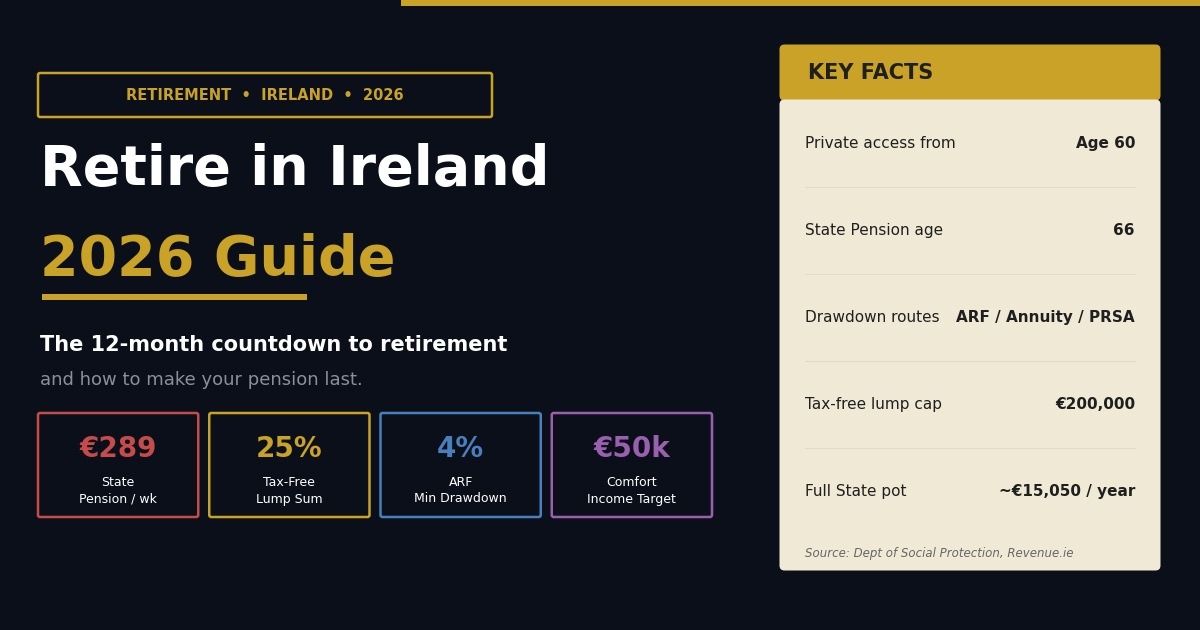
| ⚠ WHY THIS MATTERS NOW Three things about Irish retirement changed in 2026 that make this year’s decisions different. ▶ State Pension moved to €289.30 per week. From January 2026 the Contributory rate rose to ~€15,050/year , useful, but nowhere near enough to fund a comfortable retirement on its own. ▶ Standard Fund Threshold on the move. The lifetime cap on tax-privileged pension savings is scheduled to rise from €2m to €2.8m by 2029 , relevant for anyone approaching that ceiling. ▶ Living costs are still up 20–25% on 2021. Any retirement income projection built pre-2022 needs revisiting. Old “€35k is comfortable” targets have quietly moved to “€45–50k”. |
If you are within 10 years of retiring in Ireland , whether you’re targeting 2026 itself or planning for 2030, 2033 or later , this is the decade the decisions get expensive. Get retirement planning Ireland right in the run-up years, and you protect decades of income. Get it wrong, and you lock in mistakes that are hard to unwind. This guide walks you through what retirement planning actually looks like in 2026: State Pension mechanics, private pension drawdown choices (ARF vs annuity vs vested PRSA), how much you actually need, and the 12-month countdown to a smooth retirement date. At Money Maximising Advisors, we run retirement planning Ireland reviews for clients in Dublin, Galway and nationwide, with regional partners jcfc.ie in Donegal and moneysense.ie in Kerry.
The 5 questions every Irish retiree asks
What should I do before retiring in Ireland?
Twelve months out, start a structured countdown: model your projected retirement income (State Pension + private pensions + any part-time work), consolidate old pension pots, choose your drawdown route (ARF vs annuity vs vested PRSA), plan the use of your tax-free lump sum (up to 25% of the pot, capped at €200,000), and get your paperwork , forms, updated will, EPA, healthcare cover , in order. Rushing any of these in the final month usually costs money.
How much money do I need to retire comfortably in Ireland?
For a two-person Irish household, a widely used comfort target for a mortgage-free retirement is €45,000–€55,000 gross per year (indexed for inflation). The State Contributory Pension provides roughly €15,000 per person per year , €30,000 for a full-qualifying couple , so the private-pension shortfall is typically €15,000–€25,000 per year, which requires a private pot in the range of €400,000–€700,000 using standard drawdown assumptions.
What is a good retirement income in Ireland?
There’s no universal answer, but a useful benchmark: 70–80% of your final salary is a widely used target if you want to maintain a similar lifestyle. On a €65,000 final salary, that’s €45,000–€52,000 of retirement income. Higher earners often find they need less as a % (because mortgages and childcare costs drop out), while lower earners often need close to 100% because the State Pension only replaces so much.
Can I retire in 2026 if I have a private pension?
Yes , the earliest normal retirement age for most Irish private pensions is 60, though PRSAs and personal pensions can be accessed from 50 in specific circumstances (e.g., leaving service with 20+ years). You do not have to wait for the State Pension age of 66 to start drawing your own private savings. If you’ve been contributing steadily since your thirties and your projected income clears your target, retirement in 2026 is very plausible.
What is the first step in retirement planning?
Get a full picture of your pension assets , write down every pension pot you’ve ever contributed to (past employers included), pull current valuations, and check your State Pension record on MyWelfare. Then model a rough retirement income against a rough target. That single hour of work is what turns “vague worry” into “actionable plan.” Everything after that flows from having numbers on paper.
How to draw down your Irish pension
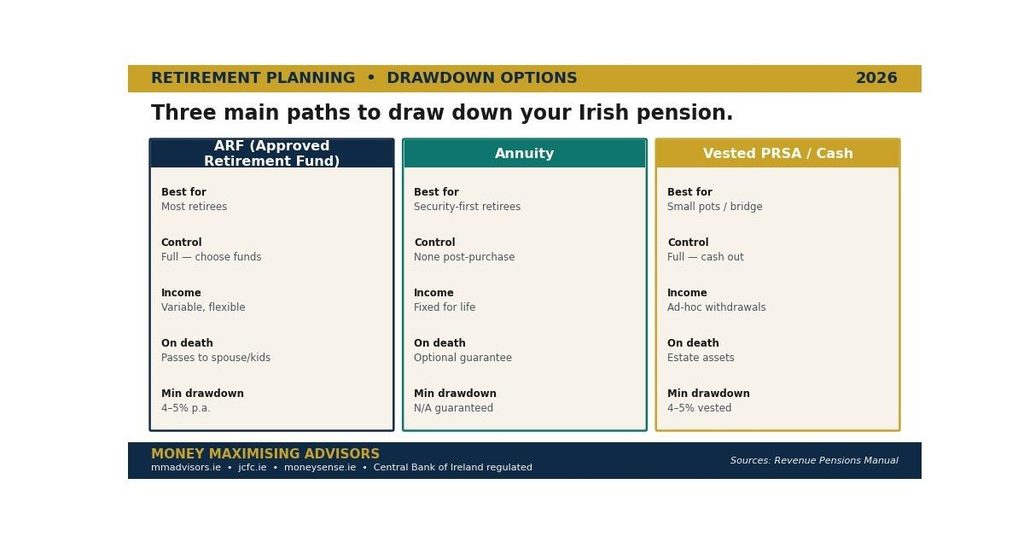
Three main paths at retirement , each with different tax, control and legacy outcomes.
Approved Retirement Fund (ARF)
The default choice for most Irish retirees. After taking your tax-free lump sum, the remainder of your pension pot rolls into an ARF , an investment account you continue to own and control. You choose the fund mix, take variable income each year (subject to minimum drawdown rules: 4% p.a. from age 61–70, 5% from age 71+), and on death the pot passes to your spouse or children. See our Approved Retirement Funds page for the mechanics.
Annuity
A traditional “pension in payment” , you hand your pot to an insurance company and receive a guaranteed income for life. The trade-offs: no market risk, no fund choice, no residual value on death (unless you buy a guarantee period or joint-life feature). Annuity rates in Ireland have improved significantly since 2022 , they’re worth quoting even if you decide against them.
Vested PRSA / Cash withdrawal
For smaller pots or pension savers who want flexibility with tax-planning, a vested PRSA keeps the pot in PRSA structure and allows ad-hoc withdrawals subject to income tax and USC. Useful for retirees who want to bridge a few years before other pensions kick in, or manage tax bands carefully. Not right for everyone but genuinely useful in specific circumstances.
| Not sure which drawdown route fits you best? Book a retirement modelling session and we’ll show you the take-home income under each route , with your actual numbers. → Enquire Now | → Book an Appointment | → Contact Us |
Retirement planning across the Irish regions
Pension rules are national, but where you retire changes the practical planning , cost of living in Dublin vs Kerry vs Donegal, healthcare access, community, family proximity. The MMA group has a regional partner near you:
| MMA GROUP | IRELAND-WIDE COVERAGE Same regulated firm, same standards , three brands covering different regions of Ireland. |
FLAGSHIP | NATIONAL mmadvisors.ie Head office Tuam, Co Galway. Full product suite, national coverage. NORTH WEST IRELAND jcfc.ie Joe Coyle Financial Consultants, Mountcharles, Co Donegal. Business-owner and family specialists. SOUTH WEST IRELAND moneysense.ie Money Sense, Killarney, Co Kerry. 40+ years serving Munster families and pre-retirees. |
The 12-month countdown to retirement
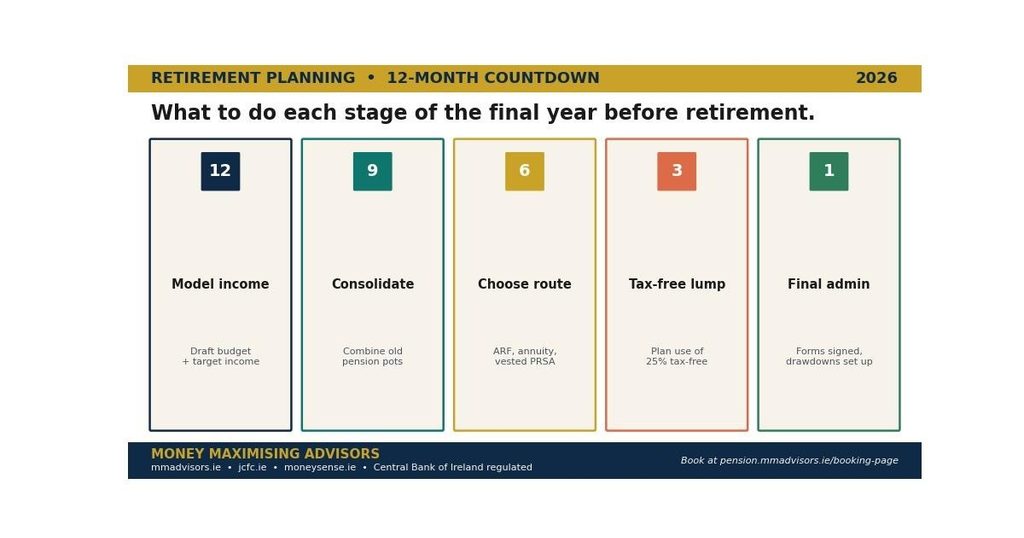
The final year, month by month , what to do and when.
12 months out , Model your income
Draft a realistic monthly budget for the first year of retirement, indexed for inflation. Include the boring items , property tax, health insurance, car costs, travel , alongside the fixed household spend. Compare against your projected pension income to identify any shortfall while there’s still time to close it.
9 months out , Consolidate old pots
If you’ve worked for multiple employers, you may have pensions from previous employments scattered across old schemes. Consolidation simplifies drawdown , one platform, one set of statements, one strategy , and can improve investment options.
6 months out , Choose your drawdown route
ARF, annuity, vested PRSA, or a blend. This is where a modelled income projection under each option becomes essential , the differences over a 25-year retirement can be substantial.
3 months out , Plan your tax-free lump sum
You can take up to 25% of your pot as a tax-free lump sum, capped at €200,000. A further €300k up to €500k is taxed at 20% (not the higher rates). Plan use , mortgage clearance, home upgrade, gifting to adult children within CAT limits , rather than defaulting to “leave in the current account”.
1 month out , Final administration
Retirement claim forms signed, drawdown accounts set up, direct debits for income transferred, State Pension application filed if eligible (you must apply , it’s not automatic), medical cover confirmed, will updated.
| CLIENT STORY How Seán and Máire retired in Cork on €49,000 a yearSeán (64) and Máire (62), based in Cork, both approaching retirement. Combined private pension pots: €580,000 (Seán €380k occupational + €90k AVCs; Máire €110k PRSA). Both have full PRSI records for maximum Contributory State Pensions.Modelled income at age 66 (both drawing State Pension + ARF at 4%): State pensions €30,100 combined, plus ARF income €19,200, total €49,300 gross per year indexed for inflation. Seán took his 25% tax-free lump sum (€117,500) and used €80k to clear the last of the mortgage and €30k to top up their emergency fund; the remaining €307k rolled into an ARF.The final year of the countdown looked like: consolidated Seán’s old employer pension into a Personal Retirement Bond at month 9; chose ARF for the main pot and vested PRSA for Máire’s smaller pot at month 6; planned tax-free lump-sum use at month 3; retirement date on Seán’s 65th birthday. First 12 months of retirement have run to plan. |
Common retirement planning mistakes
✗ Assuming the State Pension is enough. €289.30/week (~€15k/year) doesn’t come close to funding a comfortable retirement in most parts of Ireland.
✗ Leaving old pensions with old employers. Consolidation almost always simplifies drawdown and often improves fund quality.
✗ Taking the tax-free lump sum ‘because it’s tax-free’. If you don’t need it now, it may be more tax-efficient to leave it in the ARF and draw over time.
✗ Ignoring the State Pension eligibility record. Gaps in PRSI contributions can be filled voluntarily up to certain limits, but only if you know they exist.
✗ Underestimating inflation over 25 years. A 25-year retirement means today’s €50k target is tomorrow’s €85k , model this.
✓ Starting the 12-month countdown early. Retirees who plan a year out consistently retire more smoothly, and more happily, than those who ‘sort it out closer to the date’.
Reviewed by qualified financial advisors
| REVIEWED BY MONEY MAXIMISING ADVISORS This guide has been fact-checked and reviewed by the advisory team at Money Maximising Advisors Limited , a Qualified Financial Advisor (QFA) firm regulated by the Central Bank of Ireland and authorised as a Multi-Agency Intermediary across the main Irish pension providers, life insurers and lenders.Our advisors hold QFA, RPA, FA and Specialist Investment Adviser (SIA) qualifications, maintain annual Central Bank-mandated CPD, and document every recommendation in a written Statement of Suitability. Verify our authorisation on the Central Bank public register at registers.centralbank.ie. Regional partners in the MMA group: jcfc.ie (Donegal / North West) and moneysense.ie (Kerry / South West). |
Related reading
| Related post | Category | Link |
|---|---|---|
| Pension Plan in Ireland: How Much Will My Pension Pay Me If I Retire at 60? | Retirement | Read more → |
| Section 72 Pension Ireland: A Smart Guide to Tax-Efficient Retirement Planning in 2026 | Tax & Retirement | Read more → |
| Your Complete Guide to Pension Planning in Ireland 2026 | Pensions | Read more → |
| What Happens to Your Pension After Redundancy in Ireland? | Pensions | Read more → |
| Saving Pension Plan in Ireland: The 2026 Expert Guide to Building a Secure Retirement | Retirement | Read more → |
Before you leave , quick FAQ
Can I still work part-time if I’m drawing an Irish pension?
Yes , there’s no restriction on continuing to work in Ireland while drawing an occupational or private pension. Earnings are subject to normal income tax and PRSI. The State Pension is also payable regardless of continued work (subject to your PRSI record).
How is the ARF taxed on income?
ARF withdrawals are taxed as PAYE income , income tax, USC and PRSI up to age 66. Your ARF provider deducts tax at source. Careful planning of drawdown level around the standard-rate band and USC thresholds can materially reduce your effective tax rate.
What if I have overseas pensions from working abroad?
Overseas pensions have specific tax and transfer implications. UK pensions particularly are affected by post-Brexit changes to Qualifying Recognised Overseas Pension Schemes (QROPS). Talk to our Overseas Pension Advice team before consolidating anything.
Do I need long-term care insurance for retirement?
Ireland has a state-supported care scheme (Fair Deal / Nursing Homes Support Scheme) that means most retirees don’t need dedicated long-term care insurance. Planning does still need to model the potential impact of Fair Deal charges on the family home.
Ready to plan your retirement date?
| Book a retirement planning session with a QFA We’ll model your projected income under each drawdown route, stress-test for inflation, and structure a plan that works. → Enquire Now | → Book an Appointment | → Contact Us |
Important information
Money Maximising Advisors Limited is regulated by the Central Bank of Ireland and authorised as a Multi-Agency Intermediary. All figures, tax thresholds, State Pension rates and regulatory references in this article are correct as at June 2026, based on Revenue.ie, the Pensions Authority and the Central Bank. This article is for general information only and does not constitute financial, tax or legal advice. Individual circumstances vary; you should seek personalised advice from a Qualified Financial Advisor before making any pension, protection, investment or estate-planning decision. Retirement income projections depend on contribution history, investment performance, drawdown level and inflation assumptions. Past performance is not a reliable indicator of future results. Annuity rates and ARF drawdown minima are subject to change.