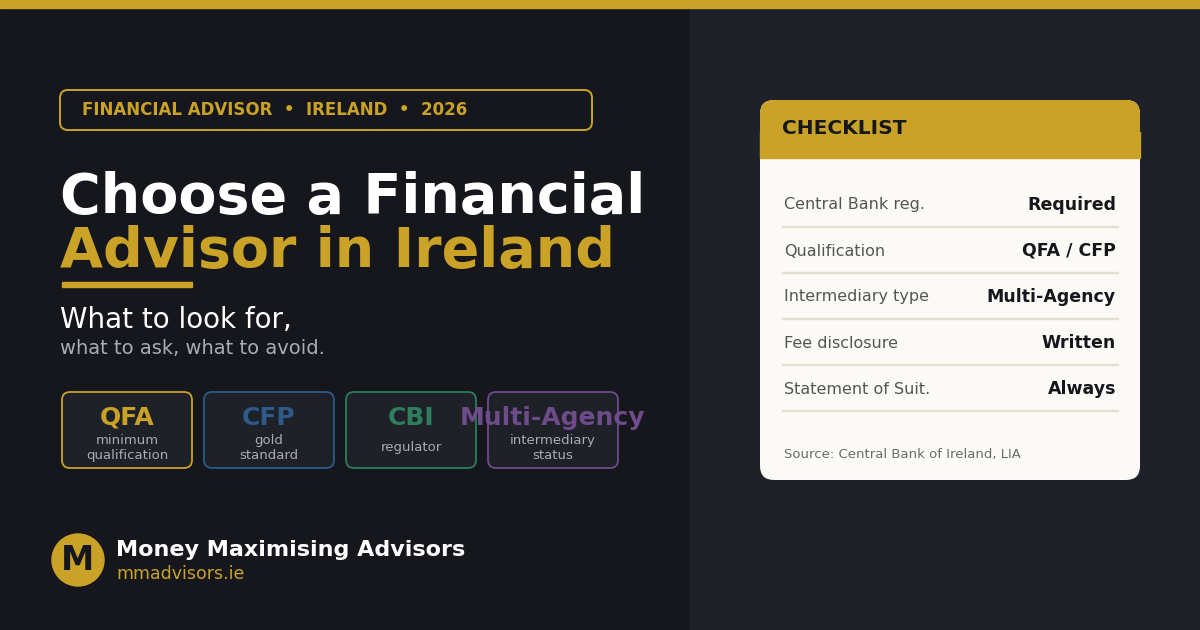
| Quick answer Before signing anything, check that the financial advisor in Ireland you are considering is authorised by the Central Bank of Ireland, holds a minimum QFA qualification (CFP and Specialist Diplomas are the gold standard), operates as a Multi-Agency Intermediary rather than a tied agent, and fully discloses fees and commissions in writing under the Consumer Protection Code. If any of those four signals are missing, walk away. |
Choosing a financial advisor in Ireland is one of the highest-leverage decisions you will make with your money; and one of the most under-researched. Most Irish consumers spend more time picking a holiday than picking the person responsible for their pension, their mortgage and their family’s protection. This pillar guide walks you through exactly what to look for in an independent financial advisor Ireland relationship, the questions to ask before signing a Letter of Engagement, the difference between a financial advisor vs broker Ireland consumers often confuse, and how the various fee models in the Irish market actually work. At Money Maximising Advisors, we operate as a Multi-Agency Intermediary regulated by the Central Bank of Ireland and serve clients across Dublin, Cork, Galway and the wider Irish market.
| This guide ties together every hub on our site, including Mortgages, Pensions, Protection, Savings & Investments, Inheritance Tax and Public Sector because the right advisor will cover all of these, not just one. |
Quick answers: seven questions every Irish consumer asks about choosing an advisor
How do I choose a financial advisor in Ireland?
Check four things, in order: (1) Central Bank of Ireland authorisation (search the public CBI register at registers.centralbank.ie), (2) qualifications QFA at minimum, ideally with additional Specialist Diplomas (Retirement Planning, Loans, Investment), (3) intermediary status Multi-Agency is wider than tied, and (4) fee disclosure in writing before any product is recommended.
What qualifications should a financial advisor have in Ireland?
The minimum legal requirement is QFA (Qualified Financial Advisor) awarded by the LIA / Institute of Banking. Above that, advisors can specialise with RPA (Retirement Planning Adviser), FA (Financial Adviser), Specialist Investment Adviser (SIA) and Loan Advisor qualifications. The gold standard for holistic financial planning is the international CFP (Certified Financial Planner) certification.
What is the difference between an independent and a tied financial advisor in Ireland?
A tied agent is contractually committed to sell the products of a single provider (one life company, one pensions provider). A Multi-Agency Intermediary (the closest thing to true “independent” in the Irish market) holds agencies across the full panel of insurers, lenders and investment houses and can recommend any of them. For most consumers, a Multi-Agency Intermediary is the right choice.
What is the difference between fee-only and commission-only financial advisors in Ireland?
A fee-only financial advisor Ireland charges you directly; hourly, fixed-fee or a percentage of assets, and rebates any commission. A commission-only advisor is paid by the product provider out of the premiums or contributions you pay, with no direct fee to you. A hybrid model uses fees for the plan and commission on implementation. All three are legitimate under the Consumer Protection Code provided they are disclosed in writing.
How much does a financial advisor cost in Ireland?
Fee-only plans typically run €1,500–€5,000 for a one-off comprehensive financial plan, or 0.5–1.0% of assets per year for ongoing wealth management. Commission-based advice has no direct cost to you, but the commission is built into the product charges; typically 4–6% of pension contributions and 80–150% of the first year’s life insurance premium. Always ask for the lifetime cost in euros, not just the headline rate.
What is the difference between a financial advisor and a broker in Ireland?
In strict legal terms, both are “intermediaries” regulated by the Central Bank of Ireland. In practice, “broker” usually implies transactional work (arranging one mortgage, one insurance policy), while “financial advisor” implies broader, planning-led work covering pensions, protection, investments and inheritance together. Many firms (including ours) do both; the distinction matters less than the underlying qualifications and intermediary status.
What are the best questions to ask a financial advisor before hiring them?
Six high-value questions:
(1) Are you regulated by the Central Bank of Ireland?
(2) Are you tied or Multi-Agency?
3) What qualifications do you hold?
(4) How exactly are you paid in euros?
(5) Will I get a written Statement of Suitability?
(6) Who else do you work with, and can I see anonymised examples?
Any reluctance on any of those is a red flag.
Tied vs Multi-Agency: the single biggest determinant of advice quality
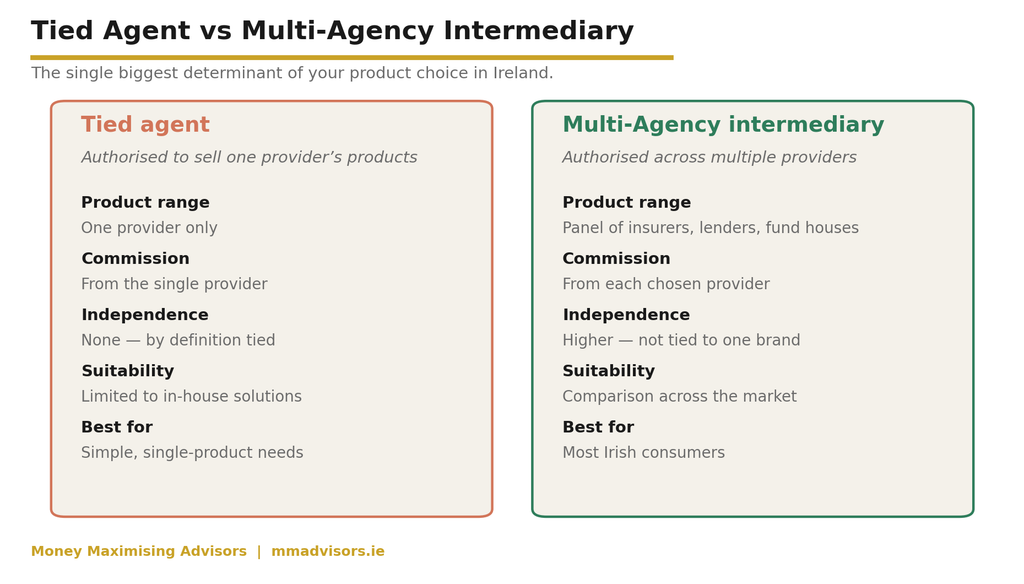
Two very different relationships with very different product universes.
Of all the variables that determine the quality of advice you receive, the intermediary status of the advisor is the most important and the least understood by consumers. The Central Bank of Ireland authorises advisors in two main categories:
Tied agent. Authorised to sell one life-and-pensions provider’s products. Often badged as a “financial advisor” at a bank branch or a single insurer’s sales channel. The product range is narrow by design; if the in-house product doesn’t fit your situation, you won’t hear about the alternatives.
Multi-Agency Intermediary. Authorised across multiple providers; typically all of the main Irish life insurers, several pension providers and a wide mortgage lender panel. The advisor can recommend any product on the panel based on what fits you best, with the legal obligation to evidence the choice in a Statement of Suitability. This is the closest thing the Irish market has to a true independent financial advisor Ireland relationship.
Crucially, the Central Bank register lists every authorised advisor and the exact intermediary status — you can search any advisor in 30 seconds at registers.centralbank.ie.
Qualifications that actually matter
QFA — the minimum legal bar
The Qualified Financial Advisor designation is the starting point. Any advisor giving regulated financial advice in Ireland must hold a current QFA or equivalent. If your advisor does not hold a QFA, walk away.
CFP — the gold standard for holistic planning
The certified financial planner Ireland designation (CFP) is an international qualification awarded in Ireland by the Financial Planning Standards Board. CFPs go beyond product advice into full lifetime cashflow planning, retirement modelling and inheritance work.
Specialist diplomas — RPA, FA, SIA, Loan Advisor
The post-QFA qualifications signal genuine domain expertise. An advisor with RPA (Retirement Planning Adviser) and Specialist Investment Adviser (SIA) has done substantial extra study in pensions and investments; valuable for anyone with a complex portfolio or imminent retirement.
Continuous Professional Development (CPD)
All qualified advisors must maintain annual CPD hours. Ask what your prospective advisor focused on in their last CPD year; a thoughtful answer (“I did 20 hours on the new Auto-Enrolment scheme”) is a good signal; a vague one isn’t.
| Want to know what a proper Multi-Agency advice relationship looks like? Book Now for a free, no-obligation consultation, or Enquire Now and we will be in touch within one working day. |
How Irish financial advisors get paid — the three models
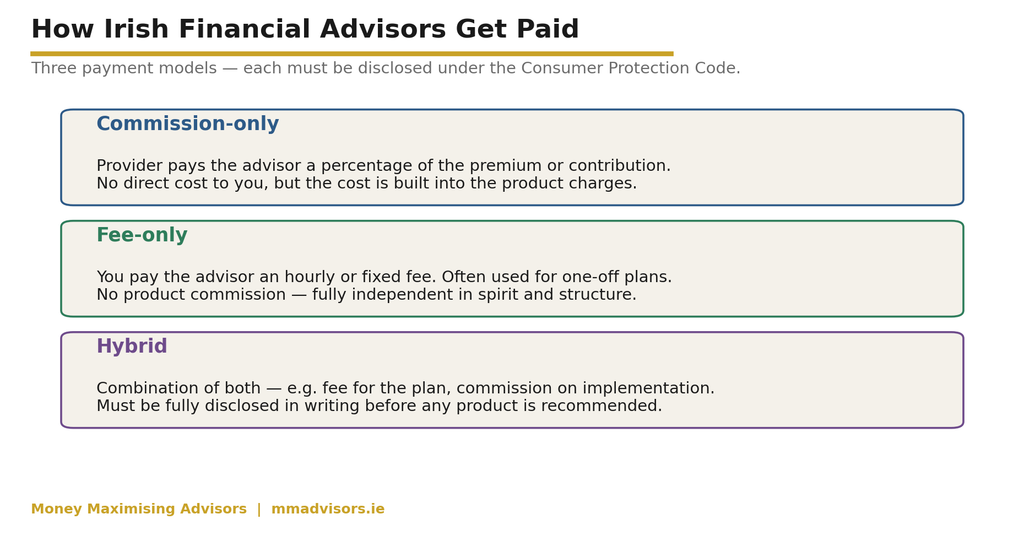
Three legitimate payment models — all must be disclosed in writing under the Consumer Protection Code.
Commission-only
The advisor is paid by the product provider out of the premiums you pay. No direct fee comes out of your bank account. The cost is real; it is built into the product charges; but it is invisible at the point of sale. Best suited to straightforward, product-led work (a mortgage protection switch, a single pension contribution) where the work involved matches the commission earned.
Fee-only
You pay the fee-only financial advisor Ireland directly; hourly, fixed-fee or a percentage of assets under advice. Any commissions paid by product providers are rebated to you or used to reduce the policy charges. Most appropriate for comprehensive financial planning work where the time involved is substantial and the products are secondary to the strategy.
Hybrid
The most common model among holistic Irish advisors. A fee is charged for the upfront planning work; commission is taken on any product implementation. Must be fully disclosed in writing before any product is recommended; the Consumer Protection Code 2012 (and subsequent updates) make this non-negotiable.
Regardless of the model, ask for the cost in euros, not percentages. “1% of assets” sounds modest until you realise it’s €10,000 a year on a €1 million portfolio.
When you need a financial advisor vs when you might not
Not every financial decision warrants a paid advisor. We routinely tell prospective clients that their question doesn’t justify an engagement. Some quick rules of thumb for when financial planning Ireland advice genuinely earns its fee:
- Yes — retirement transition. The five years either side of retirement is the highest-stakes financial planning period of most lives. Get advice.
- Yes — inheritance and CAT planning. Mistakes here cost five and six figures and are usually irreversible.
- Yes — self-employed or director-led businesses. Pension structures (Directors Pension, PRSAs, master trusts) interact with corporate tax in ways that need expert hands.
- Yes — redundancy or career transition. Tax-free lump sums, pension consolidation and protection gaps all bite at once. Take advice.
- Yes — significant lump sums. Inheritance, sale of a business, a large bonus or share vesting all merit Lump Sum Investments advice.
- Maybe not — simple PRSA contributions on a modest salary. If your only goal is monthly pension contributions and you’re happy with a default fund choice, an execution-only PRSA may be enough.
Why work with Money Maximising Advisors?
| About Money Maximising Advisors Limited is a Qualified Financial Advisor (QFA) firm regulated by the Central Bank of Ireland and authorised as a Multi-Agency Intermediary across the main Irish life insurers, pension providers and mortgage lenders. Our advisors hold QFA, RPA and FA qualifications, maintain Central Bank-mandated CPD every year, and document every recommendation in a written Statement of Suitability. We cover mortgages, pensions, protection, savings, investments, inheritance tax and public-sector planning under one roof.Our fee structure is fully disclosed before any engagement begins. To check our authorisation, search the Central Bank public register at registers.centralbank.ie, or learn more about us. |
Red flags to walk away from
- Reluctance to disclose fees in writing. A regulated advisor is legally required to do this before recommending any product.
- Pressure to commit at the first meeting. Good advice involves cooling-off periods and second meetings, not closing techniques.
- Only ever recommends one provider. Either they’re tied (fine, but they should say so) or they have an undisclosed bias. Either way, the product universe is too narrow.
- Promises specific investment returns. Anyone promising a guaranteed return on a market-linked product is misrepresenting it.
- Won’t produce a Statement of Suitability. This is a Central Bank requirement, not an optional add-on.
- Doesn’t appear on the Central Bank register. Non-negotiable; if they’re not on the register, they’re not authorised.
Most-read planning guides
- Hire Your Kids: A Legitimate Tax Strategy for Irish Business Owners
- PRSA vs Company Pension Ireland for Directors
Frequently asked questions about financial advisors in Ireland
Is wealth management the same as financial advice in Ireland?
Not exactly. Wealth management Ireland usually implies discretionary portfolio management for higher-net-worth clients; the manager makes investment decisions on your behalf within an agreed mandate. Financial advice covers a broader remit: planning, pensions, protection, mortgages and tax. Many advisors do both; ask which model your prospective firm operates.
How do I find the best financial advisor in Dublin?
The best financial advisor Dublin or anywhere in Ireland for you is the one whose qualifications, intermediary status and specialism fit your circumstances. Search the Central Bank register, request quotes and Statements of Suitability from two or three firms, and ask all six “red-flag” questions above. Reputation, online reviews and referrals are useful but secondary to authorisation.
Can I change financial advisors in Ireland?
Yes, you are not locked into any advisor. Your existing policies remain in force with the relevant providers; the new advisor simply takes over the servicing agency. There is no cost to you, and the switch can usually be completed in a couple of weeks.
What protection do I have if a financial advisor in Ireland gives me bad advice?
Regulated advisors must hold Professional Indemnity Insurance and are subject to the Central Bank’s consumer protection framework. Complaints can be made to the firm first, then to the Financial Services and Pensions Ombudsman if unresolved. Compensation can be ordered where unsuitable advice has caused a financial loss.
Do financial advisors in Ireland help with inheritance and CAT planning?
The good ones do. Look for a firm with named Inheritance Tax Advice specialism, ideally with experience of Section 72 Policies and the Small Gift Exemption — these are the two most under-used tax-planning tools in the Irish market.
Ready to talk to a Multi-Agency advisor?
Whether you’re evaluating financial advice for the first time or switching from a tied agent or a bank advisor, our team will run you through our qualifications, our fee model and what working together would look like — with no pressure to commit on the call. Book Now for a free consultation, or visit Money Maximising Advisors to learn more.
Important information
Money Maximising Advisors Limited is regulated by the Central Bank of Ireland and authorised as a Multi-Agency Intermediary. Qualifications, intermediary categories, register search instructions and Consumer Protection Code references reflect Central Bank of Ireland rules in force as at June 2026. This article is for general information only and does not constitute financial, tax or legal advice. The right financial advisor for any individual depends on personal circumstances; you should always seek personalised advice from an authorised, qualified financial advisor and verify their status on the Central Bank public register before engaging.