Summer in Ireland is the perfect window to put one of the simplest, most under-used tax strategies for self-employed parents and business owners to work, the Hire Your Kids (HYK) strategy. The idea is straightforward: if you run a business, you can put your own children on the payroll for genuine work, pay them at an age-appropriate rate, and let them use some of their personal tax allowances in the process. Done properly, it saves the family money, gets your teenager off their phone for a few hours a week, and starts building a real financial track record for them. At Money Maximising Advisors, we walk parents and directors through this every year as part of our broader Money Management Advice service. This guide explains how the strategy works in Ireland, what the rules actually allow, and how to use it without falling foul of Revenue.
| This article sits within our wider family financial planning work and supports cluster pages including Corporate Financial Wellness Advice, College Education Savings, Small Gift Exemption Savings Plan, Directors Pension and Corporate Investments. |
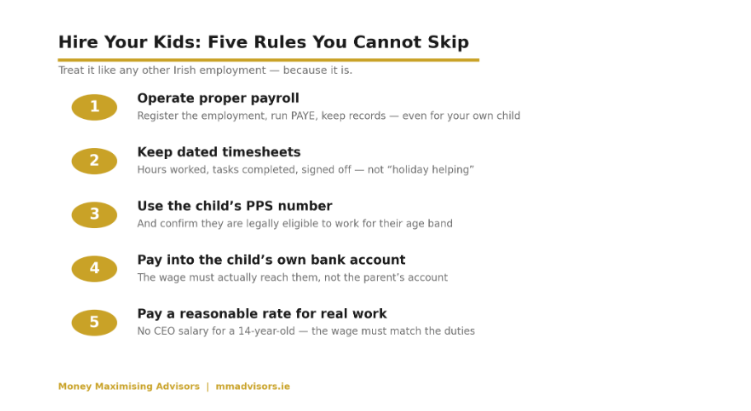
Five rules every Irish parent must follow when putting a child on the family payroll.
What is the Hire Your Kids strategy?
In essence, Hire Your Kids is a perfectly legitimate use of two things working together: your business’s ability to deduct staff wages as a business expense, and your child’s own personal tax credits and allowances. Wages paid to your child are a legitimate cost of the business (reducing your profit, and therefore your tax bill); the income, in your child’s hands, is usually below their personal allowance and so can be received with little or no income tax. The end result is that money which would otherwise be sitting in the business at your marginal tax rate ends up with your child at their (much lower) rate, perfectly legally. It is the same logic underpinning much of the planning around Section 73 Policy Savings Plan and Inheritance Tax Advice, just applied to the income side rather than capital transfer.
Who can actually use this strategy?
Three groups stand to benefit most from HYK in Ireland:
- Self-employed parents — sole traders, contractors, freelancers and tradespeople who run a business that can legitimately employ a teenager.
- Company directors — owner-managers of limited companies who can put a son or daughter on the company payroll. See Directors Pension for the wider tax-planning toolkit available to you.
- Family-business owners — anyone running a genuine business operation (retail, hospitality, e-commerce, professional services) where there is real, age-appropriate work a teenager can do.
Who it is not for: if you are a pure PAYE employee with no business of your own, this strategy does not apply to you, there is no employer through which to pay your child. In that case, our team would generally point you toward College Education Savings, Regular Saver Investment Plans and the Small Gift Exemption Savings Plan as more appropriate vehicles for moving wealth to children tax-efficiently.
The legal framework: the Protection of Young Persons (Employment) Act 1996
Before you go anywhere near payroll, you need to understand the law that governs employing a young person in Ireland. The Protection of Young Persons (Employment) Act 1996 sets out exactly when, how long and what kind of work a child can do. The rules differ depending on your child’s age:
A 14-year-old can be employed for light work only, nothing physically demanding, nothing hazardous, nothing that interferes with their education. During school holidays, they can work up to 35 hours a week. A 15-year-old can also work up to 35 hours a week during school holidays, plus up to 8 hours a week during term-time on light duties. For 16- and 17-year-olds the limits step up to 8 hours per day and 40 hours per week.
There is one rule parents often overlook: the law requires you to give your child at least three consecutive weeks off before they go back to school. That uninterrupted break is not negotiable, even if your child is keen to keep working through August. Build it into the timetable from day one.
How much can your child actually earn?
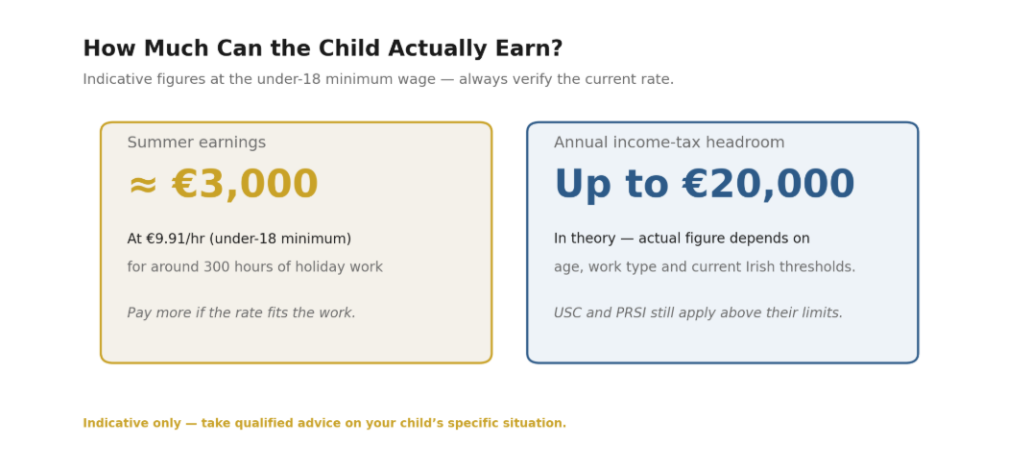
Indicative earnings at the under-18 minimum wage — verify current rates before you set anything in stone.
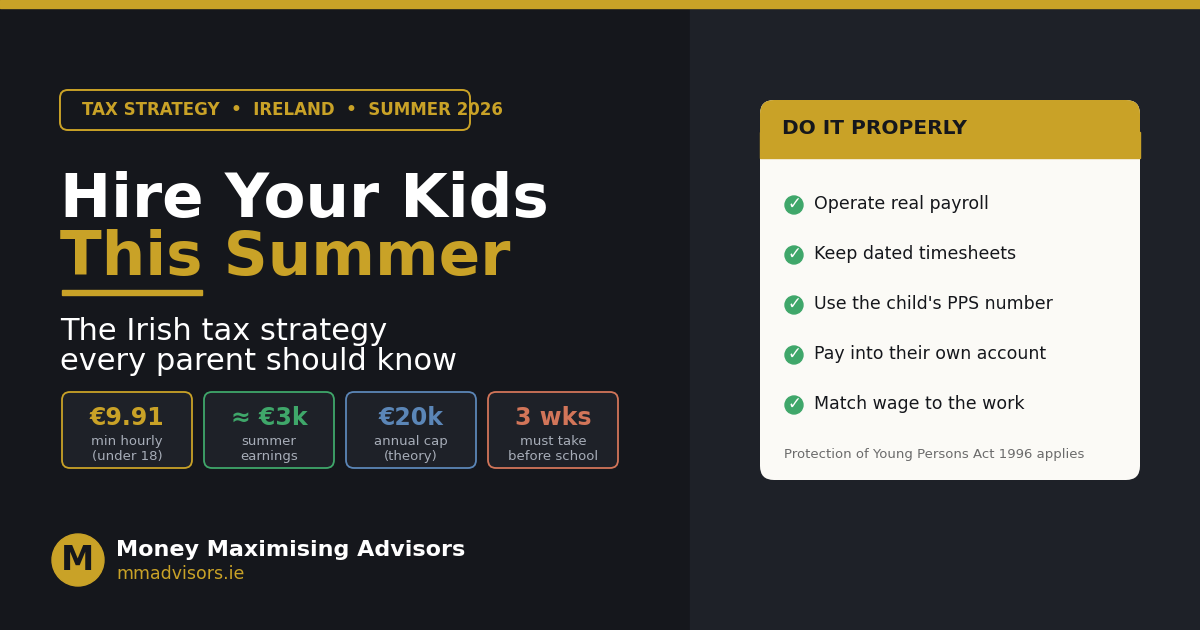
Two numbers matter here. The first is the hourly rate. The national minimum wage for under-18s is roughly €9.91 per hour (the under-18 sub-rate is set as a percentage of the adult minimum wage and is revised regularly, always check the current figure before you process payroll). You can pay more than the minimum if the work justifies it, but a rate that is wildly out of line with what an unrelated teenager would be paid for the same duties will draw attention from Revenue, and rightly so.
The second is the annual ceiling. In theory, an Irish minor can earn up to around €20,000 of income before any income tax bites, once their personal credits and PAYE credits are factored in. In practice, the achievable figure will depend on their age, the type of work they do, and the actual hours allowed under the 1996 Act, plus the working time you have available in your business. At the under-18 minimum wage for roughly 300 hours of summer work, you are looking at around €3,000 of tax-free earnings, and they can keep working modest term-time hours through the school year to top that up.
A very important caveat: “tax-free” in the income-tax sense does not automatically mean free from all deductions. USC and PRSI operate on their own thresholds and can apply even where income tax does not. We will model the full position for your child as part of any Money Management Advice review.
| Run a business and want to set this up properly? Book Now for a free consultation, or Enquire Now and we will be in touch within one working day. |
Compliance: you must do this properly
Revenue treats your child like any other employee. That is good news, it means the strategy is firmly on the right side of the law, but it does mean you have to play by the rules from day one. Five non-negotiables:
1. Operate real payroll
Your child must be registered as an employee with Revenue, and you must run them through your normal payroll process, PAYE, USC and PRSI all administered correctly, payslips issued, returns filed. A handshake and an envelope of cash is not a strategy; it is an exposure.
2. Keep dated timesheets
“Helping out around the place” is not employment. You need contemporaneous timesheets showing the hours your child has actually worked and the tasks completed. If Revenue ever asks (and on family-employment arrangements they do, sometimes), the records have to stand up.
3. Use the child’s PPS number and confirm eligibility
Your child must have their own PPS number (most do from birth) and must be legally entitled to work for their age band. If you do not already have it, your child’s PPS letter is needed before payroll can begin.
4. Pay into the child’s own bank account
The net wage must arrive in an account in the child’s name. Paying it into the parent’s account, or never paying it at all, defeats the entire purpose and looks like a sham employment to Revenue.
5. Match the wage to the work
A reasonable rate for the actual duties performed is the litmus test. A 14-year-old cannot be paid a CEO-level salary for stuffing envelopes once a week. As a rough guide, ask yourself what you would pay an unrelated teenager for the same work, and stay close to that figure.
Where Hire Your Kids fits in your wider family financial plan
HYK is rarely a strategy on its own, it is one strand of a wider family wealth-building plan. The earnings your child receives can be deployed in genuinely valuable ways:
- Long-term savings and investments — a Regular Saver Investment Plan in the child’s name builds a real, compounding pot from age 14 or 15.
- Education funding — ringfenced College Education Savings reduces the bill you will face as a parent in five to ten years’ time.
- Tax-efficient family transfers — the Small Gift Exemption Savings Plan lets you move €3,000 per parent, per child, per year into the same long-term pot, on top of the wage.
- Financial literacy — the most underrated benefit. A teenager who has actually earned, banked and budgeted their own wages has a head-start most adults never get.
If you run a limited company, the planning conversation typically extends to your own pension as well, the same business that can hire your child can fund a Directors Pension for you. The right combination of the two often saves multiples of what HYK alone achieves.
Common mistakes to avoid
From running this strategy with Irish families for years, these are the pitfalls we see most often:
- Treating it as cash-in-hand. Skipping payroll defeats the whole purpose and creates real Revenue risk.
- Paying a wage that doesn’t match the work. Inflated rates for sporadic effort are the single fastest way to lose the deduction on audit.
- Ignoring USC and PRSI. Income tax is only one of three deductions, the others can still apply.
- Forgetting the three-week school break. It is a hard legal requirement, not a guideline.
- Not having a bank account in the child’s name. Open one before payroll starts, not the week after the first payslip.
Most-read guides for Irish parents and business owners
If you found this useful, these are some of the most-visited guides on related topics:
- Small Gift Exemption in Ireland: What Do You Need to Know?
- How Much Money Can You Gift to a Family Member Tax-Free in Ireland?
- College Education Savings Plan Ireland: The 2025 Parent’s Guide
- Inheritance Tax Savings Plans For Children in Ireland: A Complete 2026 Guide
- Smart Tax Planning in Ireland: Legal Ways to Reduce Your Tax Bill in 2026
- Understanding Your Irish Payslip: Breakdown of Deductions and Taxes
Explore our full range
You can dig deeper into the cluster of services and products that sit around this strategy via our Savings & Investments hub, or explore our Pensions, Mortgages, Protection, Public Sector and Inheritance Tax hubs, or learn more about us.
Our Services & Products
Our Services
Our Products
Related posts
- Smart Tax Planning in Ireland: Legal Ways to Reduce Your Tax Bill in 2026
- Saving for Education in Ireland: A Practical Guide for Parents
- Child Savings Plan: Tips to Help You Save for Your Child’s Education in 2026
- How Irish Self-Employed Can Maximise Tax Relief Before October Deadline
Frequently asked questions
Is hiring my own child actually legal in Ireland?
Yes, provided you follow the Protection of Young Persons (Employment) Act 1996, treat the arrangement as a genuine employment relationship and run proper payroll. The strategy is on solid legal footing and is used by many self-employed parents and company directors every year.
What if I am a PAYE employee with no business of my own?
The Hire Your Kids strategy does not apply to you in its simplest form, because there is no employer in your life through which to pay your child a wage. Other vehicles, such as a Small Gift Exemption Savings Plan or a College Education Savings plan, may achieve a similar effect for moving family wealth to children tax-efficiently.
What kind of work can my teenager actually do for my business?
The list is wider than most parents assume: filing, basic admin, social media support, simple data entry, packing orders, shop-floor or front-of-house help during the busy holiday weeks, basic photography or content work, or assisting with deliveries (within the legal hours and the “light work” restrictions for under-16s). The test is always whether the work is real, age-appropriate and reasonably valued.
Do I have to pay USC and PRSI on my child’s wages?
Possibly, USC and PRSI have their own thresholds independent of income tax. For modest summer earnings, USC may not bite, and PRSI Class A rules will depend on weekly income levels. The full picture is always specific to the individual; we model it in any HYK consultation.
Can my child contribute to a pension from these earnings?
In principle, an Irish minor with relevant earnings can hold a PRSA, with a guardian involved in the setup. Whether it makes sense at age 15 or 16 is a planning question — most families prioritise other vehicles first, but it is on the table. Our Pensions Advice team is happy to walk through the options.
Ready to set this up properly?
If you run a business in Ireland, sole trader, partnership or limited company, and you have a son or daughter old enough to do real work in it, the Hire Your Kids strategy can be a quietly powerful piece of family financial planning. We will help you set it up to Revenue’s standard, calculate exactly how much your child can earn tax-efficiently, and fold it into a wider family plan that puts those earnings to work. Book Now for a free consultation, or visit Money Maximising Advisors to learn more about how we work.
Important information
Wage rates, tax credits, USC and PRSI thresholds change from time to time, and the under-18 minimum wage referenced in this article should be verified against the current statutory rate before processing payroll. Money Maximising Advisors Limited is regulated by the Central Bank of Ireland. This article is for general information only and does not constitute financial, tax or legal advice. You should seek personalised advice from a Qualified Financial Advisor and, where appropriate, a tax adviser, before making any decision about employing a family member.