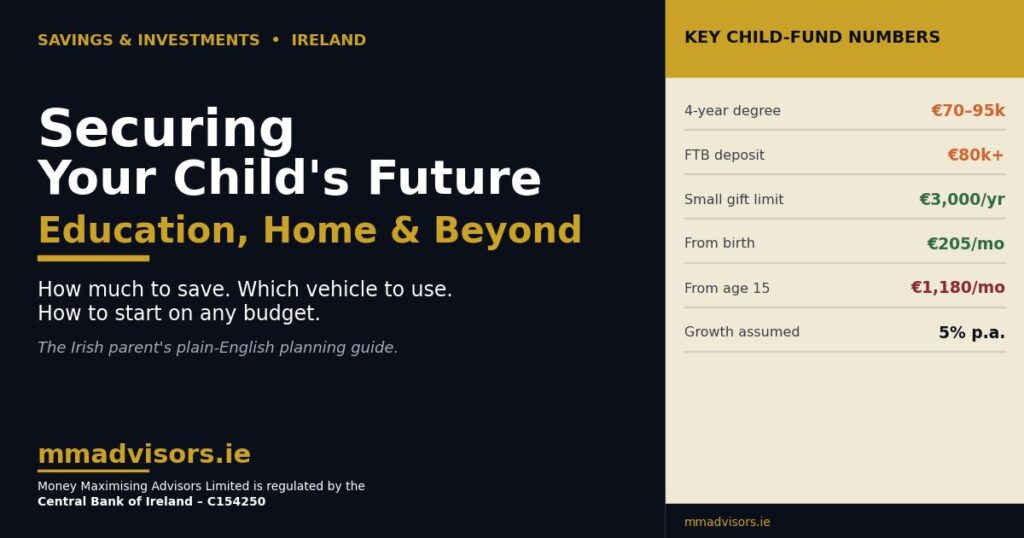
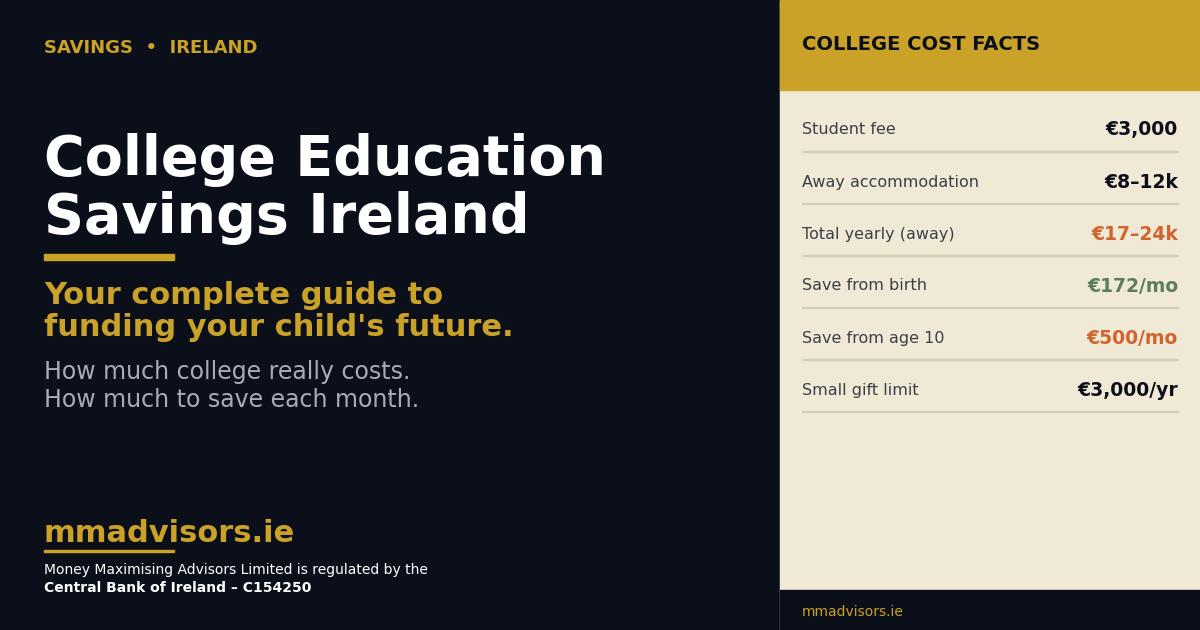
Sending a child to college in Ireland costs more than most parents expect. The student contribution is only the start. Add accommodation, food, books, transport and social costs. A single college year can easily reach €17,000–€24,000 for a student living away from home.
The good news? A small monthly saving, started early, does most of the heavy lifting. This guide from Money Maximising Advisors walks you through what college actually costs, how much to save, and the smartest ways to build the fund.
| QUICK ANSWER A four-year college degree in Ireland typically costs €50,000–€90,000 for a student living away from home, including fees, accommodation and living costs. Starting from birth, saving €172 per month at 5% average annual growth builds a €60,000 fund by age 18. Starting at age 10, you would need to save €500 per month for the same result. |
| This guide connects Irish parents to the vehicles our team arranges most often for college saving: Regular Saver Investment Plans, Lump Sum Investments, the Small Gift Exemption Savings Plan and College Education Savings plans. |
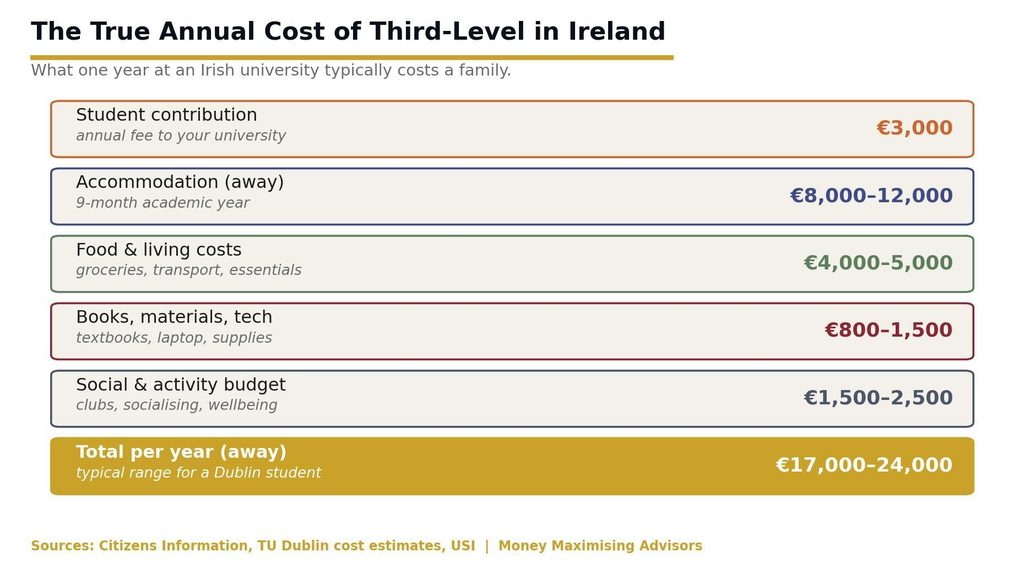
The real cost of one year at an Irish university fees are only the start.
How much does college in Ireland actually cost?
Most parents plan for the €3,000 student contribution. That’s the visible number. But it’s a small share of the real cost of college. Here’s what typically makes up the annual bill for a student living away from home.
Student contribution
The student contribution is currently €3,000 per year for undergraduate students at Irish universities. It’s paid directly to the college. If the household income is below a threshold, part or all of it may be covered by the SUSI grant.
Accommodation (student living away)
This is the biggest cost. Student accommodation whether purpose-built, on-campus digs, or a shared house — typically runs €8,000–€12,000 per academic year for a nine-month lease. Dublin is at the top of this range. Cork, Galway and Limerick sit lower.
Food and daily living
Groceries, transport, phone, toiletries. Realistic budget: €4,000–€5,000 per year for a student cooking most meals themselves.
Books, materials and tech
A laptop, textbooks, printing, software. Typically €800–€1,500 in Year 1 (higher because of the laptop), lower in subsequent years.
Social life and activities
College sports, clubs, socialising, wellbeing. A realistic figure is €1,500–€2,500 per year. This is where students most often ask their parents for help mid-year.
The total: €17,000–€24,000 per year
Add it up. A student in Dublin sharing a purpose-built apartment can easily hit €22,000–€24,000 per academic year. A student in a shared house in Galway or Cork, cooking at home, sits closer to €17,000–€19,000. Over a four-year degree, that’s a total range of €68,000–€96,000 per child.
When should you start saving for college?
The short answer: as early as possible. Time is the single most powerful factor in college saving. Every extra year lets compounding do more of the work and reduces how much you need to set aside each month.
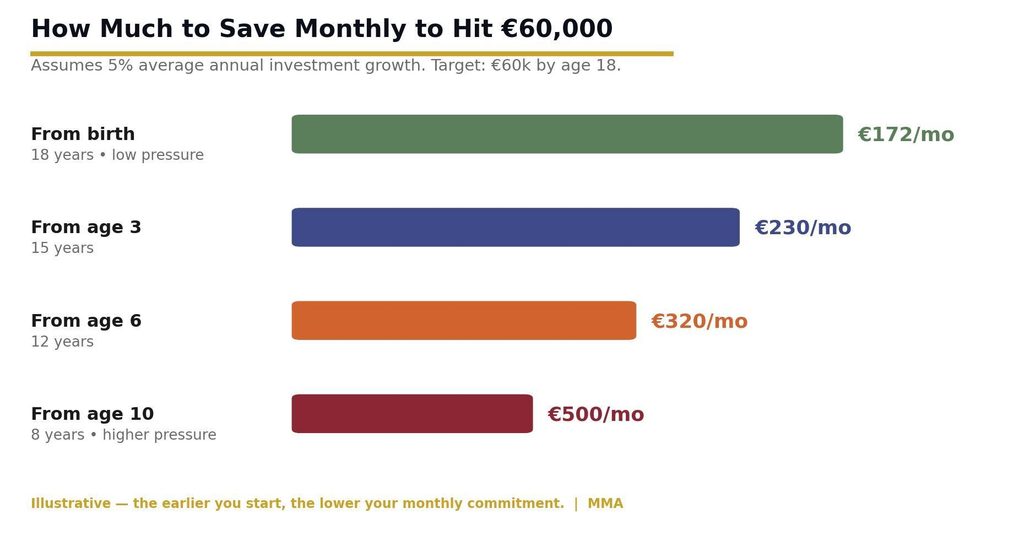
The monthly amount you need to save to hit €60,000 by age 18 falls sharply the earlier you start.
Here’s what it takes to hit a €60,000 fund by your child’s 18th birthday, assuming 5% average annual investment growth:
- Start from birth. €172 per month. 18 years of compounding. Lowest monthly commitment.
- Start at age 3. €230 per month. 15 years.
- Start at age 6. €320 per month. 12 years.
- Start at age 10. €500 per month. 8 years — three times the monthly cost of starting at birth.
The message is simple. Starting late doesn’t mean giving up. It just means the monthly commitment is significantly higher.
What are the main college savings options in Ireland?
There is no single “college savings account” in Ireland. But there are several vehicles Irish parents combine to build a fund. Each one has a role. Most successful plans use two or three together.
Regular saver investment plan
The workhorse. A monthly direct debit into a diversified investment fund. Because the horizon is 10–18 years, most parents can afford to take investment risk and the historical return of a growth-focused fund has comfortably beaten cash savings over that period. See our Regular Saver Investment Plans.
PRSA-linked family savings strategy
A less obvious approach. A parent maximises pension contributions and uses the 25% tax-free lump sum at retirement to help fund college fees. This can work well for higher-rate taxpayers if the parent is planning to retire around the time the child hits college age. The tax relief on pension contributions (40% for higher earners) beats the tax treatment of a regular savings plan.
Small Gift Exemption from grandparents
The best-kept secret of Irish family wealth transfer. Each grandparent can gift €3,000 per year, per grandchild — tax-free, and outside the Group B €40,000 lifetime inheritance tax threshold. Two grandparents gifting two grandchildren for 18 years transfers €216,000 completely tax-free. Structured into a Small Gift Exemption Savings Plan, these gifts compound powerfully.
Lump-sum investments
A one-off deposit — from a redundancy payment, an inheritance, a bonus or the sale of a business — invested for 10–15 years. This works alongside a monthly regular saver rather than replacing it. Our Lump Sum Investments service covers the tax and structure options.
How much should you save each month?
The right amount depends on three things: your target fund size, how many years you have, and how much investment risk you can carry. Here are two typical scenarios we plan with Irish families.
Scenario 1: Save enough to fully cover a Dublin degree
Target: €80,000 over 18 years. Assuming 5% growth, that means €230 per month from birth. Starting at age 5, the required contribution rises to €330 per month. This scenario works best where both parents are stable earners and can absorb the monthly commitment.
Scenario 2: Save enough to cover half the cost
Target: €40,000 over 18 years. This works if you plan to top up from other sources at the time the SUSI grant, student earnings, part-time work, or a lump sum from your pension tax-free amount. The monthly commitment drops to about €115 per month from birth a much lower entry point for most families.
| Want the numbers modelled for your family? Book Now for a free 30-minute review, or Enquire Now we’ll build a personalised college savings plan within one working day. |
The Small Gift Exemption: the smartest wealth-transfer tool
The Small Gift Exemption is one of the most powerful and most under-used legal tools in Irish family finance. Under Revenue rules, any individual can gift up to €3,000 to any other individual, per calendar year, tax-free. It does not use up any part of the lifetime inheritance tax threshold.
How families combine it
A family with two grandparents, two parents, and two children creates twelve annual €3,000 windows (six givers, two receivers, though grandchildren receive from grandparents typically). That is €12,000–€36,000 per year that can move to the college fund tax-free, depending on who is gifting to whom.
Where to put the gifted money
Cash gifts sitting in a deposit account lose real value to inflation. A Small Gift Exemption Savings Plan invests the annual gifts in a diversified fund, allowing them to grow over 10–18 years alongside your own monthly savings.
Investment options for college savings
The right investment mix depends on how many years you have before the money is needed. A common approach uses a “glidepath”: higher-risk assets while the child is young, gradually shifting to safer assets as college approaches.
Years 1–10: growth focus
With 10+ years to go, an equity-heavy fund (80–100% shares) has historically delivered the best long-term returns. Short-term dips do not matter the money will not be needed for a decade.
Years 11–14: balanced approach
As the goal date approaches, gradually shift to a balanced fund (roughly 60% equity / 40% bonds and cash). This reduces volatility as the target date nears.
Years 15–18: capital protection
In the final three or four years, protect what you have built. Move toward cash and short-dated bonds. You want the fund to be available and stable when the college bills arrive. See our Capital Protected Investments for the late-stage options.
What if you can’t save enough?
Not every family can hit a full-cost target. That is okay. Here are the realistic top-up routes when the savings fund falls short.
The SUSI grant
Ireland’s Student Universal Support Ireland (SUSI) grant covers the student contribution (or a portion of it) for households below specific income thresholds. It also provides a maintenance grant. Check eligibility as soon as you know your child is heading to college — the application windows matter.
Part-time work and student earnings
Most Irish undergraduates work part-time during term and full-time in summer. Realistic student earnings of €6,000–€10,000 per academic year can cover a large chunk of living costs.
Pension tax-free lump sum
If a parent will be turning 50 while their child is in college, the pension tax-free lump sum at 50 can provide a substantial one-off amount at exactly the right time. Combined with regular savings, this is one of the most tax-efficient funding routes.
Family gifting from grandparents
Where grandparents are willing and able, the Small Gift Exemption route (above) can top up a shortfall dramatically particularly when combined with a longer-term investment horizon.
Common college savings mistakes Irish parents make
- Waiting until secondary school. Leaving the plan until your child is 12 triples the monthly commitment needed vs starting from birth.
- Keeping the money in cash for 15+ years. Deposit interest rates rarely beat inflation. A diversified investment fund has historically delivered much better real returns.
- Ignoring the Small Gift Exemption. Grandparents often want to help but do not know about the €3,000 tax-free annual gifting window. Unused years are permanently lost.
- Not shifting to safety near the end. A market drop in your child’s final year of secondary school can wipe out three years of gains at the worst possible moment.
- Skipping the pension route. For higher-rate taxpayers, pension contributions with a tax-free lump sum at 50 can be the single most tax-efficient way to fund college.
Related posts
Frequently asked questions
How much does a college degree in Ireland cost?
A four-year Irish undergraduate degree typically costs €50,000–€90,000 for a student living away from home. The main costs are the €3,000 annual student contribution, plus €8,000–€12,000 for accommodation, food, transport, books and social costs.
When should I start saving for my child’s college?
As early as possible. Starting from birth requires roughly €172 per month to build a €60,000 fund by age 18 (assuming 5% average annual growth). Starting at age 10 requires €500 per month for the same result. Every year of delay significantly raises the monthly commitment.
What is the best way to save for college in Ireland?
Most Irish families combine three vehicles: a monthly regular saver investment plan, the Small Gift Exemption from grandparents (€3,000 per year per grandchild, tax-free), and a lump sum invested from an inheritance or bonus. Higher-rate taxpayers should also consider the pension tax-free lump sum at 50.
Can grandparents help pay for college tax-free?
Yes. Under the Small Gift Exemption, each grandparent can gift up to €3,000 per year, per grandchild, tax-free. This does not use up any part of the lifetime inheritance tax threshold. Two grandparents gifting to two grandchildren for 18 years transfers €216,000 tax-free.
Do investment funds beat deposit accounts for college savings?
Historically, over a 15–18 year horizon, yes. Diversified equity investment funds have delivered materially higher returns than deposit accounts once inflation is factored in. Over shorter horizons (5 years or less), investment funds carry more risk of a short-term loss.
Is there tax on college savings in Ireland?
Investment funds are subject to exit tax on gains (currently 41%). Deposit accounts pay Deposit Interest Retention Tax (DIRT) on interest. Pension routes are tax-advantaged. The Small Gift Exemption is entirely tax-free within the €3,000/year/gifter/recipient limit.
Reviewed by our savings and investment team
This guide was prepared and reviewed by the savings and investment team at Money Maximising Advisors, drawing on Citizens Information, USI cost data and TU Dublin published cost estimates for 2026. Money Maximising Advisors Limited is regulated by the Central Bank of Ireland (C154250). Watch our video walkthroughs on the YouTube channel.
Ready to plan your child’s college fund?
Whether your child is a newborn, a toddler or already heading into secondary school, we will build a personalised college savings plan for your family. Book Now for your free consultation, or Enquire Now — we reply within one working day.
Important information
Cost figures are indicative and based on Citizens Information, USI and TU Dublin published cost estimates for the 2025–26 academic year. Investment projections assume 5% average annual growth for illustration; actual returns vary. Money Maximising Advisors Limited is regulated by the Central Bank of Ireland (C154250). This article is for general information only and does not constitute financial, tax or legal advice. The value of investments can fall as well as rise, and past performance is not a reliable indicator of future returns. Speak to a Qualified Financial Advisor before making any investment decision.