Public sector workers in Ireland are among the most attractive mortgage applicants a lender will see. Stable income. Predictable increments. Defined-benefit pension entitlements. This guide from Money Maximising Advisors walks you through exactly how to convert those advantages into a better mortgage deal.
You will see how much you can borrow. You will see which lenders reward public sector employment. And you will see how to prepare your application for the fastest possible approval.
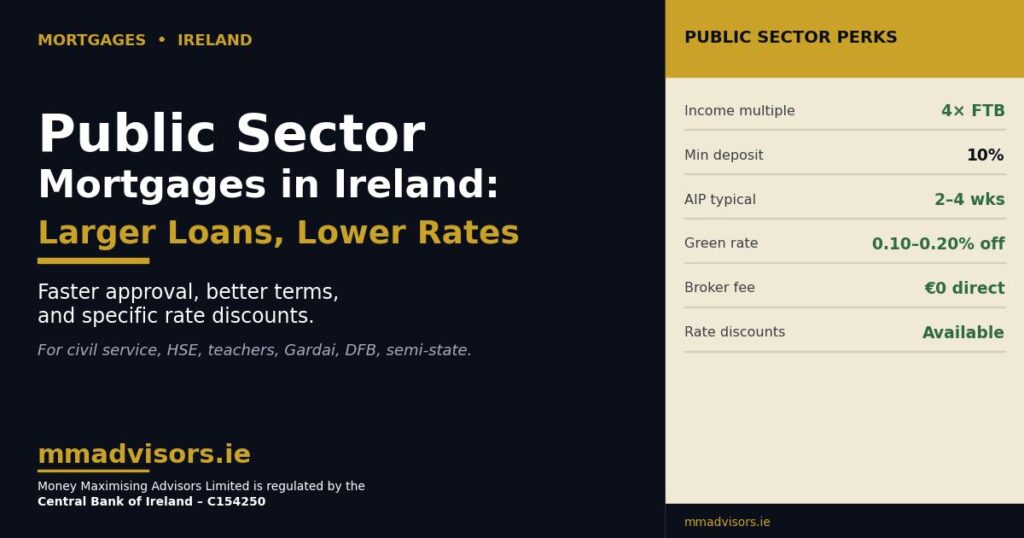
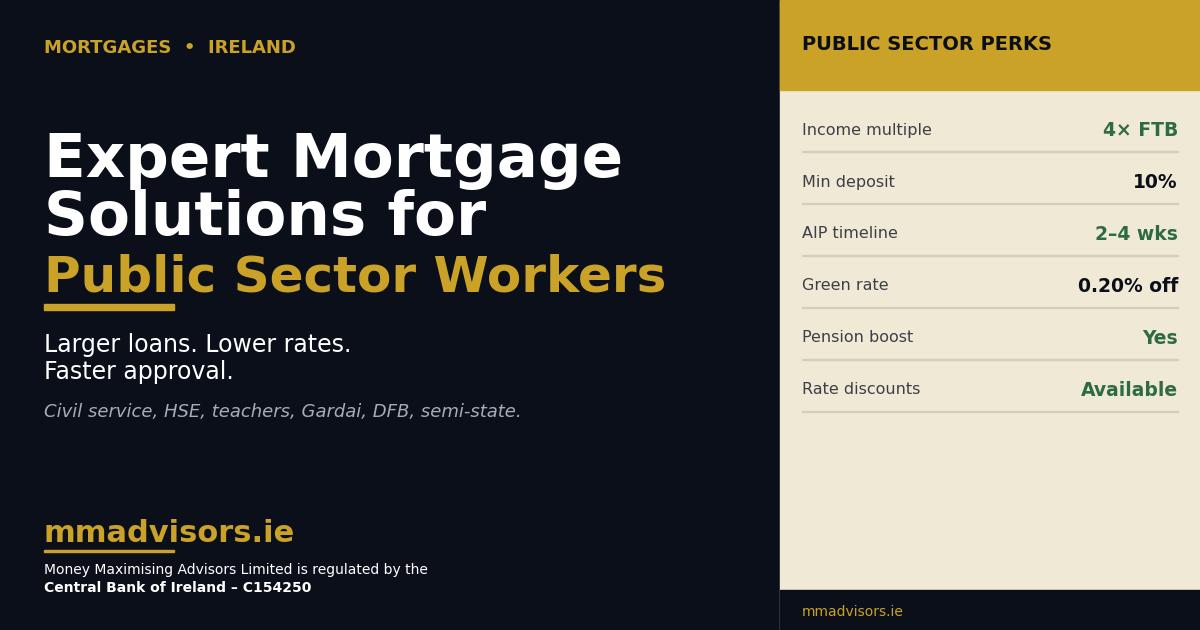
| QUICK ANSWER: Public sector workers in Ireland (civil service, HSE, teachers, Gardai, Defence Forces, local authority and semi-state staff) benefit from three mortgage advantages: faster Approval in Principle (2–4 weeks typical), full 4× income multiple lending (10% deposit for FTBs), and access to specialist rate offers from some lenders. Employment income is straightforward to verify, DB pension entitlements support long-term affordability, and salary progression is predictable, all of which reduce lender risk. |
| This pillar connects Irish public sector workers to Public Sector Mortgages, Public Sector Superannuation Advice, Public Sector AVCs and Public Sector Salary Protection. |
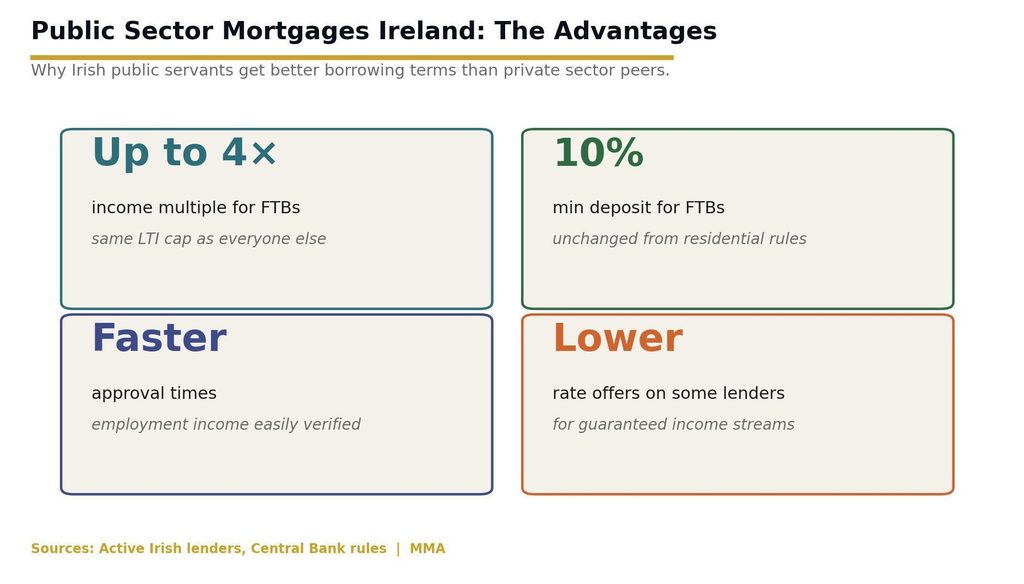
The four ways public sector employment strengthens a mortgage application in Ireland.
Why lenders love public sector applicants
Every mortgage lender assesses two things: can you afford the loan today, and will you still afford it in ten or twenty years’ time?
Public sector employment answers both questions positively. Income is guaranteed by the State. Salary bands are published and predictable. Pension entitlements are defined-benefit, rare and valuable in the private sector today.
This is not marketing spin. It’s straightforward risk management from the lender’s side. Lower risk means better terms for you.
Who qualifies as public sector in Ireland?
Irish lenders recognise a broad range of employment types as “public sector” for mortgage purposes:
Civil Service
All grades from Clerical Officer (CO) up to Secretary General. Includes permanent, contract and Senior Civil Service positions. Departments include Justice, Finance, Foreign Affairs, Health, Education, Social Protection and dozens more.
Education Sector
Primary school teachers, secondary school teachers, third-level lecturers, university staff. Special needs assistants, school secretaries and caretakers under DES schemes.
Health Sector
HSE staff at all grades. Consultants, junior doctors, nurses, midwives, health and social care professionals. Section 38 and 39 organisations funded by the HSE.
Local Government
City and county council staff. Local authority engineers, planners, administrative and outdoor staff. Fire service employees in most authorities.
Defence and Emergency Services
Defence Forces personnel (Army, Air Corps, Naval Service). An Garda Siochana. Dublin Fire Brigade. Coast Guard where PAYE employed.
Semi-State Bodies
ESB, Bord Gais, RTE, Iarnrod Eireann/CIE, Bord na Mona, EirGrid, and dozens of other commercial and non-commercial semi-state bodies.
How much can a public sector worker borrow?
The Central Bank of Ireland macroprudential rules apply equally to everyone. First-time buyers can borrow up to 4× gross income. Movers can borrow up to 3.5×. Minimum deposits are 10% for FTBs and 20% for movers.
Public sector workers don’t bypass these rules. Instead, they hit them more easily. Because their income is fully verified through payroll and pension entitlement is guaranteed, lenders are less likely to trim borrowing at the affordability stage.
A HEO earning €65,000 can borrow up to €260,000 as an FTB. A Garda Sergeant on €72,000 can borrow up to €288,000. A hospital consultant on €220,000 can borrow up to €880,000.
The actual approved amount depends on affordability, existing debt, and stress-testing at 2% above the offer rate.
Where public sector applications win
Three specific areas make public sector applications faster and stronger than private sector equivalents.
Faster Approval in Principle
A well-prepared public sector file typically reaches Approval in Principle within 2–4 weeks. Some straightforward cases complete in under two weeks.
The reason: everything is easy to verify. Salary, service length, contract type and pension entitlement all come from consistent, government-backed documentation.
Pension entitlement recognised
Defined-benefit pension entitlement is factored into lenders’ long-term affordability models. Private sector applicants with defined-contribution pensions don’t get the same treatment.
For older applicants, this matters even more. The DB pension effectively provides income into retirement, extending the age at which lenders will lend. For a full walk-through of these entitlements, see our Public Sector Superannuation Advice service.
Specialist rate offers
A small number of Irish lenders publish specific public sector or professional rate discounts. Others don’t publish it but will offer discretionary preferential terms to public sector applicants.
These preferential terms are rarely visible to individual applicants going direct. A broker with lender relationships often surfaces them.
| Ready to move? Book Now for a free consultation with our public sector team, or Enquire Now, we reply within one working day. |
The 5-step application process
Step 1: Employment verification
Gather your salary certificate, employment contract, most recent three months of payslips, and current P60 or T4. HR teams in most public sector organisations issue salary certificates within a few working days.
Step 2: Pension entitlement review
Request your current pension modeller output. This shows your projected retirement benefits based on service to date and expected years remaining. Lenders use this to assess long-term affordability.
Step 3: Rate comparison
We compare every active Irish lender side-by-side, including broker-only lenders you can’t access directly. Public sector-specific rates and preferential terms are surfaced at this stage.
Step 4: Approval in Principle
Application submitted to the best-fit lender. AIP typically issues in 2–4 weeks for a clean file. Valid for 6 months. This is what you take property-viewing.
Step 5: Full application to drawdown
Once you go sale-agreed on a property, the full application submits. Valuation, structural survey, life cover and solicitor’s undertaking all fall into place over 6–10 weeks. Drawdown on closing date.
Common public sector borrower situations
First-time buyer public servant
Standard 4× income, 10% deposit route. Access to Help to Buy and First Home Scheme. Our team runs the full comparison including public sector-specific offers. See our companion piece on Civil Service Mortgages for the civil-service-specific angle.
Mover trading up
Moving family from a starter home to a forever home. 3.5× income, 20% deposit. Bridging finance may be needed if you’re selling and buying simultaneously, our team coordinates the timing.
Switcher refinancing
Public sector workers with existing mortgages should review rates every 2–3 years. Green mortgage rates for B3+ properties can save €10,000+ over the life of a loan.
Investment property purchase
Public sector workers can also access Buy-to-let Mortgages. Stable rental income affordability and government-backed employment make the case straightforward for lenders.
Protection products that pair well
Every mortgage lender requires life cover before drawdown. Public sector workers should consider two additional products at the same time.
Public Sector Salary Protection covers your salary if illness stops you working. It’s typically cheaper for public sector workers because of sick pay entitlements that reduce claim risk.
Serious Illness Cover pays a lump sum if you’re diagnosed with a listed condition. Arranged alongside mortgage protection, it costs meaningfully less than arranged separately.
Common mistakes public sector applicants make
- Applying directly to one bank. You lose access to broker-only lenders and preferential rates.
- Not requesting the pension modeller output. It’s the single strongest supporting document for a public sector mortgage.
- Ignoring green rate eligibility. A BER of B3 or better unlocks 0.10–0.20% rate discounts.
- Skipping protection until drawdown. Life cover, income protection and serious illness all cost less when arranged together.
- Not switching after 3 years. Public sector workers with equity and improved BER routinely save €2,000+ per year on switching.
Frequently asked questions
Do public sector workers get better mortgages in Ireland?
Yes. Faster approval times, easier access to full 4× income multiples, and specialist rate offers from some lenders. The advantages come from lower risk in the lender’s eyes, stable income, defined-benefit pensions and predictable salary progression.
How much can a public sector worker borrow?
Central Bank rules cap borrowing at 4× gross income for first-time buyers and 3.5× for movers. Public sector workers hit these limits more easily because affordability is easier to prove. A HEO on €65,000 can borrow up to €260,000 as an FTB.
Do public sector workers get lower mortgage rates?
Some lenders offer specific public sector or professional rate discounts. Others apply discretionary preferential terms. A broker with lender relationships surfaces these preferential rates that are often invisible to direct applicants.
What documents does a public sector applicant need?
Salary certificate, employment contract, most recent 3 payslips, most recent P60 or T4, pension modeller output, and 6 months of bank statements. HR teams in most public sector organisations issue salary certificates within a few working days.
How long does a public sector mortgage take?
Approval in Principle typically issues within 2–4 weeks. From sale-agreed to drawdown is usually 6–10 weeks. Total time from first enquiry to keys is typically 3–4 months.
Reviewed by our public sector mortgage team
This pillar was prepared and reviewed by the mortgage team at Money Maximising Advisors, drawing on live lender criteria, Central Bank rules, and public sector applications we complete every week. MMA is regulated by the Central Bank of Ireland (C154250).
Ready to apply? Let’s talk.
Whether you’re a first-time buyer, mover, switcher, or investor, our public sector mortgage team knows exactly how to position your application for the best terms in the market. Book Now for your free consultation, or Enquire Now.
Important information
WARNING: Your home is at risk if you do not keep up payments on a mortgage or any other loan secured on it.
WARNING: You may have to pay charges if you pay off a fixed-rate loan early.
Rates, thresholds and Central Bank rules are correct at time of writing and are subject to change. Money Maximising Advisors Limited is regulated by the Central Bank of Ireland (C154250). This article is for general information only and does not constitute financial advice. Lending criteria, terms and conditions apply.