
Quick answer
A healthy bank balance can create valuable choices for a company director. It can also create false confidence. Before calling cash surplus, the business needs to protect tax, payroll, debt, reinvestment and a reserve for disruption.
Once those commitments are clear, the director can compare four broad uses: retain cash, reinvest in the trade, fund retirement, or invest or extract value. Each route changes access, risk, tax and the balance between company and household wealth.
Define surplus cash carefully
Start with a rolling cash-flow forecast rather than the year-end bank statement. Allow for Corporation Tax, VAT, PAYE, suppliers, annual insurance, loan repayments, planned recruitment and capital expenditure. Consider delayed customer payments and seasonal trading.
The reserve should reflect the company’s actual risk. A consultancy with low fixed costs may differ from a business carrying stock, premises and employees. The board should document why cash is being retained and when the amount will be reviewed.
Option 1: keep an operating and contingency reserve
Cash provides resilience and optionality. It can cover a temporary fall in turnover, repair essential equipment or allow the company to act on an opportunity. The cost is that low-return cash may lose purchasing power over time and some interest may fall within close company surcharge rules.
Separate accounts for tax, operations and contingency can make the purpose of each reserve easier to see. This does not change the accounting treatment, but it can improve decision-making.
Option 2: reinvest in the trading business
Reinvestment might include technology, staff, marketing, premises or an acquisition. The expected return should be assessed against the risk and the director’s wider exposure. A director whose income and wealth already depend heavily on one business may also need diversification outside it.
Not every expense is deductible, and timing matters. The accountant should confirm the treatment. The commercial case should stand on its own rather than being justified only by tax.
Option 3: use suitable employer pension funding
Pension contributions can move retirement wealth away from the trading company. For a PRSA, the current employer limit before benefit-in-kind on an excess contribution is 100% of annual emoluments from that employer. Occupational arrangements follow different funding rules.
A pension is long-term. It should not receive cash needed for the business or household. The chosen contribution should reflect retirement goals, existing benefits, investment risk, charges and future access.
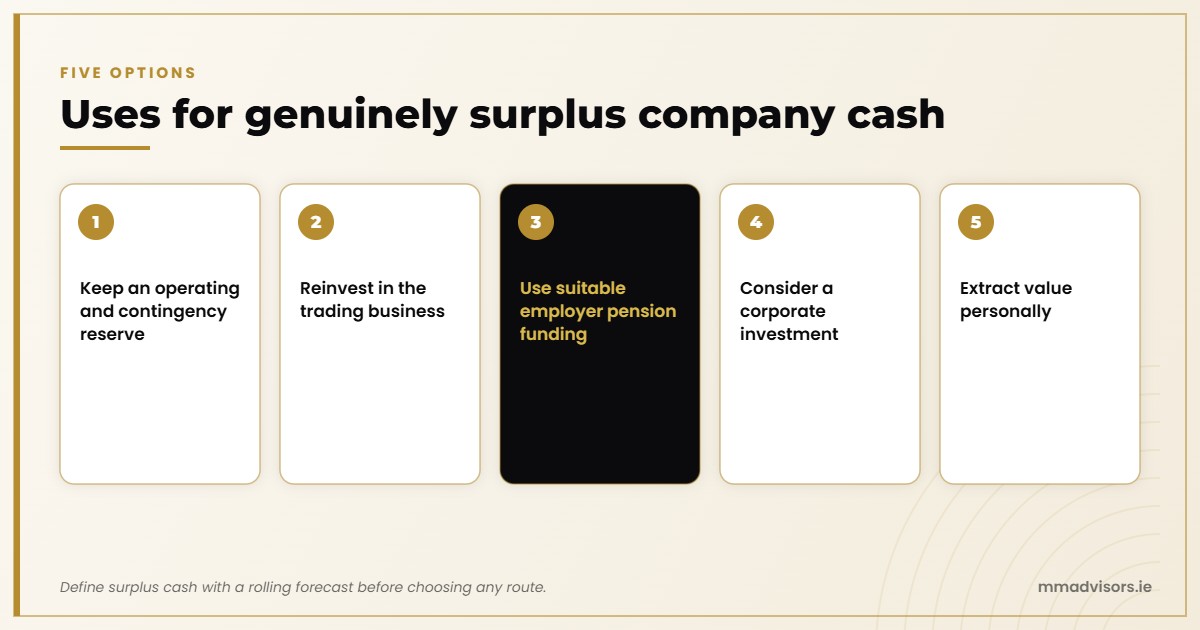
Option 4: consider a corporate investment
A corporate investment may be considered for genuine long-term surplus. The company should understand risk, liquidity, charges, taxation and the later cost of moving value to the shareholder. Investments can fall as well as rise.
Investment assets can also affect close company surcharge exposure and may matter when assessing reliefs on a future sale or transfer. A trading company should obtain tax advice before building a substantial non-trading portfolio.
Option 5: extract value personally
Salary, bonuses and dividends can make funds available to the household. They have different payroll, ownership and tax consequences. Personal extraction may support a mortgage, emergency savings or investments, but the after-tax amount and company affordability must be modelled.
A director loan is not a neutral fifth route. Close company tax charges can arise, and personal expenses paid by the company may create taxable benefits or distributions.
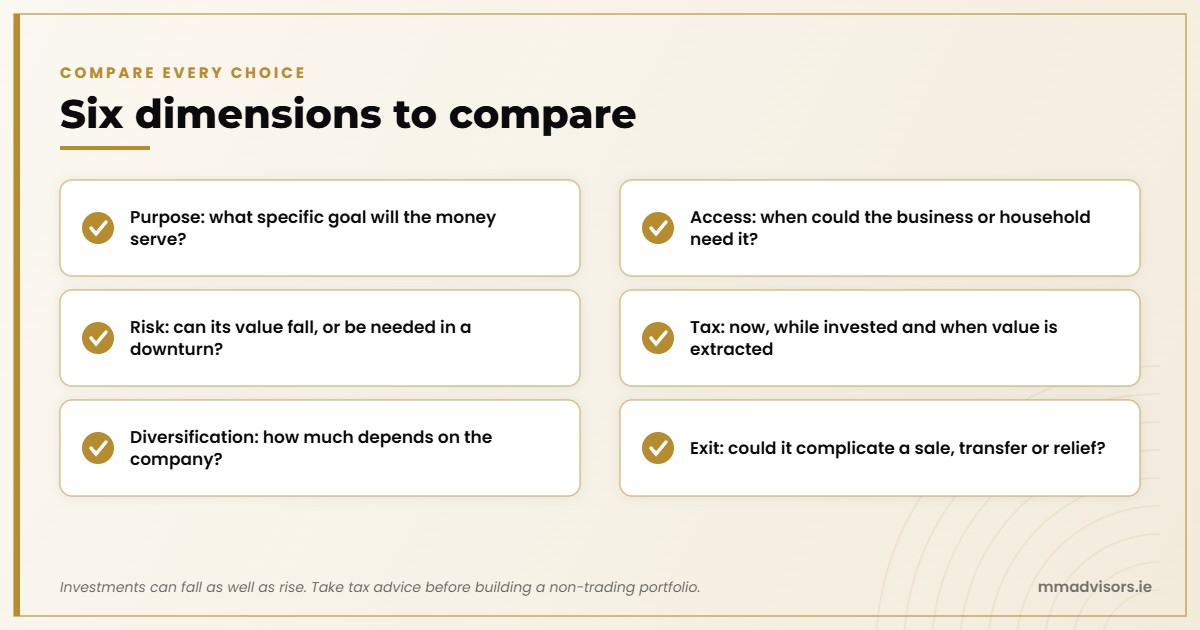
Compare choices across six dimensions
- Purpose: what specific goal will the money serve?
- Access: when could the business or household need it?
- Risk: can its value fall, or could the company need it during a downturn?
- Tax: what arises now, while invested and when value is extracted?
- Diversification: how much of the family’s future already depends on the company?
- Exit: could the asset complicate a sale, transfer or relief claim?
Illustrative director scenario
An owner-director has built up cash after several strong years. The company plans to hire, while the family wants to reduce dependence on a future business sale. The plan keeps a documented operating reserve and protects recruitment costs.
The remaining long-term surplus is divided between suitable pension funding and accessible personal savings. A corporate investment is considered only after the accountant reviews tax and exit implications. The proportions are reviewed annually.
Build a decision calendar
- Update business and household forecasts.
- Meet the accountant before the company year end.
- Review pensions, personal investments and protection with the financial adviser.
- Record board approvals and implement only confirmed transactions.
- Revisit the plan after a major contract, recruitment, borrowing or family change.
The goal is flexibility, not simply extraction
Surplus cash planning should give the director more options over time. That can include a resilient company, a funded retirement, accessible personal wealth and an exit plan that does not depend on one optimistic valuation.
MM Advisors helps directors connect company cash, pensions, investments and family goals. Book a director financial planning consultation at https://financial-planning.mmadvisors.ie/.
How to prepare for an adviser review
Create a 12 to 24 month business cash-flow forecast and a separate household forecast. Stress test delayed customer payments, lower turnover and an unexpected cost. Cash that disappears under a realistic downside case is not suitable for a long-term commitment.
Give each reserve a named purpose and a review date. A tax reserve, operating reserve and planned investment budget should not be treated as one undifferentiated pool. The board can then see what remains after essential commitments have been protected.
Compare the available routes using the same assumptions. Record when the money may be needed, who will own it, whether its value can fall, the likely charges and how it may eventually reach the household. Include the effect on a future sale or family transfer where that is a real objective.
Implement in stages where appropriate. A regular pension contribution or phased investment may be easier to review than one irreversible decision. Keep emergency access outside a pension and do not expose short-term company needs to unsuitable investment risk.
Frequently asked questions
How do I know if company cash is genuinely surplus?
Use a forecast that protects tax, payroll, suppliers, debt, reinvestment and a suitable contingency reserve.
Can I invest cash through my company?
Potentially, but risk, liquidity, taxation, extraction costs, close company rules and exit implications require review.
Can all retained profits go into a PRSA?
No. The company bank balance does not set the employer PRSA limit. The current limit is linked to annual emoluments from that employer.
Is keeping cash in the company always safer?
Cash avoids market volatility but carries inflation, concentration and possible tax considerations. Its purpose and amount should be reviewed.
Should I take a director loan instead?
Do not assume a loan is tax free. Close company rules can impose a tax charge on loans to participators and associates.
Company directors
Book a director financial planning consultation
Related guides
Sources
Important information
General information only. Tax treatment depends on individual circumstances and may change. Investments can fall as well as rise, and you may get back less than you invest. Pension access restrictions apply.