
Quick answer
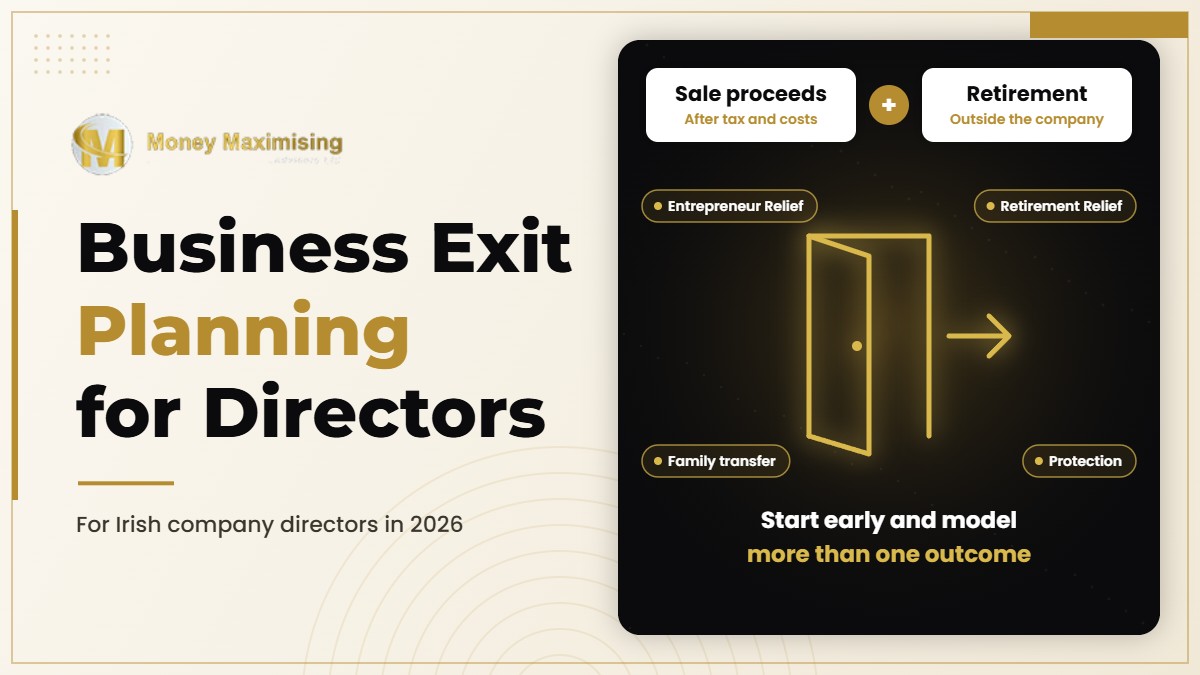
Business exit planning is not only about finding a buyer. A company director also needs to understand the household income that will replace salary, the tax and transaction costs, what happens if the sale is delayed, and how ownership will pass.
Starting early gives the director time to organise records, review pension funding, separate personal goals from business forecasts and obtain specialist tax and legal advice.
Choose the exit you are actually planning for
An exit may be a third-party sale, management buyout, family transfer, phased reduction in hours or closure. Each route produces a different pattern of cash, risk and responsibility. A staged payment is not the same as cash received at completion.
The financial plan should model several outcomes. What if proceeds are lower, paid later or linked to future performance? What if the director remains involved? The household should not commit to spending based on an unverified headline valuation.
Build retirement resources outside the company
A business can be a valuable asset, but it is concentrated and illiquid. Pension funding and accessible personal savings can reduce reliance on one future transaction. They can also provide income if market conditions delay the sale.
Pension contributions need to remain affordable and follow the relevant funding rules. Accessible savings may be needed between stepping back and pension access.
Understand Revised Entrepreneur Relief
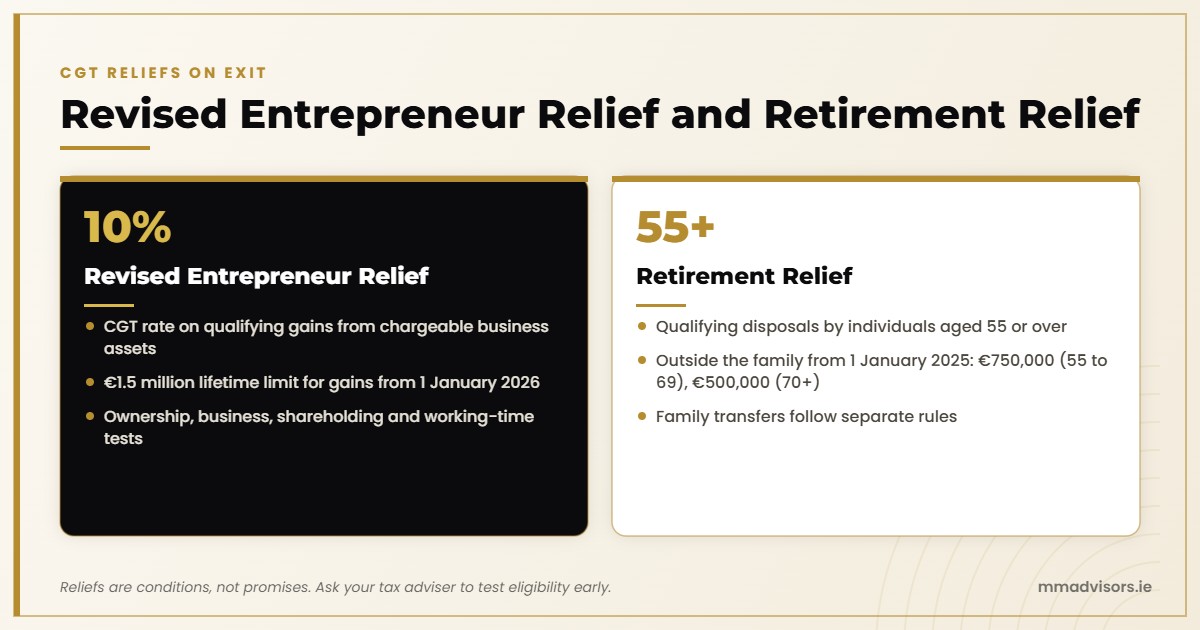
Revenue states that Revised Entrepreneur Relief provides a 10% Capital Gains Tax rate on qualifying gains from chargeable business assets. For qualifying gains arising on or after 1 January 2026, the lifetime limit is €1.5 million.
The relief has detailed conditions. Revenue describes ownership, qualifying business, shareholding and working-time tests. Investment activities and development or letting of land are excluded from the definition of a qualifying business. A director title alone does not establish entitlement.
Understand Retirement Relief
Retirement Relief can apply to qualifying disposals by individuals aged 55 or over, subject to conditions and lifetime thresholds. Its name does not always require the individual to stop working.
For disposals outside the family from 1 January 2025, Revenue states a €750,000 threshold for those aged 55 to 69 and €500,000 for those aged 70 or over. Marginal relief may apply where value exceeds the threshold. Family transfers follow separate rules, including deferral and clawback provisions.
A family transfer can involve several taxes
A transfer may create Capital Gains Tax for the disponer, Capital Acquisitions Tax for the recipient and stamp duty. These taxes and reliefs must be assessed separately.
Revenue’s CAT Business Relief can reduce the taxable value of qualifying relevant business property by 90%. Conditions, ownership periods, excepted assets and clawbacks apply. Surplus investment assets may be excluded from the relief calculation.
Review company assets before the transaction
Property, investments, surplus cash and non-trading subsidiaries can affect valuation and relief eligibility. The correct action depends on commercial and tax facts. Moving assets shortly before a sale can create its own tax or legal problems.
The director should assemble share records, accounts, contracts, debt details, pension information and shareholder agreements. A buyer or family successor will need reliable information.
Protect the plan against disruption
Death or illness before completion can affect ownership, management and family finances. Key person cover, shareholder protection and personal protection may be relevant when supported by suitable legal agreements and ownership arrangements.
A will, enduring power of attorney and documented succession responsibilities may also be important. The solicitor should coordinate these with the company’s constitutional and shareholder documents.
A practical exit planning sequence
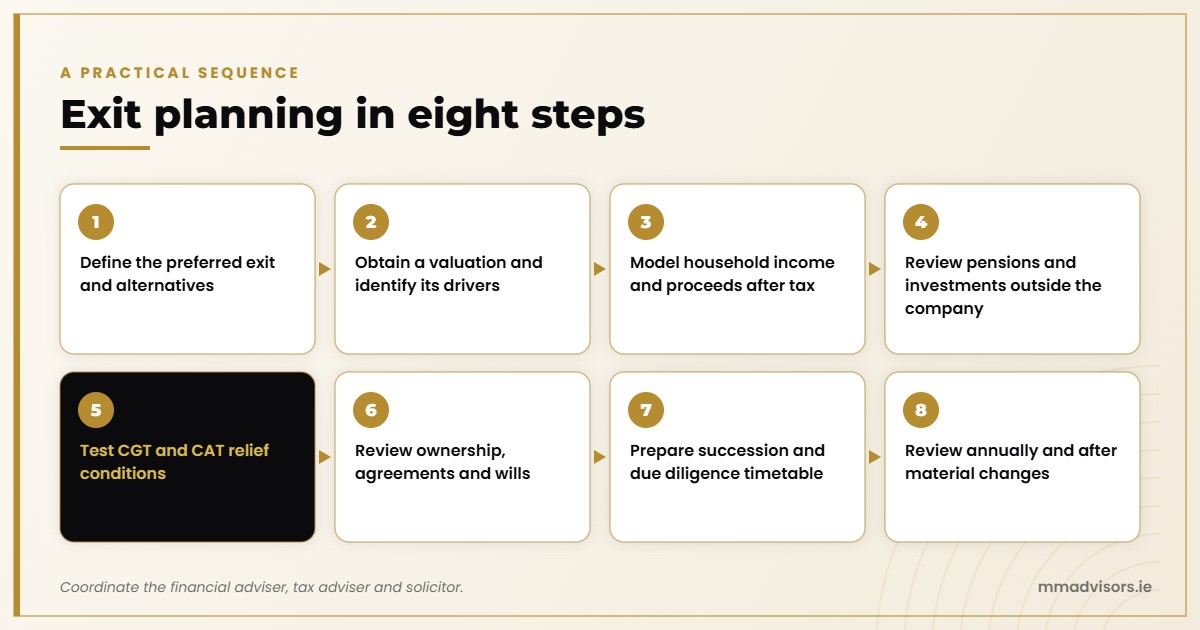
- Define the preferred exit and realistic alternatives.
- Obtain a business valuation and identify what drives it.
- Model household spending, retirement income and sale proceeds after tax and costs.
- Review pensions and accessible investments outside the company.
- Ask the tax adviser to test relevant CGT and CAT relief conditions.
- Ask the solicitor to review ownership, agreements, wills and transaction structure.
- Prepare management succession and a timetable for due diligence.
- Review the plan annually and after a material business change.
Illustrative example
An owner-director in their late fifties hopes to sell to management in four years. The first forecast assumes full payment at completion. A second assumes staged payments and a lower price. The household also models an outcome where the sale takes two extra years.
The director builds retirement resources outside the company, reviews protection and asks tax advisers to assess relief conditions well before a binding agreement. This creates choices even if the preferred transaction changes.
Treat tax relief as a condition, not a promise
Reliefs can materially affect an exit, but they should never be presented as guaranteed. Eligibility depends on the asset, ownership history, business activity, working role, age, recipient and transaction details. Rules may also change before completion.
MM Advisors helps company directors model the personal financial outcome of selling or transferring a business and coordinate with tax and legal advisers. Discuss your plan at https://financial-planning.mmadvisors.ie/.
How to prepare for an adviser review
Prepare a personal balance sheet alongside the company valuation. List pensions, savings, property, debts and expected household spending. This shows the minimum after-tax resources the family needs and how much of the plan depends on the sale.
Write down the preferred transaction and at least two alternatives. Include the expected timetable, payment structure, continuing role and risks. A management buyout with staged payments creates a different household cash flow from a cash sale to a third party.
Ask the tax adviser to test relief conditions against the actual shareholding, ownership period, working role, business activity and assets. Ask the solicitor to review shareholder agreements, warranties, wills and succession documents. Do this before commercial terms become difficult to change.
Set annual milestones for reducing owner dependence, strengthening management, organising records and building retirement resources outside the company. The exit plan should remain useful even when the eventual buyer, price or date changes.
Frequently asked questions
What is the 2026 lifetime limit for Revised Entrepreneur Relief?
Revenue states that the lifetime limit is €1.5 million for qualifying gains arising on or after 1 January 2026.
Does Retirement Relief mean I must stop working?
Not necessarily. The statutory conditions must be met, but the name does not always require actual retirement.
Can CAT Business Relief eliminate inheritance tax?
Do not assume so. It can reduce the taxable value of qualifying business property by 90%, but conditions, thresholds, aggregation and excepted assets still matter.
When should exit planning start?
Ideally several years before the intended transaction, because ownership, business assets, pensions, protection and due diligence can take time to organise.
Who should be involved?
Usually the director, accountant or tax adviser, solicitor, financial adviser and, where relevant, corporate finance or valuation specialists.
Company directors
Book a director financial planning consultation
Related guides
- Company director financial planning
- Financial planning for business owners
- Section 72 inheritance tax planning
Sources
Important information
General information only. Tax treatment depends on individual circumstances and may change. Investments can fall as well as rise, and you may get back less than you invest. Pension access restrictions apply.