Choosing a financial planner is a big decision. The right one saves you thousands over your working life. The wrong one costs you far more. This guide from Money Maximising Advisors explains what a qualified Irish financial planner actually does, and how to pick the right one for your family.
You will see the independent research on the value of advice. You will see the credentials that matter. And you will see the exact questions to ask before you sign anything.
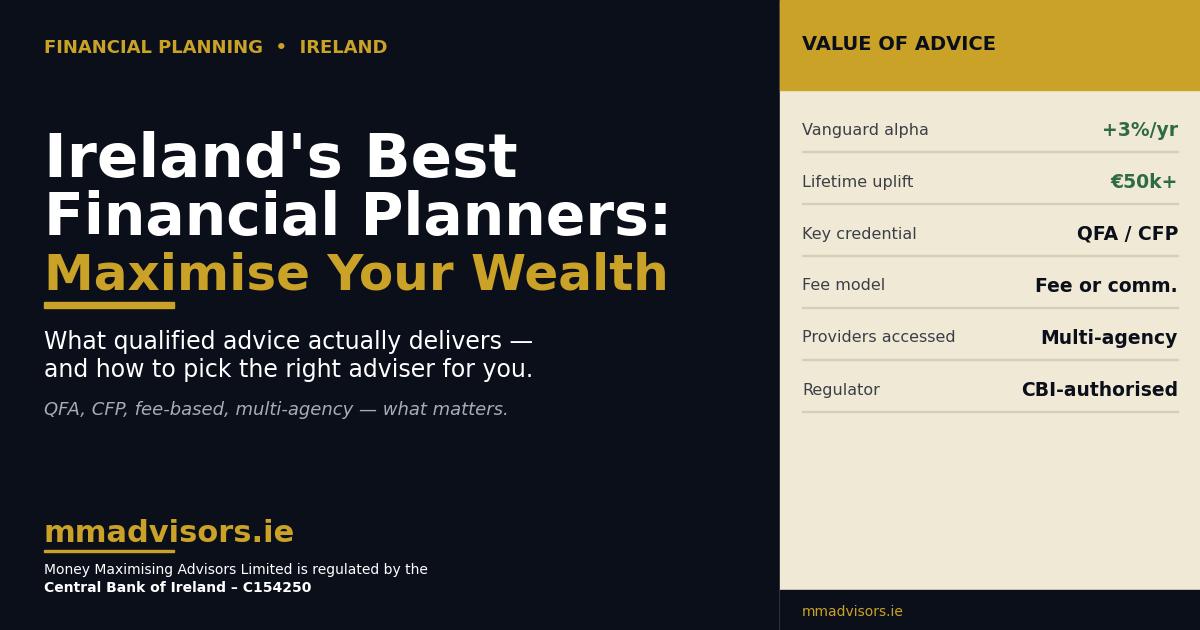
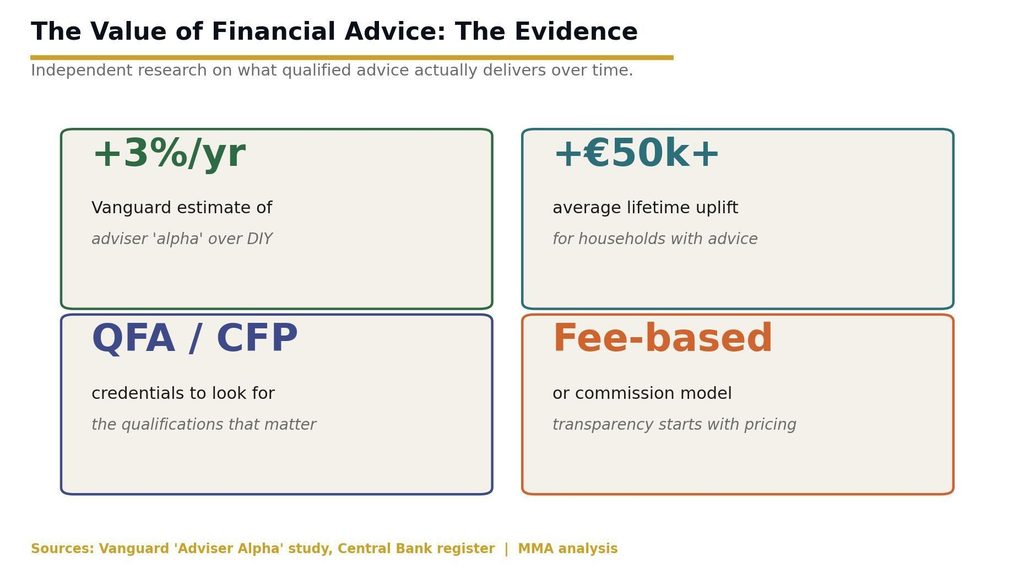
| QUICK ANSWER: Independent research suggests qualified financial advice adds roughly 3% per year to household investment outcomes over time (Vanguard’s “Adviser Alpha” study). This translates to €50,000+ in lifetime uplift for the average advised household. Key credentials to look for in Ireland: QFA (Qualified Financial Adviser) as the baseline, CFP (Certified Financial Planner) for advanced planning, and Central Bank of Ireland authorisation. Fee-based advisers are typically more independent than commission-only ones. |
| This pillar sits at the heart of every service we offer, from Pensions Advice and Retirement Planning Advice to Mortgage Comparison Advice and Inheritance Tax Advice. |
Independent research on what qualified Irish financial advice actually delivers.
What does a financial planner actually do?
This is where most people get confused. A financial planner does not just sell products. A good one runs a five-workstream planning process on a repeating cycle.
Workstream 1: Cashflow and budget forecast
Where are you today. Where will you be in 10, 20 and 30 years. This is the foundation of every good financial plan.
A cashflow forecast shows you exactly when your household hits key milestones: mortgage clear, kids finish college, retirement adequacy, and so on. It also flags shortfalls before they become emergencies.
Workstream 2: Pension and retirement planning
Contribution strategy. Fund choice. Retirement age target. Drawdown model. This is the biggest financial decision most people ever make, and the one they engage with least.
Whether you are early career, mid-career or approaching retirement, Retirement Planning Advice belongs on every household’s annual review. The compounding effect of small changes over decades is massive.
Workstream 3: Protection and risk review
Life cover. Income Protection. Serious Illness Cover. Mortgage Protection. Each covers a different risk. Getting the stack right matters.
Many households have protection they don’t need and don’t have protection they need. A good adviser strips out the waste and fills the actual gaps.
Workstream 4: Tax and estate planning
The Small Gift Exemption. Section 72 Policies. CAT thresholds. Business relief. Retirement lump sums. Every Irish family has tax planning options they haven’t used.
Our Inheritance Tax Advice typically saves families €50,000–€200,000+ over a generation. The techniques are legal, straightforward, and widely used, they just require someone to point them out.
Workstream 5: Investment structure
Fund allocation. Provider choice. Cost audit. Tax-wrapper selection. Choosing between a PRSA, an occupational scheme, an execution-only platform, or a lump sum investment.
The lowest-cost provider is not always the best fit. Nor is the highest-cost. The right structure depends on your goals, timeframe and tax position.
The evidence: does financial advice actually pay?
Vanguard’s long-running Adviser Alpha study estimates that qualified advice adds around 3% per year to household investment outcomes. That is not from stock-picking. It comes from behavioural coaching, tax-efficient structuring, and disciplined rebalancing.
Three per cent per year sounds modest. Compounded over a 30-year working life, it produces €300,000+ of additional wealth on a typical retirement pot. For higher-income households, the number climbs into the millions.
Other independent studies (from Morningstar and the ILC-UK) reach similar conclusions. Advised households consistently save more, invest more efficiently, and reach financial goals earlier than DIY households.
What credentials should you look for?
Ireland has a well-regulated financial advice market. Every adviser you engage should be authorised by the Central Bank of Ireland. That’s non-negotiable.
QFA, Qualified Financial Adviser
The baseline professional qualification for retail financial advisers in Ireland. QFA-holders have passed exams in six core areas including regulation, life assurance, pensions, and investment. This is the minimum.
CFP, Certified Financial Planner
A globally-recognised advanced qualification. CFP-holders have completed additional study and typically demonstrate multi-year planning experience. This is the mark of a full-service financial planner.
Chartered / RPA
Retirement Planning Adviser (RPA) and Chartered Financial Planner qualifications indicate deeper expertise in specific specialisations. Chartered advisers have completed additional academic study.
Central Bank register
Every Irish adviser is on the Central Bank of Ireland’s public register. You can check your adviser’s authorisation, permissions, and any regulatory history in seconds. Do this before you engage anyone.
| Want a genuine first review? Book Now for a free 30-minute consultation, or Enquire Now, we reply within one working day. |
Fee-based vs commission-based: which is better?
This is the single most important structural question in Irish financial advice.
Fee-based advisers
You pay the adviser directly, typically an hourly rate, a flat project fee, or a percentage of assets under advice. Product providers pay no commission. The adviser has no financial incentive to recommend one product over another.
This model is more transparent. It aligns adviser and client interests. It’s the standard model in the US and UK for higher-value households.
Commission-based advisers
Product providers pay the adviser a commission when you buy a product. You may pay nothing directly, but the commission is embedded in the product cost.
This model has an inherent conflict of interest. That said, many highly ethical commission-based advisers work brilliantly for clients. Regulation requires them to disclose commission and act in the client’s best interest.
The practical answer
For simple product purchases (a single life policy, a single mortgage), commission-based advice is often perfectly appropriate and cheaper for you upfront.
For ongoing multi-workstream planning, fee-based (or a fee + reduced commission model) usually delivers better outcomes over decades.
How to choose the right planner: six questions to ask
Question 1: Are you QFA and/or CFP qualified?
A yes to QFA is the minimum. A yes to CFP indicates a full-service planner. If either answer is unclear, move on.
Question 2: How are you paid?
A good adviser explains their fee structure clearly and upfront. They should be comfortable stating exactly what they earn from your account.
Question 3: How many providers do you access?
A multi-agency broker accesses the full Irish market. A tied agent represents only one provider. The former will find you better value; the latter will only sell what they have.
Question 4: What does your annual review look like?
The real value of financial advice is in the ongoing plan, not the initial sale. A serious adviser has a documented review process.
Question 5: Are you authorised by the Central Bank of Ireland?
Verify on the public register. Any hesitation here is a red flag.
Question 6: Can I speak to two of your clients?
A confident planner welcomes this request. A hesitant one may not have long-term relationships.
Common mistakes people make with financial advice
- Choosing an adviser based only on lowest cost. The cheapest advice is rarely the best value. Focus on outcomes over decades, not fees in the first year.
- Skipping the annual review. A one-off plan gets stale within 12–18 months. Life changes, markets change, tax rules change.
- Only reviewing one product. Pension without protection review misses income risk. Mortgage without tax planning misses inheritance efficiency.
- Not asking about commissions. Regulation requires disclosure. If you don’t ask, you may not fully understand what you’re paying.
- Trusting AI or automated tools alone. Automated planning is useful for framing. It cannot replace judgement on your specific tax, family and goals situation.
Frequently asked questions
What does a financial planner do in Ireland?
A qualified financial planner covers five workstreams: cashflow forecast, pension and retirement planning, protection and risk review, tax and estate planning, and investment structure. The value comes from an integrated plan reviewed and updated annually.
How much does financial advice cost in Ireland?
Fee-based advisers typically charge €150–€300 per hour or a flat project fee of €1,000–€3,000 for a household plan. Commission-based advisers may charge no upfront fee but earn commission on products sold. Ongoing review fees for fee-based advice typically run 0.5–1.0% of assets under advice.
Is a financial planner worth it in Ireland?
Independent research (Vanguard, Morningstar, ILC-UK) suggests qualified advice adds roughly 3% per year to household investment outcomes over time. For a typical Irish household, this translates to €50,000+ in lifetime uplift. The value is in behavioural coaching, tax-efficient structuring, and disciplined execution.
What qualifications should an Irish financial planner have?
Baseline: QFA (Qualified Financial Adviser) plus Central Bank of Ireland authorisation. For full-service planning: CFP (Certified Financial Planner) or Chartered Financial Planner qualifications. Verify all authorisations on the Central Bank register before engaging.
How do I choose a financial planner in Ireland?
Check credentials (QFA/CFP), verify Central Bank authorisation, ask how they’re paid, ask how many providers they access, review their annual planning process, and ask to speak to existing clients. Fee-based advisers are typically more independent than commission-only ones.
Do I need a financial planner if I have a good pension already?
Possibly. A good pension is one workstream of five. A financial planner also reviews protection stack, tax efficiency, cashflow, and investment structure, all of which affect long-term outcomes independently of your pension.
Reviewed by our planning team
This guide was prepared and reviewed by Money Maximising Advisors, drawing on Vanguard Adviser Alpha research, Morningstar advice-value studies, and Central Bank of Ireland regulatory guidance. MMA is regulated by the Central Bank of Ireland (C154250).
Ready for a genuine plan? Let’s start.
Whether you’re building your first pension, buying your first home, planning your inheritance, or reviewing your whole household plan, our team maps every option and helps you choose. Book Now for your free consultation, or Enquire Now.
Important information
Research references (Vanguard, Morningstar, ILC-UK) describe average outcomes for advised households across specific samples, individual results vary. Investment returns are not guaranteed. The value of investments can fall as well as rise, and past performance is not a reliable indicator of future returns. Money Maximising Advisors Limited is regulated by the Central Bank of Ireland (C154250). This article is for general information only and does not constitute financial, tax or legal advice. You should always verify an adviser’s authorisation on the Central Bank register before engagement.