Quick answer
An investment can meet a financial goal and still feel unsuitable if it conflicts with your values. For Muslim doctors and families in Ireland, Sharia compliant investment planning may involve screening what companies do, how they are financed and how the investment is overseen.
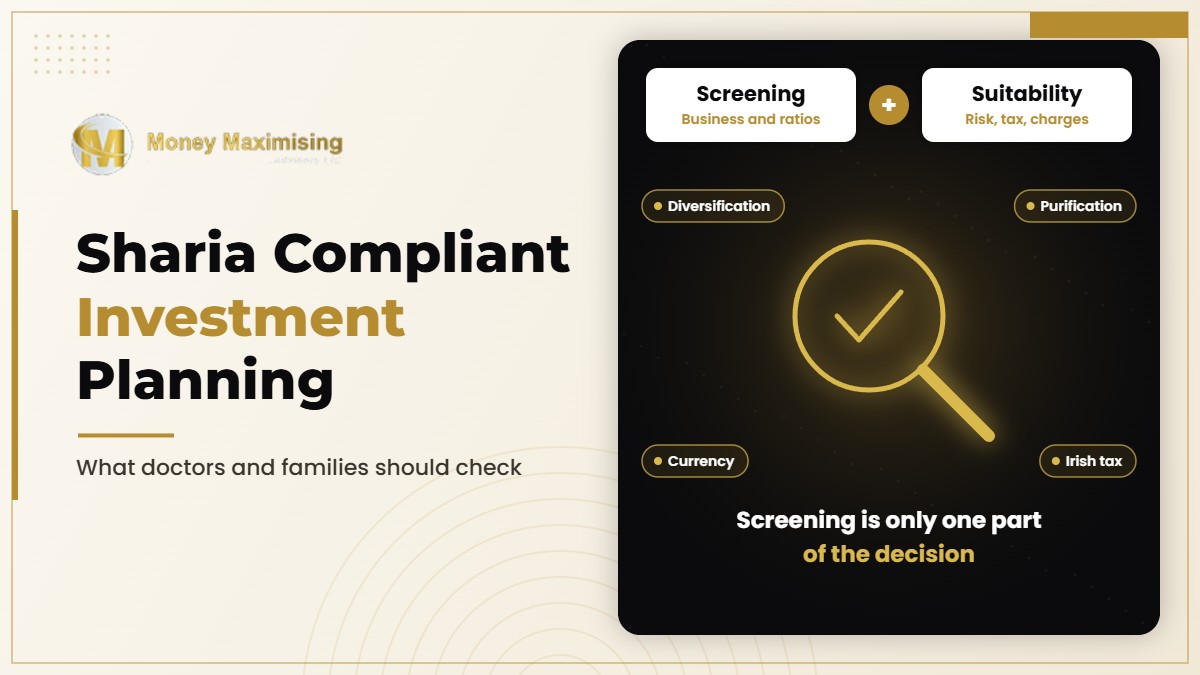
Screening is only one part of the decision. You must still consider risk, diversification, access, charges, currency and Irish tax treatment. Availability can also differ between personal investments, pensions and providers.
This guide explains the questions to ask. It does not make a religious determination or recommend a particular fund. Review the fund’s methodology and provider information, and involve your preferred religious adviser where appropriate.
What Sharia compliant investing aims to do
Sharia compliant investing seeks to align investment decisions with Islamic principles. Funds or indices generally apply rules that exclude certain business activities and assess financial characteristics.
The precise methodology can differ. A fund may follow an index provider’s rules, use a Sharia supervisory board or refer to a recognised standard. Two funds with similar names can therefore hold different companies.
Do not rely on the word “Islamic” or “Sharia” in a product name. Read the stated methodology, oversight and current holdings. Ask who sets the standard, how often screening occurs and what happens when a holding no longer meets the criteria.
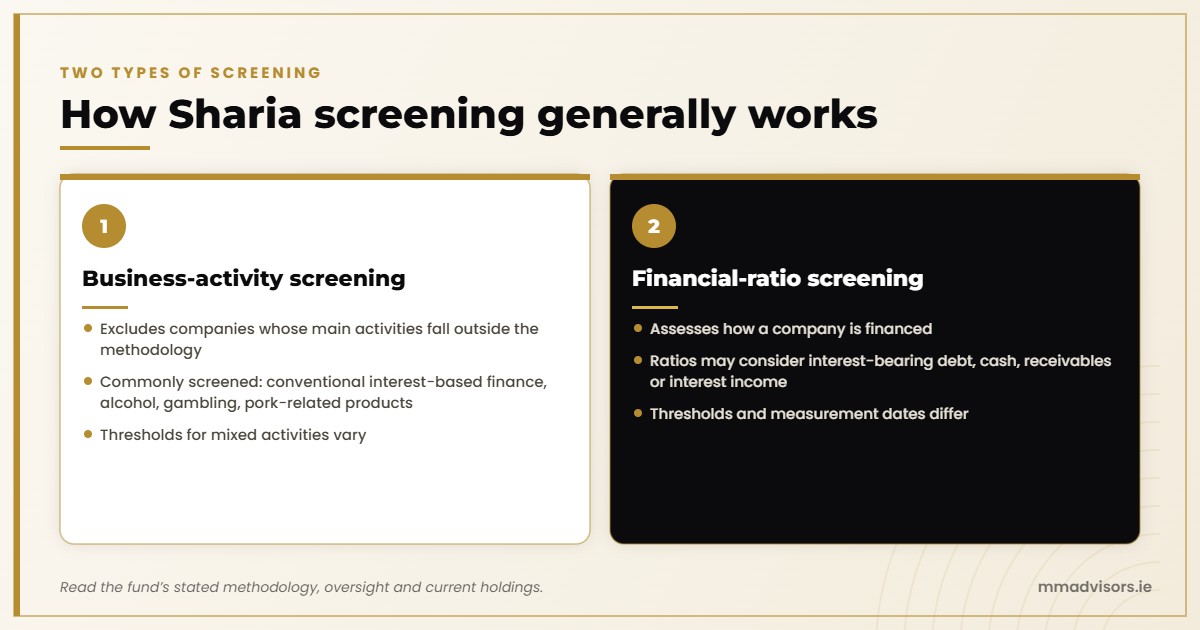
Business-activity screening
Business screening generally excludes companies whose main activities fall outside the methodology. Commonly screened sectors can include conventional interest-based finance, alcohol, gambling, pork-related products and other restricted activities.
The treatment of mixed business activities can vary. Methodologies may use thresholds for income that arises from a non-compliant source. The threshold and calculation basis should be checked in the provider or index documents.
This creates an important limitation. Screening does not mean every investor or religious adviser will reach the same conclusion. The methodology should be transparent enough for you to assess it with suitable guidance.
Financial-ratio screening
Many methodologies also assess how a company is financed. Ratios may consider interest-bearing debt, cash, receivables or income from interest. The permitted thresholds and measurement dates can differ between standards.
Financial screening can affect the shape of a portfolio. Excluding conventional financial companies and businesses with particular balance-sheet characteristics may create sector, style or regional differences from a broad market index.
These differences can influence performance and risk. A Sharia screened fund may outperform or underperform an unscreened market over different periods. Compliance with its stated methodology does not guarantee a return.
Who oversees the screening?
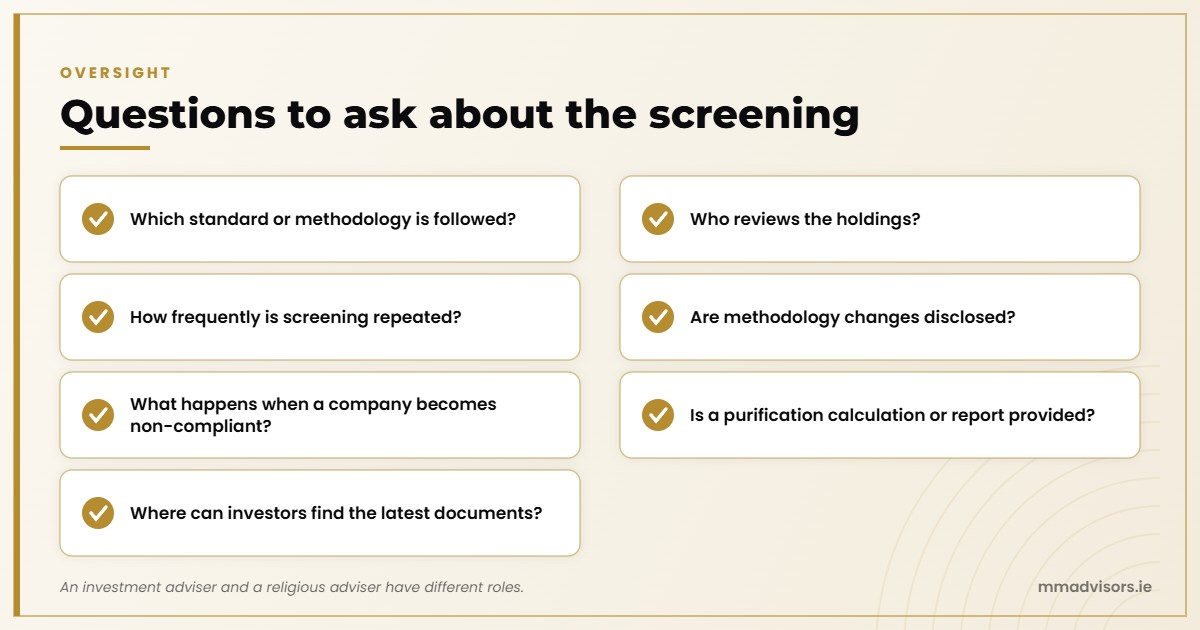
Check the roles of the fund manager, index provider and any Sharia board or adviser. Useful questions include:
- Which standard or methodology is followed?
- Who reviews the holdings?
- How frequently is screening repeated?
- Are methodology changes disclosed?
- What happens when a company becomes non-compliant?
- Is a purification calculation or report provided?
- Where can investors find the latest documents?
An investment adviser can explain the financial structure and suitability. A preferred religious adviser can help you assess whether the stated approach meets your own requirements. These are different roles.
Purification guidance
Some Sharia investment methodologies identify a small amount of income that may require purification. The provider may publish a figure, calculation or process for investors.
Do not assume every fund handles this in the same way. Ask whether purification is carried out within the fund or left to the investor. Confirm what information is provided and how frequently it is updated.
Tax, charitable giving and religious treatment should not be conflated. Obtain the appropriate guidance for each question.
Diversification still matters
A fund can hold many companies and still be concentrated. Screening may reduce exposure to certain sectors and increase exposure to others. A portfolio can also be concentrated by country, currency, company size or investment style.
Review:
- The number and size of holdings.
- Sector and geographic exposure.
- Dependence on a small group of large companies.
- Emerging-market or specialist exposure.
- Currency exposure relative to euro spending needs.
- How the fund fits with other pensions and investments.
Diversification can reduce reliance on one holding or market, but it does not prevent losses. The CCPC advises investors to consider their goals, time horizon, personal circumstances and attitude to risk before investing.
Understand the investment structure
Sharia screened exposure may be offered through a fund or exchange-traded fund. An ETF is a fund whose shares can be traded on an exchange. The label does not by itself describe the investment risk, tax treatment or level of advice.
Read the current Key Information Document and fund documents. Check the objective, index, risks, charges, dealing arrangements and recommended holding period. Confirm whether the product and provider are regulated and available to investors in Ireland.
Most online trading platforms provide an execution-only service. They carry out your instruction but do not provide advice or assess whether the investment is suitable for you. An advisory service should consider your circumstances before making a personal recommendation.
Charges and tracking differences
Charges reduce the return received by the investor. Consider the fund’s ongoing charge as well as platform, advice, transaction, custody and currency-conversion costs where applicable.
An index-tracking fund may not deliver exactly the same return as its index. Charges, taxes, trading costs, cash holdings and the timing of changes can create a difference. Ask how closely the fund has tracked its stated benchmark over suitable periods.
A lower charge does not automatically make one option more suitable. Compare the methodology, exposure, service, access and total cost.
Currency risk
Many Sharia screened funds invest outside the euro area. The underlying companies may earn revenue in several currencies, and the fund’s trading currency may differ from the currency exposure of its assets.
A euro-denominated share class does not necessarily remove currency risk. Currency movements can increase or reduce the return experienced by an Irish investor.
Consider the currency of the goal as well as the investment. A family expecting to spend the money in euro should understand how foreign exchange can affect the amount available.
Irish tax treatment needs a product-level check
Irish tax treatment can vary according to the legal form, domicile and ownership structure of an investment. Funds, ETFs, direct shares, pension investments and company-owned investments may be taxed differently.
Do not select an investment only from its pre-tax performance. Ask which tax regime applies, when a liability can arise and what reporting is required. The correct treatment should be confirmed for the actual product and investor.
Company investment adds another layer. The company’s business needs, tax treatment and the eventual cost of extracting money for personal use must be considered. Company cash needed for tax, payroll or short-term commitments should not be placed at inappropriate investment risk.
Can Sharia compliant investments be held in a pension?
Potentially, but availability depends on the pension arrangement, provider and platform. A fund available for a personal investment account may not be offered within a particular pension.
The pension wrapper also has its own contribution, access and benefit rules. Sharia screening does not change those rules. Review the investment choice alongside existing public-sector benefits, AVCs, private pensions and the expected retirement date.
Ask whether the available option provides suitable diversification and whether it can be changed if the methodology, provider or your circumstances change.
Match the investment to a real goal
Begin with the purpose of the money. A long-term retirement goal can tolerate a different level of access and market movement from a house deposit or near-term education cost.
Define:
- The goal and expected date.
- The amount already available.
- The regular or lump-sum contribution that is affordable.
- The loss you can financially and emotionally tolerate.
- The access required before the goal date.
- The other pensions, savings and investments already held.
Only then compare suitable Sharia screened options. Values-based investing should still be disciplined financial planning.
Questions to ask before investing
- What exact Sharia screening methodology applies?
- Who oversees and reviews the methodology?
- How are non-compliant holdings removed?
- Is purification guidance provided?
- What sectors, regions and currencies dominate the fund?
- What are the total charges across the fund, platform and advice service?
- How is the investment taxed in Ireland?
- Can it be held in the required pension or account?
- What access restrictions apply?
- How does it fit the rest of the family financial plan?
Frequently asked questions
Does Sharia compliant mean low risk?
No. Screening concerns compliance with the stated methodology. The investment can still fall in value and may have concentration, market, currency and liquidity risks.
Are all Sharia screening methods the same?
No. Index providers, boards and scholars can apply different standards, thresholds and review processes. Check the actual methodology.
Does MMA decide whether an investment is religiously compliant?
An adviser can explain the product, methodology, financial risks and suitability. Your preferred religious adviser can help assess whether the approach meets your personal religious requirements.
Can I use a Sharia compliant ETF in my pension?
Possibly. Availability differs between pension providers, schemes and platforms. Pension access and contribution rules still apply.
Does a Sharia screened investment make my mortgage or insurance Sharia compliant?
No. Investment screening applies to the investment. A conventional bank account, mortgage or insurance policy requires separate consideration.
Sources
Next step
Sharia compliant investing should sit within a plan for your goals, liquidity, pensions, family and risk. Learn more about financial planning for doctors and consultants.
Doctors and consultants
Review your investment plan with an advisor
Important information
General information only. Investments can fall as well as rise, and you may get back less than you invest. Product availability, tax treatment and pension access depend on individual circumstances and may change.
Money Maximising Advisors Ltd is regulated by the Central Bank of Ireland. C154250.