

Quick answer
A spouse or family member may make a real contribution to a medical practice. They might manage appointments, support bookkeeping, coordinate patients, handle administration or oversee suppliers. Where the work is genuine and needed, paying them can be a legitimate business expense and part of the household plan.
That does not mean income can simply be moved between family members. The role, pay, payroll treatment and records must reflect what actually happens. PRSI treatment can also differ according to the business structure and family relationship.
This guide outlines the questions to work through with your accountant, payroll adviser and financial adviser. It is general information and does not determine the correct tax, employment or PRSI treatment for a particular family.
Start with genuine work and a business need
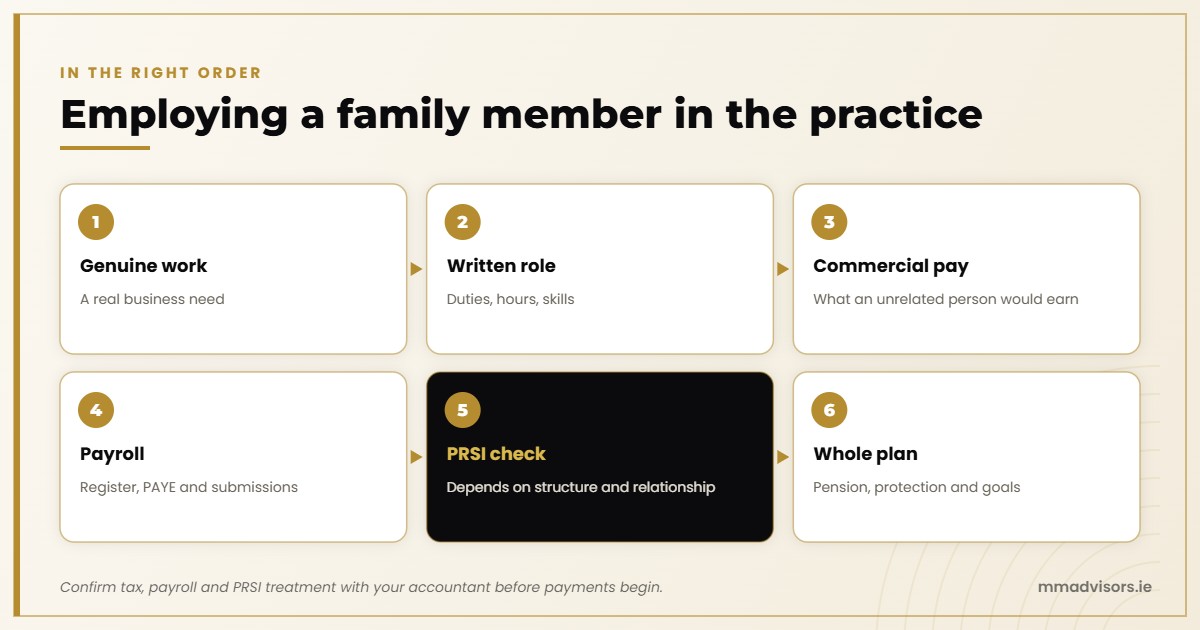
The first question is not how much tax might be saved. It is whether the practice needs the work and whether the family member genuinely performs it.
Revenue’s guidance on family wages recognises that spouses and other relatives can work in a business. It also states that a deduction is available only where the expense is incurred wholly and exclusively for the trade or profession. Pay must be bona fide and commensurate with the duties undertaken.
Examples of genuine work could include:
- Managing appointments and diaries.
- Bookkeeping or preparing records for the accountant.
- Patient administration and coordination.
- Ordering supplies and dealing with service providers.
- Managing correspondence or practice systems.
- Cleaning or other operational work where genuinely required.
The examples do not create an automatic entitlement to a deduction. The facts, necessity and amount of the payment still matter.
Write down the role before setting pay
A written role description helps separate a genuine job from an informal family arrangement. Record the main duties, expected hours, location, reporting responsibility and skills required.
Then consider what the practice would reasonably pay an unrelated person for comparable work. Relevant factors can include experience, responsibility, hours and local market rates. A senior practice-management role should not be described as occasional administration, and occasional help should not receive a full-time commercial salary.
Keep the role under review. Duties can grow or reduce as the practice changes. Pay should not remain disconnected from the work performed.
Pay must be real and properly recorded
A bookkeeping entry alone is not the same as genuine remuneration. Payment should follow the agreed arrangement and be supported by payroll and bank records.
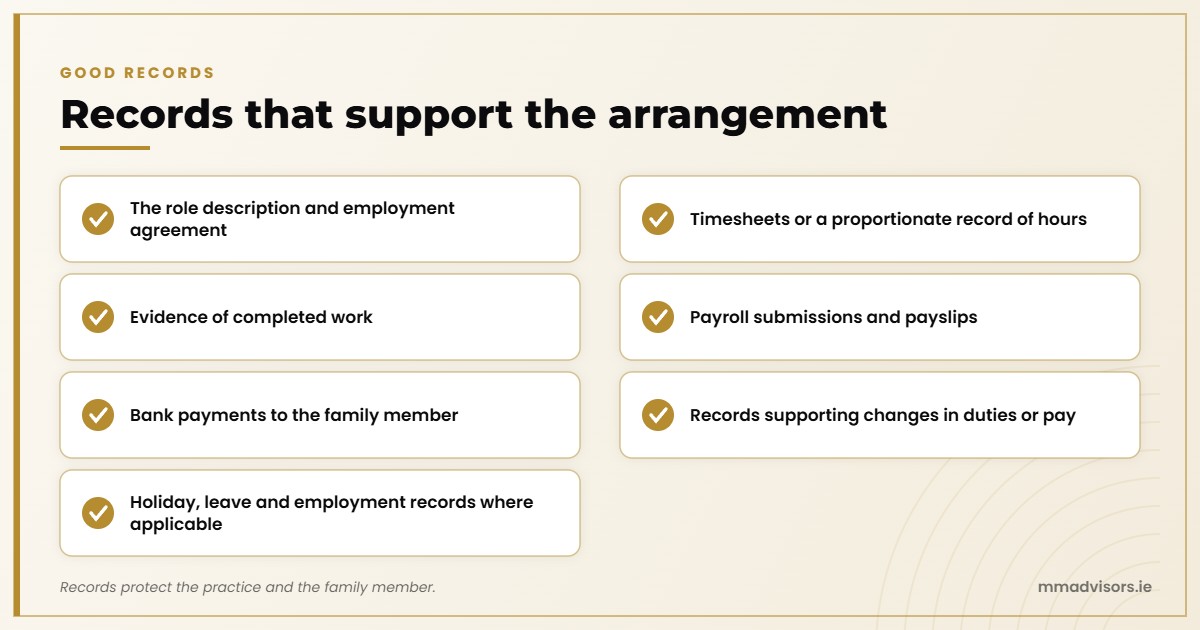
Useful records may include:
- The role description and employment agreement.
- Timesheets or another proportionate record of hours.
- Evidence of completed work.
- Payroll submissions and payslips.
- Bank payments to the family member.
- Records supporting changes in duties or pay.
- Holiday, leave and employment records where applicable.
Good records protect both the practice and the family member. They can also help clarify pension eligibility, income evidence for a mortgage and access to social-insurance benefits.
Operate payroll correctly
Where the arrangement is an employment, the practice may need to register as an employer, operate PAYE and make payroll submissions. Income Tax, USC and PRSI treatment depend on the facts and current rules.
Do not assume that a family connection removes normal employer obligations. Employment law, minimum pay, working time, leave and age restrictions may apply. A child or young family member can raise additional employment-law issues.
The accountant or payroll adviser should confirm the correct treatment before payments begin. Correcting a poorly structured arrangement later can be more difficult than establishing it properly at the outset.
Why PRSI needs a separate check
Department of Social Protection guidance describes specific family-employment situations involving a self-employed sole trader or businessperson and certain relatives. The rules are not the same in every structure.
The Department states that employment by a limited company or a partnership is not family employment for this purpose because the employment relationship is with the company or partnership. Sole-trader arrangements can produce different outcomes. The relationship between the people, the nature of the work and whether there is a contract of service can all matter.
Do not select a PRSI class from a general article. Ask the payroll adviser or the Department of Social Protection to confirm the position where there is uncertainty. An incorrect classification can affect contributions and access to benefits.
Can employing a spouse reduce the household tax bill?
It may change the household tax position, but there is no automatic saving. The result depends on both partners’ income, available credits, rate bands, USC, PRSI and other circumstances.
The practice must first establish that the work and pay are commercial. Tax treatment follows the real arrangement. Paying an amount that is excessive for the duties can put the business deduction at risk.
The spouse’s other income also matters. Someone who already has employment income may use tax credits and rate bands differently from someone with no other earnings. Joint assessment does not remove the need to operate payroll correctly.
This is why the household calculation and the business deduction should be reviewed together with the accountant. A tax saving should never be presented as guaranteed.
Pension planning for a spouse working in the practice
Genuine employment and earnings may create pension-planning opportunities, subject to the arrangement and pension rules. The appropriate option depends on whether the practice is a sole trade, partnership or company, the spouse’s employment status, existing pensions and the affordability of contributions.
Employer pension contributions and personal pension contributions follow different rules. Do not assume that unused pension allowances can be transferred between spouses. Personal tax relief normally requires qualifying earnings for the person making the contribution.
Pension funding should also be proportionate to the wider household plan. Consider emergency savings, practice reserves, mortgage plans and each partner’s retirement position. A pension for one spouse should not be treated as a substitute for the other spouse’s financial security.
Include the spouse in the whole financial plan
Pay is only one part of the decision. A joined-up plan should also consider:
- Who owns personal, joint and business assets.
- How each partner accesses money.
- Whether both partners have adequate protection.
- What happens during illness, leave or a practice interruption.
- Each partner’s pension and PRSI record.
- Mortgage evidence and future borrowing plans.
- Wills, enduring powers of attorney and succession planning.
A spouse who contributes unpaid caring work may still need to be fully included in financial decisions. Employment in the practice should reflect real business work, not an attempt to place a value on every household contribution through payroll.
What if a child or another relative works in the practice?
The same foundation applies: real work, a business need, commercial pay and proper records. Additional restrictions can arise for younger workers, and their other income can affect tax treatment.
Confidentiality and patient information also require attention in a medical setting. The practice should provide suitable training, access controls and supervision. A family relationship does not reduce professional or data-protection responsibilities.
Where a relative performs occasional work, the arrangement should still be clear. Do not create a regular salary without evidence of regular duties.
Questions to ask before employing a family member
- What work does the practice genuinely need?
- Would we engage someone else if the relative were unavailable?
- What duties, hours and responsibilities will be documented?
- What is a commercial rate for this work?
- Is the person an employee, partner or working under another genuine arrangement?
- Which payroll, PRSI and employment-law rules apply?
- How will work and payments be evidenced?
- What effect will the income have on the household tax position?
- Is pension funding appropriate and affordable?
- How does the arrangement affect protection, borrowing and retirement plans?
Common mistakes to avoid
- Setting pay by reference to a hoped-for tax result rather than the work.
- Paying a salary where no genuine duties are performed.
- Using an informal transfer without payroll or evidence.
- Assuming one PRSI class applies to every family business.
- Ignoring employment law because the worker is a relative.
- Funding a pension before confirming employment and scheme eligibility.
- Treating company or practice money as household money.
Frequently asked questions
Can I pay my spouse from my medical practice?
Potentially, where the spouse performs genuine work required by the practice and the pay is commercial for the duties. Payroll, tax, PRSI and employment obligations must be confirmed.
Is the salary automatically deductible?
No. Revenue states that family wages must be wholly and exclusively for the trade or profession, bona fide and commensurate with the duties undertaken.
Which PRSI class applies to my spouse?
It depends on the business structure, relationship and actual working arrangement. Family-employment rules can differ between sole traders, partnerships and limited companies. Obtain a case-specific determination where needed.
Can the practice make pension contributions for my spouse?
That depends on the genuine employment, business structure, pension arrangement, remuneration and current pension rules. The contribution must also be affordable and appropriate within the household plan.
Can I employ my child?
Potentially, for genuine work and commercial pay. Age restrictions, employment law, payroll, PRSI and record-keeping must be checked. The role must also respect medical-practice confidentiality and professional obligations.
Sources
Next step
The decision to employ a spouse should fit the practice, payroll and household plan. Explore financial planning for doctors and consultants to see how business income, pensions and family finances can be considered together.
Doctors and consultants
Plan pay, PRSI and pensions for your practice
Important information
General information only. Tax, payroll, PRSI, employment and pension treatment depend on the actual arrangement and may change. Confirm the position with the appropriate professional or authority.
Money Maximising Advisors Ltd is regulated by the Central Bank of Ireland. C154250.