Quick answer
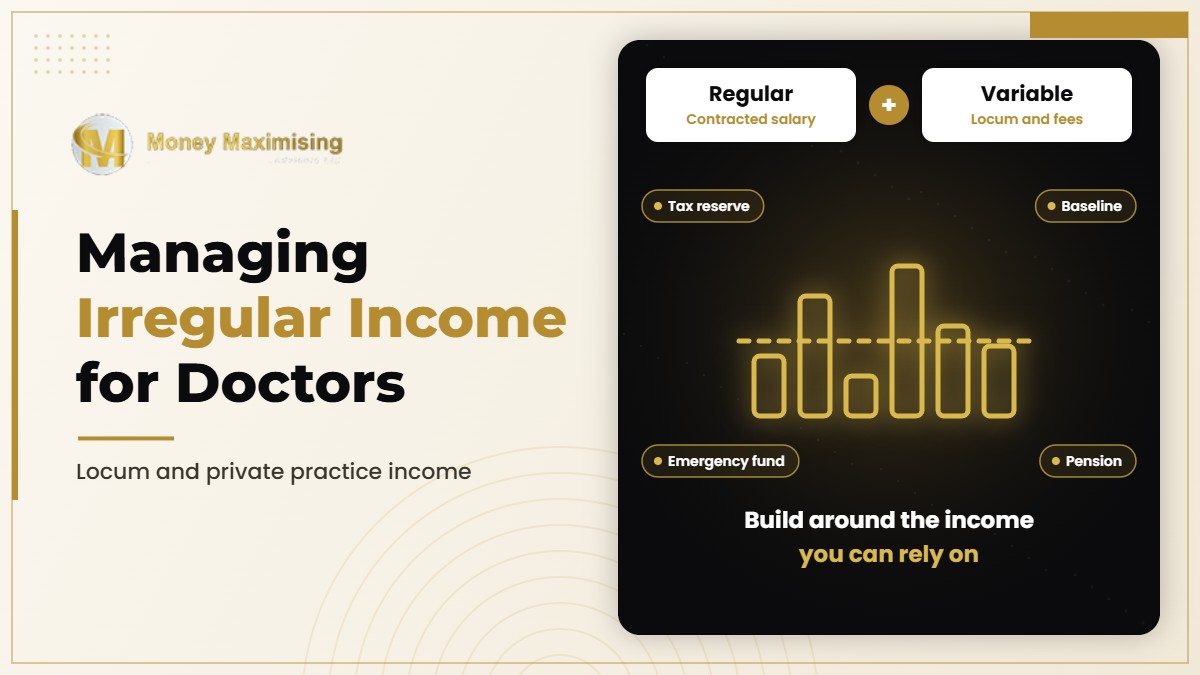
Irregular income can make a strong annual total feel surprisingly difficult to manage. A doctor may receive a dependable hospital salary, variable overtime, locum payments, private-practice fees and company remuneration at different times. Some money belongs to the business, some must be reserved for tax, and only part is available for household spending.
The solution is not a standard percentage or a complicated collection of accounts. It is a clear system built around the income you can rely on, the liabilities you must meet and the goals that matter to your family.
This guide explains a practical approach to cash-flow planning for doctors and consultants in Ireland. It is general information. Tax reserves and payment dates should be confirmed with your accountant.
Receipts, profit and personal income are different
Start by identifying what each payment represents. Money arriving in a practice account is not automatically personal income. It may need to cover practice expenses, payroll, tax, professional costs or future commitments.
For a sole trader, taxable profit is broadly the income of the trade after allowable business expenses, subject to the applicable tax rules. For a limited company, company funds remain separate from the director’s personal money. Salary, dividends or other payments must be made and recorded correctly.
Confusing these categories can create two problems. The household may spend money needed by the practice, and the practice may appear cash-rich even though significant liabilities are approaching.
Create a simple map of:
- Public or private employment income.
- Locum income and its employment or business structure.
- Private-practice receipts.
- Business expenses and payroll.
- Personal remuneration from a company.
- Tax liabilities and payment dates.
- Household commitments and goals.
The map should show ownership as well as timing.
Separate regular, variable and uncertain income
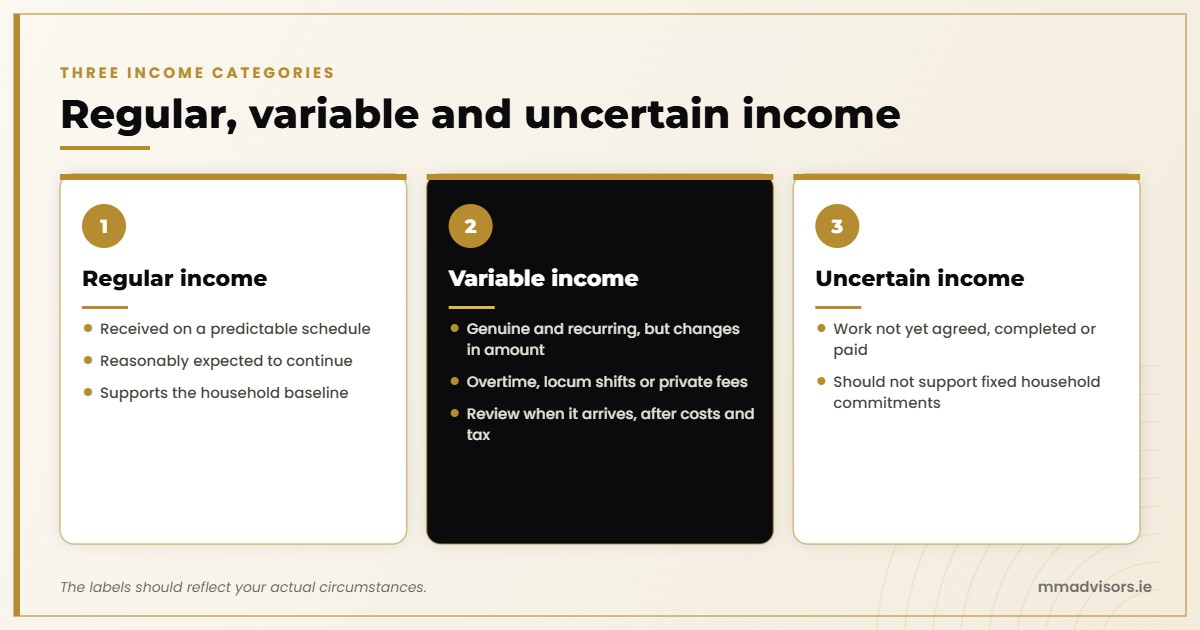
Not every recurring payment is equally dependable. Divide income into three useful categories.
Regular income is received on a predictable schedule and is reasonably expected to continue. A contracted salary may belong here.
Variable income is genuine and recurring but changes in amount. Overtime, locum shifts or private fees may fall into this category.
Uncertain income depends on work that has not yet been agreed, completed or paid. It should not support fixed household commitments.
The labels should reflect your actual circumstances. A long history of locum work may still be variable, while a new allowance may be less dependable than it first appears.
Build the household baseline from the most reliable net income. Treat variable income as available for review when it arrives, after costs and tax have been allowed for. This reduces the risk of committing to spending that requires every strong month to continue.
Give each account a clear purpose
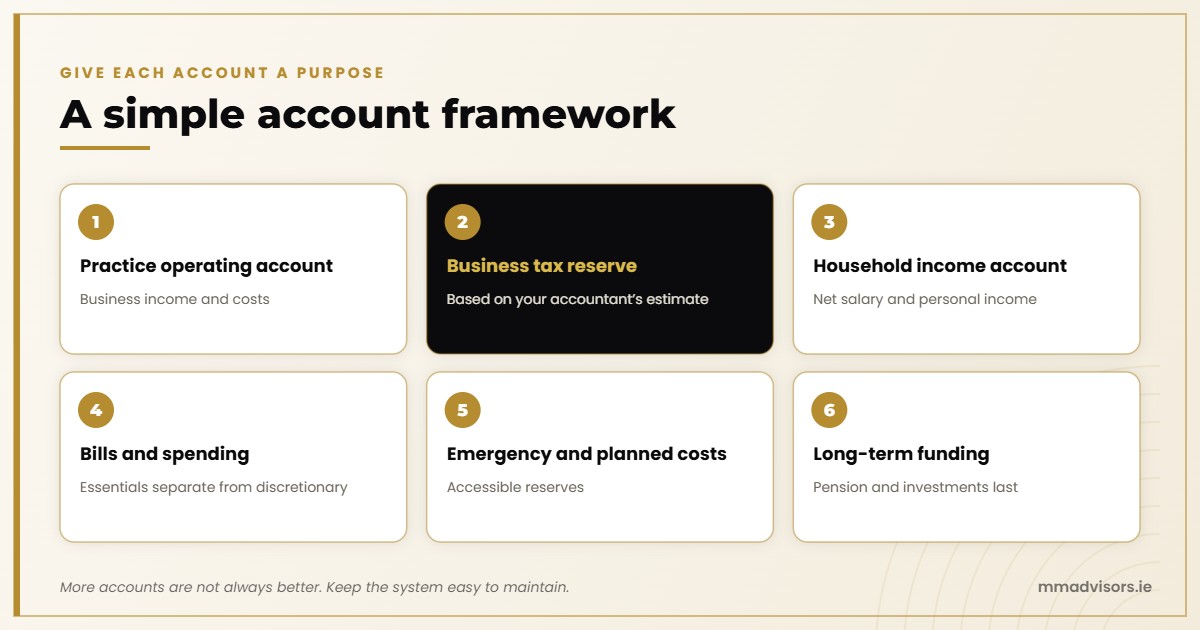
Separate accounts can make the system easier to operate, although the exact setup depends on your bank and business structure. A typical framework may include the following.
Practice operating account
Receive business income and pay genuine business costs. Limited-company funds remain in the company’s name. Avoid using this account for personal spending.
Business tax reserve
Hold an amount based on your accountant’s current estimate for relevant liabilities. This could include Income Tax, Corporation Tax, payroll liabilities, VAT where applicable, PRSI and USC. The correct amount depends on the structure and facts.
Household income account
Receive net salary and other properly paid personal income. Agree how both partners contribute and who can access the account.
Bills and spending accounts
Separate essential commitments from day-to-day discretionary spending. This makes the sustainable household cost easier to see.
Emergency and planned-cost savings
Build accessible reserves for illness, unpaid leave, quieter months, professional costs, home repairs and annual family expenses.
Long-term funding
Make agreed pension and investment contributions only after essential commitments and suitable reserves are covered.
More accounts are not always better. The system should be easy to understand, reconcile and maintain.
Build spending around a sustainable baseline
The household baseline is the level of spending that can be supported without depending on an exceptional month. It should include housing, utilities, food, childcare, transport, insurance, debt payments and other essential commitments.
Annual and irregular costs also belong in the calculation. Divide predictable annual costs into monthly amounts and transfer them to a planned-expenses account. Professional registration, car costs, school expenses and insurance renewals should not feel like emergencies when their timing is known.
Keep discretionary spending visible. A realistic plan includes enjoyment and flexibility, but it should not assume that every euro above the baseline is permanently available.
If the baseline is too high for reliable income, identify which commitments can change. It is safer to make that decision deliberately than to use tax reserves or credit when a quieter period arrives.
Set the tax reserve with your accountant
There is no universal percentage that suits every doctor. The amount depends on the income type, allowable expenses, credits, prior payments and business structure.
Revenue’s self-assessment guidance explains that preliminary tax is an estimate of Income Tax, PRSI and USC for the current year. It is generally due by 31 October and must meet one of the permitted calculation bases to avoid underpayment. The filing and payment date may be extended for eligible users of Revenue Online Service in a particular year, so confirm the current deadline. Your accountant can estimate the appropriate reserve and update it when earnings change.
Schedule reviews during the year rather than waiting for the filing deadline. A new private contract, a reduction in expenses or a strong period of locum work can change the expected liability. The tax account should respond to the updated estimate.
Do not invest money that may be needed for tax in a long-term or volatile asset. The time horizon is short and the liability is not optional.
Decide what happens when extra income arrives
Variable income becomes easier to manage when the decision process is agreed in advance. After business costs and tax have been allowed for, review the remaining personal amount against current priorities.
A review order could be:
- Replenish any practice or household reserve below its target.
- Fund known annual or short-term costs.
- Reduce expensive debt where appropriate.
- Make an affordable pension contribution within the applicable rules.
- Add to accessible investments or savings for medium-term goals.
- Increase discretionary spending where the long-term plan remains on track.
This is not a fixed formula. The order can change when you are buying a home, taking leave or approaching retirement. Its purpose is to prevent extra income from disappearing into unplanned spending.
Keep short-term money accessible
Different goals need different time horizons. Money for tax, a home deposit, planned leave or a near-term purchase should usually remain accessible and should not depend on short-term investment performance.
Longer-term money can be considered for pensions or suitable investments, subject to risk, tax, charges and access restrictions. A pension can provide valuable long-term funding, but it is not an emergency reserve.
Doctors with irregular earnings may value flexibility. A plan that directs every surplus euro to a restricted product can leave the household vulnerable when income falls or a major expense arises.
Coordinate pension contributions with variable earnings
Pension contributions should be assessed across all roles and arrangements. Personal tax relief is subject to age-related limits, qualifying earnings and an aggregate earnings cap. Existing employee contributions and the income source to which a contribution relates also matter.
Company employer contributions follow different rules from personal contributions. Affordability, deductibility, scheme rules, remuneration and the overall pension position must be reviewed.
Rather than setting an aggressive contribution at the start of the year, some doctors may benefit from a sustainable regular amount and a later review when income is clearer. The appropriate timing depends on the pension arrangement and tax deadlines.
Use forecasts for the decisions ahead
A cash-flow forecast connects the monthly system to future choices. It can explore what happens if you:
- Buy or move home.
- Take parental or unpaid leave.
- Reduce locum shifts.
- Expand or close part of a practice.
- Increase pension funding.
- Support children’s education.
- Reduce public work or retire earlier.
Use cautious assumptions for income, expenses, inflation, charges and investment returns. Test a lower-income period and higher family costs. A forecast is an estimate, not a promise, and should be updated as circumstances change.
Include both partners in the system
The strongest plan covers the household, not only the highest earner. A spouse or partner may have a separate salary, pension, caring role or employment in the practice.
Agree how income reaches the household, which accounts are joint and which remain personal or business-owned. Both partners should understand the essential commitments, reserves and long-term goals. They should also know how to access money if the other becomes ill or dies.
Protection needs may be different for each partner. The financial effect of losing private-practice income can be different from the sick-pay protection attached to public employment.
A monthly and quarterly routine
Each month
- Reconcile practice receipts and costs.
- Make the agreed tax-reserve transfer.
- Pay the planned household amount.
- Fund bills, annual costs and essential savings.
- Review any unusual personal or business payment.
Each quarter
- Compare actual income and expenses with the forecast.
- Ask whether the tax estimate needs updating.
- Review reserve levels.
- Decide how any genuine surplus will be used.
- Update pension or investment contributions only where affordable.
Each year
- Review the full household and practice plan.
- Confirm tax filings and payments.
- Check pension statements, protection and investment costs.
- Revisit the mortgage, major goals and retirement timeframe.
Frequently asked questions
What is irregular income?
It is income that changes in amount or timing. For a doctor, it may include overtime, locum payments, private-practice fees or variable company remuneration.
How much should I keep for tax?
Use an estimate prepared or confirmed by your accountant. A standard percentage will not reflect every income source, expense, credit or business structure.
Can I invest my tax reserve until the payment date?
That can expose money needed for a known short-term liability to investment loss or access restrictions. The tax reserve should normally remain suitable for its short time horizon.
Should I base my household budget on average annual income?
An average can hide weak months. A sustainable baseline based on reliable net income may be more useful, with variable income reviewed separately when received.
Can I make extra pension contributions after a strong year?
Potentially, subject to qualifying earnings, age-related limits, the aggregate earnings cap, existing contributions, scheme rules and deadlines. Obtain advice before acting.
Sources
Next step
A financial plan can connect variable income, tax reserves, household spending, pensions and future choices. Explore financial planning for doctors and consultants.
Important information
General information only. Tax and pension treatment depend on individual circumstances and may change. Investments can fall as well as rise, and pension access restrictions apply.
Money Maximising Advisors Ltd is regulated by the Central Bank of Ireland. C154250.