PENSIONS | SELF-EMPLOYED | TAX DEADLINE 2026
Quick answer
If you are self-employed, the weeks before the Form 11 deadline are the last chance to cut your 2025 Income Tax with a pension contribution. Paid in time and elected back to 2025, the same payment can lower this year’s balance, may lower your 2026 preliminary tax, and builds a fund for your own retirement.
The deadline that matters this year
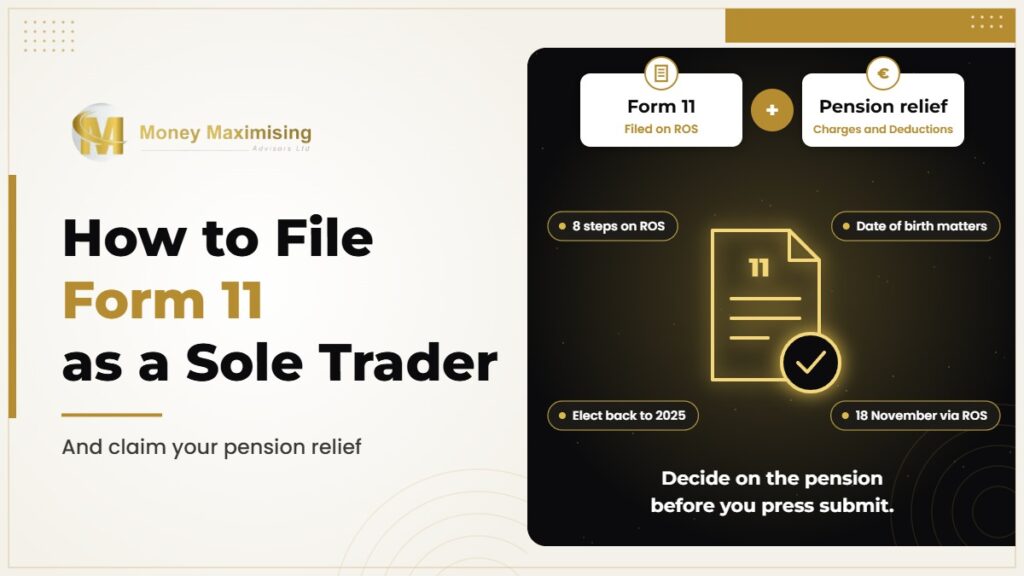
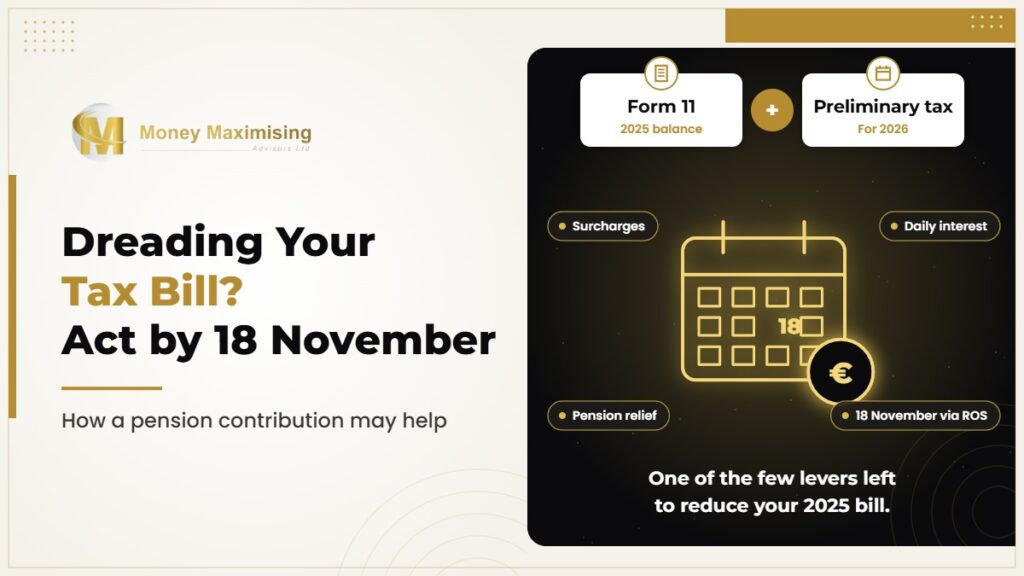
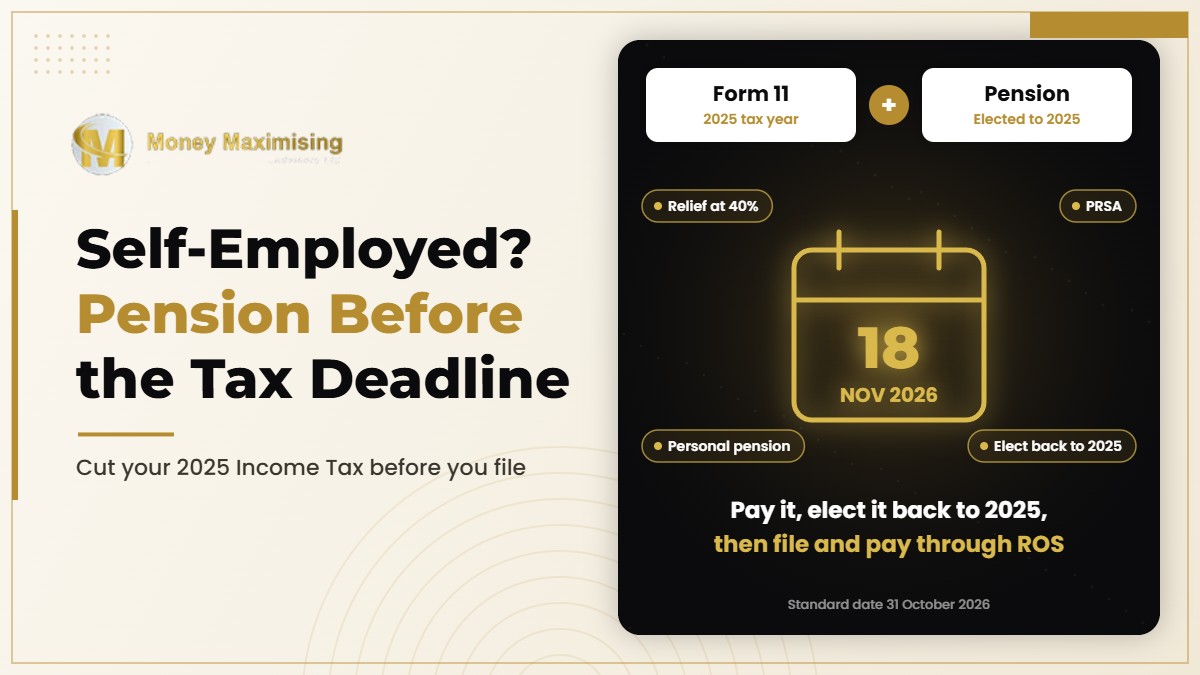
Self-employed taxpayers pay the balance of 2025 Income Tax and their 2026 preliminary tax together with the 2025 Form 11. The standard date is Saturday 31 October 2026. Anyone who both files and pays through ROS has until Wednesday 18 November 2026. If only one of those happens through ROS, the 31 October date applies to both.
Why a contribution now still counts for 2025
A qualifying contribution paid after 31 December 2025, but by your return filing date, can be elected back to 2025 on the Form 11 itself. Pay it, keep the certificate, and make the election when you file. Once the return is in and the deadline has passed, the 2025 window closes.
Four reasons to contribute before you file
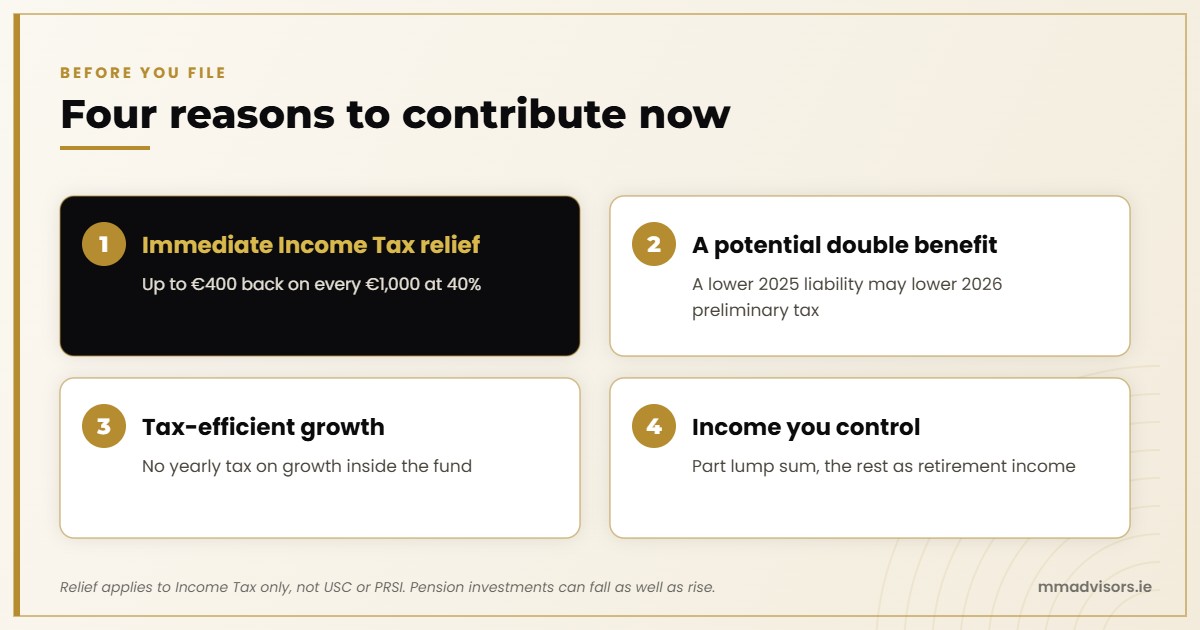
1. Immediate Income Tax relief
Contributions within the limits receive relief at your marginal rate. For many self-employed people with profits above the standard rate band, that is 40%: every €1,000 contributed may reduce Income Tax by up to €400. Relief does not extend to USC or PRSI.
2. A potential double benefit on preliminary tax
Many self-employed people base preliminary tax on 100% of the previous year’s liability. Reducing your 2025 liability with a backdated contribution can therefore also reduce the 2026 preliminary tax payable at the same deadline. If you use the 90% of current-year basis, the effect depends on your 2026 figures.
3. Tax-efficient growth
Investment growth inside an approved pension fund is not taxed each year as it would be in many other savings products. Over a long period, that gives compounding more room to work. Pension investments can fall as well as rise, and growth is not guaranteed.
4. Income you control in retirement
The State Pension is a foundation, not a full retirement income for most self-employed people, and entitlement depends on your PRSI record. A personal pension gives you a separate fund, with options to take part as a lump sum and draw the rest as income.
Which pension can a self-employed person use?
| Product | Typical feature |
|---|---|
| PRSA (Personal Retirement Savings Account) | Flexible, portable, capped charges |
| Personal pension (retirement annuity contract) | Wider fund choice on some plans |
| Existing employment pension or AVC | Linked to employment earnings, not trading profit |
Both a PRSA and a personal pension can be set up for a once-off lump sum, regular monthly contributions, or both. Charges, fund choice and investment risk vary between providers and should be compared before you pay.
How much can you contribute with relief?
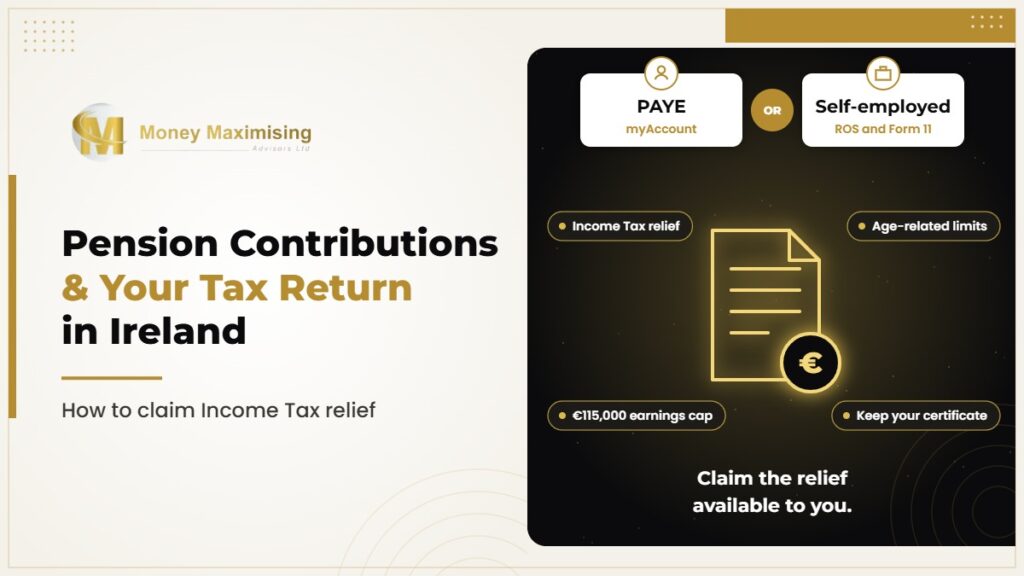
The limit is a percentage of your net relevant earnings, broadly your taxable trading profit after capital allowances and losses. The percentage depends on your age at any time during the tax year and is applied to earnings up to €115,000. Contributions you have already made for the year use part of the limit.
The age-related pension contribution limits
| Age during the tax year | Maximum qualifying percentage |
|---|---|
| Under 30 | 15% |
| 30-39 | 20% |
| 40-49 | 25% |
| 50-54 | 30% |
| 55-59 | 35% |
| 60 or over | 40% |
Worked example: a self-employed electrician
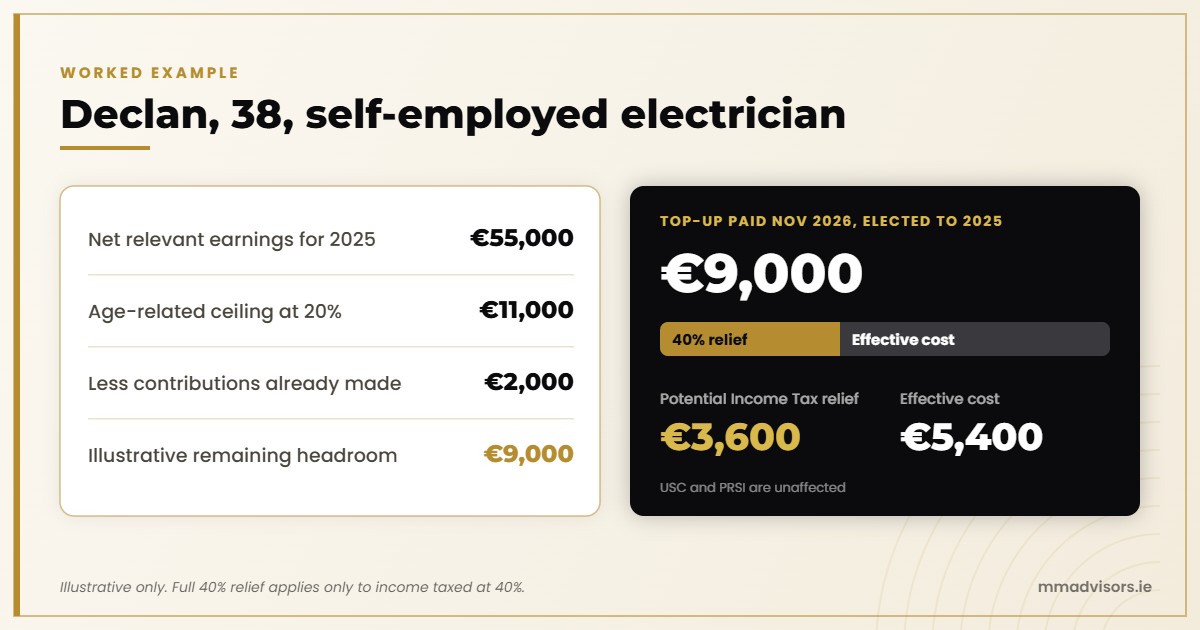
Declan is 38 and works for himself as an electrician. His net relevant earnings for 2025 were €55,000, with income above the standard rate band taxed at 40%. He contributed €2,000 to a PRSA during 2025 and wants to top up before filing.
| Net relevant earnings for 2025 | €55,000 |
| Age-related ceiling at 20% | €11,000 |
| Less contributions already made in 2025 | €2,000 |
| Illustrative remaining headroom | €9,000 |
| Top-up paid in November 2026, elected to 2025 | €9,000 |
| Potential Income Tax relief at 40% | €3,600 |
| Illustrative effective cost of the top-up | €5,400 |
The full €9,000 attracts 40% relief only if at least that much of Declan’s income is taxed at 40%. His 2025 Income Tax may fall by €3,600, and if his 2026 preliminary tax is based on 100% of his 2025 liability, that may fall too. USC and PRSI are unaffected.
Ready to speak with an advisor?
Or
Call us now (9am to 5pm, Mon to Fri)
How to make a contribution before the deadline
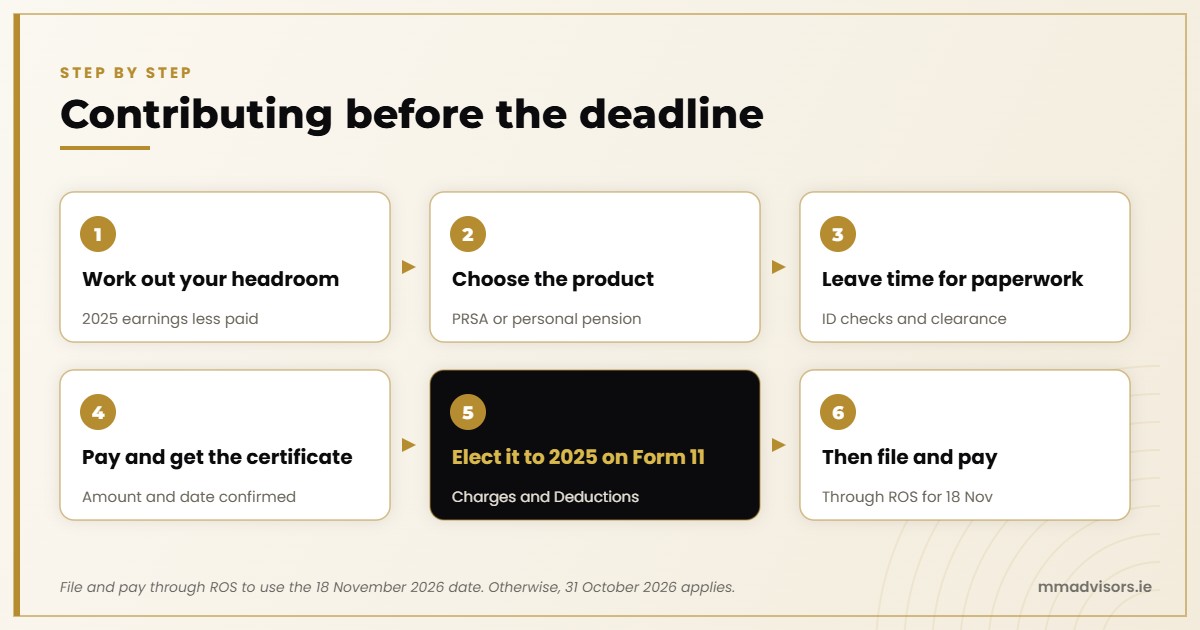
- Work out your headroom. Confirm 2025 net relevant earnings with your accountant and subtract contributions already made.
- Choose the product. Compare PRSA and personal pension options on charges, fund choice and flexibility.
- Leave time for paperwork. Identity checks, application forms and payment clearance can take several working days.
- Pay and get the certificate. The provider issues a contribution certificate confirming the amount and date.
- Elect it to 2025 on Form 11. PRSA and personal pension contributions go in the Charges and Deductions panel.
- Then file and pay. Complete the return and payment through ROS to use the 18 November date.
What you can do with the fund later
PRSA and personal pension benefits can generally be taken from age 60, and must be taken by 75. At retirement, you can usually take up to 25% of the fund as a lump sum, with the first €200,000 of lifetime retirement lump sums tax-free. The balance can be used to buy an annuity, invested in an Approved Retirement Fund (ARF), or, for some PRSAs, left invested as a vested PRSA. Income drawn in retirement is taxable.
Points to weigh before you pay
- Pension money is locked away until retirement age, so keep cash for tax, business costs and emergencies.
- Relief at 40% only applies to income taxed at 40%; a contribution beyond that gets relief at 20%.
- Do not exceed your age-related limit; excess contributions may carry forward but do not reduce the current bill.
- Make sure your accountant knows about the contribution before the return is finalised.
- Regular monthly contributions next year can avoid another last-minute lump sum.
Frequently asked questions
Is it too late to contribute for 2025?
Not if you pay before your filing date and elect the contribution back to 2025 on your return. For ROS pay-and-file users the date is 18 November 2026; otherwise it is 31 October 2026. Confirm the date that applies to you with your adviser.
Can I contribute more than my age limit?
You can, but relief is restricted to the limit for that year. Excess contributions may be carried forward and relieved in a later year, subject to that year’s limits.
Do I need an accountant to claim the relief?
No. The relief is claimed on Form 11, which you can file yourself. Many self-employed people still prefer their accountant to confirm net relevant earnings and the election.
Does a pension contribution reduce USC or PRSI?
No. Relief applies to Income Tax only.
PRSA or personal pension: which is better?
It depends on charges, fund choice, flexibility and how you plan to contribute. A regulated adviser can compare options for your circumstances.
I am also an employee. Does that change anything?
Yes. Employment earnings support AVCs or employer schemes, while trading profit supports a PRSA or personal pension. An adviser can check the headroom available across both.
Before your deadline
Self-employed and filing Form 11?
Work out your pension headroom from your 2025 profit and see how a contribution elected back to 2025 may reduce your bill.
Sources and important information
Important: This article is general information, not tax, legal or investment advice. Tax relief depends on individual circumstances, Revenue rules and limits. Tax treatment may change. Pension investments can fall as well as rise, and retirement access rules apply.
Money Maximising Advisors Limited | Central Bank of Ireland C154250 | 091 393 125 | office@mmadvisors.ie