
| Key Takeaways ✅ A gift of shares can trigger two taxes at once: CGT for the person giving and CAT for the person receiving ✅ The CAT rate is 33%, and a child can currently receive up to €400,000 from parents across their lifetime before CAT applies ✅ The Section 104 credit can set the giver’s CGT against the receiver’s CAT on the same gift, but it can be clawed back if the shares are sold within two years ✅ Share options themselves usually can’t be gifted, so you generally need to exercise first and gift the shares ✅ Gifting now moves future growth to your family, while waiting until death avoids CGT on the transfer, and the right answer depends on your numbers |
After years of building up shares, whether through employee share options or ordinary investing, many people eventually ask the same lovely question. How do I pass some of this to my children? It’s a conversation we have often at Money Maximising Advisors Limited, and we can tell you that Irish tax law has a way of complicating generous instincts. A single family gift can bring Capital Gains Tax, Capital Acquisitions Tax and a two-year rule into the same transaction. None of it is unmanageable, but the order you do things in genuinely matters, so let’s take it slowly.
The two taxes hiding in one gift
Your side: Capital Gains Tax
When you gift shares, Revenue generally treats you as having disposed of them at their market value on the day of the gift, even though no money changed hands. If the shares have grown since you acquired them, you may owe CGT at 33% on that growth, with your €1,270 annual exemption available against it. Yes, you can owe real tax on a gift where you received nothing. It surprises everyone the first time, and it’s the main reason a family transfer should never be a spur-of-the-moment gesture. Working out your base cost matters here too, and for shares that came from employee options, the value at exercise usually plays a central role in that calculation, so dig out those old exercise confirmations before you do anything.
Their side: Capital Acquisitions Tax
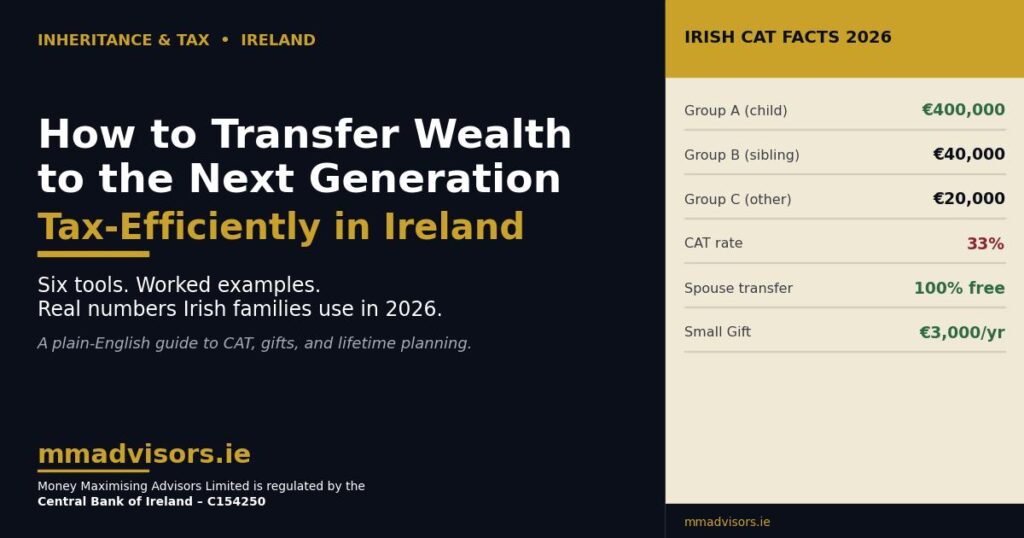
Your child, or whoever receives the gift, may face CAT on its value. The rate is 33%, but the lifetime thresholds do a lot of work here. A child can currently receive up to €400,000 in total from their parents, across all gifts and inheritances since December 1991, before CAT applies. That’s the Group A threshold. Group B, covering siblings, nieces, nephews and grandchildren, is €40,000, and Group C for everyone else is €20,000. You’ll find the current figures on Revenue’s CAT thresholds page. Earlier taxable benefits in the same group get added together, so a gift today and an inheritance in twenty years are counted against the same lifetime allowance, not two separate ones.
The small gift exemption: the quiet workhorse
Alongside the big thresholds sits a modest rule that does remarkable work over time. Each person can receive €3,000 per year from any individual completely free of CAT, without touching their lifetime threshold at all. Two parents can therefore pass €6,000 a year to each child, and €12,000 a year to a child and their spouse, year after year. Over a decade or two, steady use of this exemption can move a serious amount of wealth entirely outside the CAT net, and it pairs naturally with a phased approach to gifting shares. It’s unglamorous, it requires patience, and it’s one of the most effective estate planning tools in the country.
Section 104: the credit that softens the double hit
Paying CGT and CAT on the same gift feels like being taxed twice, and the law partly agrees. The Section 104 credit lets the CGT you pay as the giver be set against the CAT your child owes on the very same shares from the very same event. Two things to watch, though. The credit can’t exceed the CAT attributable to those shares, and it gets clawed back if your child sells the shares within two years of receiving them. It also has to be claimed through the CAT return rather than arriving automatically. So before you transfer anything, have an honest conversation about what they actually plan to do with the shares. A quick sale to fund a house deposit could undo the credit entirely, and knowing that in advance changes how you’d structure the whole thing.
Can I just gift the share options instead?
Usually not, and this catches out a lot of employees. Most employee share option plans make the option personal to you and prohibit transferring it, except in limited situations such as death. So the normal route is to exercise the option first, pay the employment taxes that come with exercising, and then gift the resulting shares. And even in the rare case where a plan does allow an assignment, don’t assume the tax moves with the option. Irish rules can still charge you, the original employee, even where a family member realises the gain, and CAT may need to be considered on the value transferred as well. This is one area where specific advice before acting isn’t optional.
Gift now or wait until death?
This is the real decision at the heart of most family conversations, and there’s no answer that wins every time. Here’s how the two routes compare in plain terms.
The case for gifting now
A lifetime gift fixes the value transferred at today’s price and moves all future growth, dividends and risk to your child. You can phase transfers over years, use the small gift exemption alongside, and watch your family enjoy the benefit while you’re around to see it. The costs are equally real. You may face an immediate CGT bill, your child may face CAT, and you give up ownership, voting rights and control for good. Once it’s given, it’s given.
Phasing deserves a special mention here, because it changes the arithmetic. Instead of transferring one large block in a single year, a parent can gift smaller tranches over several years, using each year’s €3,000 small gift exemption and spreading the CGT across multiple annual exemptions and tax years. It takes discipline and a bit of paperwork, but it smooths the tax, keeps each transfer manageable, and lets you pause if circumstances change. For families with time on their side, the phased route is often the difference between a plan that feels heavy and one that barely registers.
The case for waiting
Death generally wipes the CGT slate on the transfer itself. There’s no CGT on assets passing on death, and your beneficiary takes the shares with a fresh CGT cost equal to their value at that date, so decades of growth escape CGT entirely. You also keep control, voting rights and dividends for life. Against that, if the shares keep growing, the eventual CAT bill grows with them, the shares stay exposed to market risk in the meantime, and probate can delay your family’s access at a difficult time. An inheritance from a spouse or civil partner, it’s worth adding, is exempt from CAT altogether. And where the shares are in a genuine trading business, CAT Business Relief can reduce the taxable value by 90%, though the ownership and retention conditions are detailed and an ordinary quoted employee shareholding won’t usually qualify.
Which route wins depends on your numbers. The current value and your base cost, the growth you expect, how much of the €400,000 threshold your child has already used, whether Section 104 helps, and how long they’d hold the shares. This is a modelling exercise, not a rule of thumb, and it sits naturally alongside wider estate planning, which is exactly what our inheritance tax advice service is for.
What happens to shares and options on death
One last piece completes the picture. If you still hold unexercised options when you die, the scheme rules decide everything. Some plans let your personal representatives exercise within a set period, some accelerate vesting, and some provide that options simply lapse. Any permitted window can be short, so your executor should contact the employer and plan administrator quickly and get the deadline in writing, because a valuable option can quietly expire during probate. Where an exercise does go ahead, the gain is calculated for you as the deceased and assessed on your personal representatives, and the estate needs cash ready for both the exercise price and the tax. Shares you already owned are simpler. They pass through your estate with no CGT on the transfer, your beneficiary inherits them at date-of-death value, and CAT applies based on their relationship to you and their remaining threshold. Mentioning your options in your estate planning conversations, and telling your executor they exist, costs nothing and can save your family a scramble.
Frequently Asked Questions
Do I pay tax if I gift shares to my child in Ireland?
Possibly on both sides. You may face CGT at 33% on the growth in the shares, as gifting counts as disposing of them at market value, and your child may face CAT once their €400,000 lifetime Group A threshold is used up.
How much can my child receive from me tax free?
The Group A threshold is currently €400,000 across all gifts and inheritances from both parents combined since December 1991. On top of that, each parent can give €3,000 per year under the small gift exemption without touching the threshold at all.
What is the Section 104 credit?
It’s a credit that sets the CGT you pay on gifting an asset against the CAT your beneficiary owes on the same asset from the same event. It’s capped at the CAT attributable to that asset and is clawed back if the beneficiary sells within two years.
Can I transfer my employee share options directly to my children?
Almost never. Employee plans typically prohibit transferring options, so the usual route is to exercise first, pay the employment taxes, and then gift the shares. Where assignment is technically allowed, the tax can still land on you, so take advice first.
Is it better to gift shares now or leave them in my will?
It depends on your numbers. Gifting now moves future growth to your family but can trigger immediate CGT and CAT. Waiting avoids CGT on the transfer and gives a fresh base cost, but growing values can mean a bigger CAT bill later. Model both before deciding.
What happens to my share options if I die before exercising them?
Your plan rules decide. Some allow your personal representatives to exercise within a set window, others lapse the options. Your executor should contact the plan administrator immediately and confirm the deadline in writing, because permitted windows can be short.
Final Thoughts
Passing shares to your family is one of the most satisfying things your money can do, and one of the easiest to get wrong on timing. Keep the essentials in mind. A gift can tax both sides, the €400,000 Group A threshold and €3,000 annual exemption are your friends, Section 104 softens the double hit but has a two-year string attached, and the gift now or wait question deserves proper modelling rather than guesswork. Helping families move wealth between generations sensibly is something we’ve been doing for over 30 years, and every plan starts with a free, no-obligation conversation. If there are shares in your life and children in your plans, talk to us before you transfer anything. The right order of steps could save your family a small fortune.
Planning to Pass Shares to Your Family?
Free estate and inheritance tax consultation with our qualified advisors
Money Maximising Advisors Limited | Unit 3, Office 6, Liosban Business Park, Tuam Rd, Galway | +353 91 393 125 | office@mmadvisors.ie
Money Maximising Advisors Limited is regulated by the Central Bank of Ireland (C154250). This article is for information purposes only and does not constitute financial or tax advice.