If you’re a member of an Irish workplace pension scheme and you’ve never heard of AVCs, you’re leaving significant tax relief on the table every year. Additional Voluntary Contributions are the single biggest lever most Irish employees have to boost their retirement without changing employer.
This guide from Money Maximising Advisors explains what AVCs are, who can use them, and how they work in the Irish tax system. You’ll also see a real worked example showing how a mid-career teacher on €70,000 can add €220,000+ to their retirement pot for a net personal cost of €90,000.
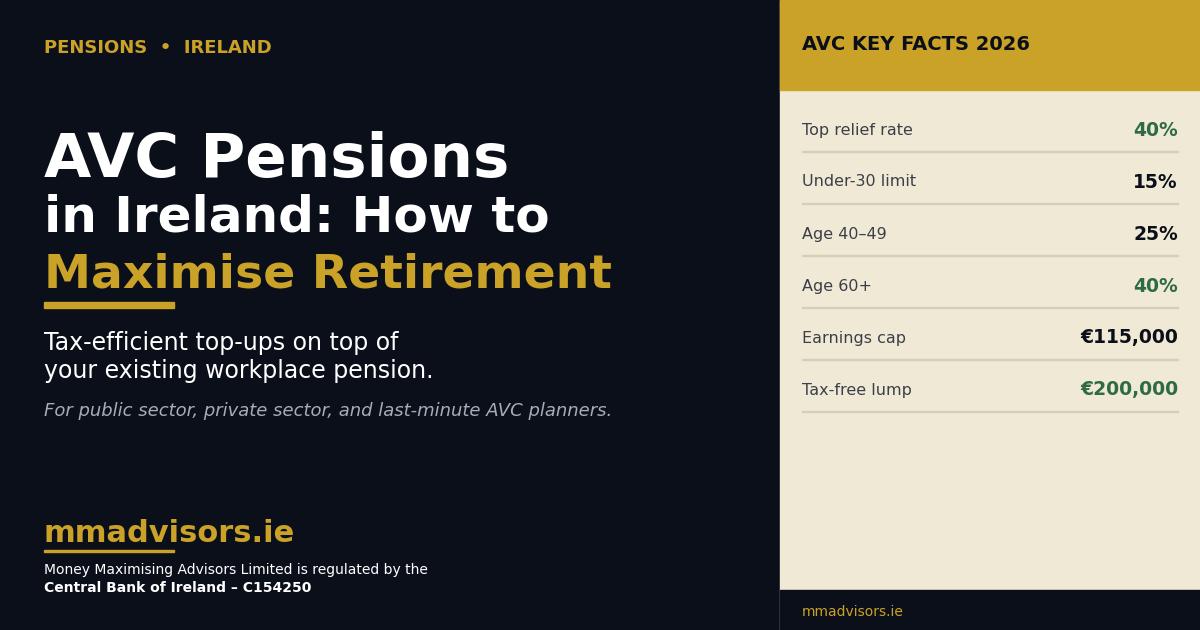
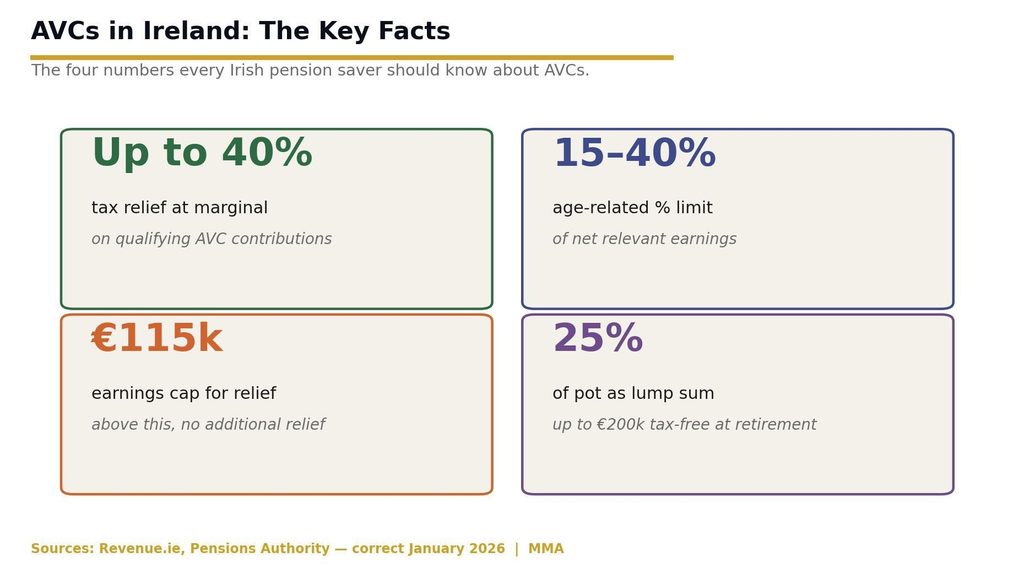
| QUICK ANSWER: An AVC (Additional Voluntary Contribution) is an extra top-up you can make to your existing Irish workplace pension. Available if you’re already in an occupational pension scheme, including public sector schemes. Contributions attract tax relief at your marginal rate (up to 40%). Age-related percentage limits apply: 15% under 30, 20% for 30–39, 25% for 40–49, 30% for 50–54, 35% for 55–59, and 40% for 60+. Earnings cap of €115,000 applies for tax relief. At retirement, AVCs are combined with your main pension pot for the 25% tax-free lump sum (capped at €200,000 tax-free lifetime) and the remainder can be moved to an ARF or annuity. |
What is an AVC?
AVC stands for Additional Voluntary Contribution. It’s an extra top-up you make to your existing workplace pension scheme, over and above your normal contributions.
The key word is “additional.” An AVC is on top of what you already contribute (and what your employer contributes on your behalf). It cannot exist on its own, you must already be a member of an occupational pension scheme to make AVCs.
Who can make AVCs?
Anyone in an Irish occupational pension scheme. This includes private sector employees, public sector workers, semi-state staff, and members of company pension schemes.
If you’re self-employed with no workplace pension, AVCs aren’t the right vehicle for you. You’d use a PRSA or personal pension instead.
If you’re a PAYE worker with no workplace pension, you can’t make AVCs. You’d need to open a PRSA or wait until auto-enrolment covers you.
Why AVCs are so tax-efficient
Three tax benefits stack together to make AVCs one of the most powerful savings tools in the Irish tax code.
Benefit 1: Tax relief on the way in
Every euro you contribute gets tax relief at your marginal rate. If you pay 40% income tax, a €1,000 AVC contribution costs you only €600 net.
The tax relief is applied automatically through payroll for salary-sacrifice AVCs. For lump-sum AVCs paid outside payroll, you claim the relief through your tax return.
Benefit 2: Tax-free growth inside the pension
Investment returns inside your AVC pot grow tax-free, no income tax, no capital gains tax, no dividend withholding tax on qualifying funds.
Over 20–30 years, this compounding effect can double the final pot compared to the same money invested in a taxable account.
Benefit 3: Tax-free lump sum at retirement
Your AVC pot combines with your main pension for the tax-free lump sum at retirement.
You can take up to 25% of the combined pot tax-free, up to a lifetime limit of €200,000. This means an AVC-boosted pension gets the same lump sum treatment as a normal pension.
Age-related contribution limits
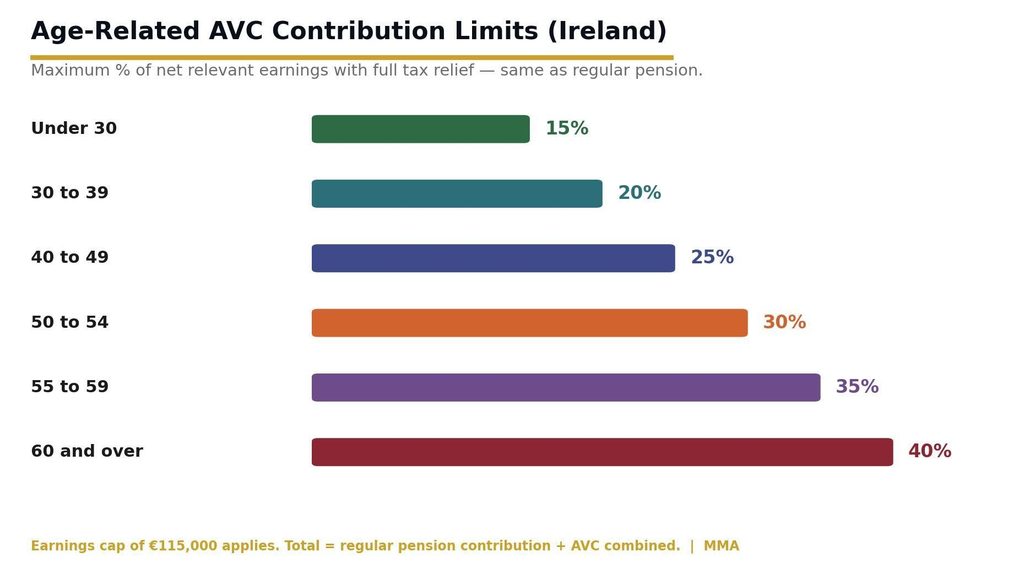
The Irish rules set age-based percentage limits on total pension contributions (regular + AVC combined) that qualify for tax relief.
Under age 30
Up to 15% of net relevant earnings. That includes both your regular pension contribution and any AVC.
Age 30 to 39
The limit rises to 20%. If your regular contribution is 6%, your AVC capacity is up to 14%.
Age 40 to 49
25% limit. Sweet spot for many mid-career earners who are settling into higher salaries and want to accelerate.
Age 50 to 54
30% of net relevant earnings. This is where AVCs really come into their own for late-career catch-up.
Age 55 to 59
35% of net relevant earnings.
Age 60 and over
The maximum: 40% of net relevant earnings. Powerful for anyone still working full-time in their 60s.
Earnings cap
Contributions are calculated on earnings up to €115,000. Above that, further contributions don’t attract additional tax relief.
Worked example: a 50-year-old teacher on €70,000
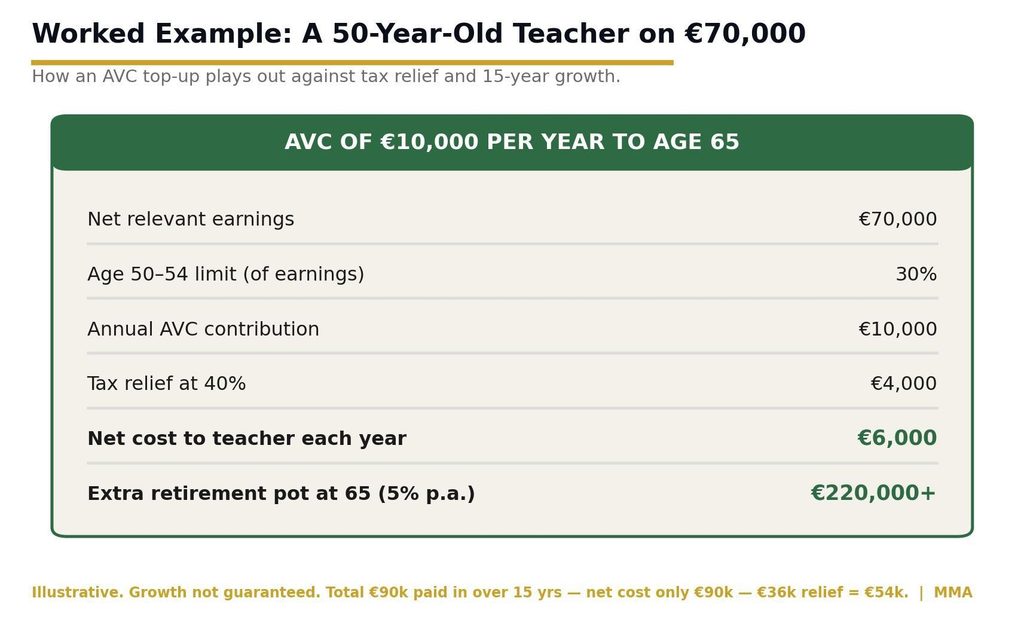
Meet Aisling. She’s 50, a secondary school teacher in Galway, and a member of the Single Public Service Pension Scheme. She earns €70,000 gross.
Her existing pension is on track, but she wants a bigger retirement pot to fund travel, help her adult children, and reduce mortgage debt at retirement.
Step 1: Calculate her AVC capacity
At age 50, Aisling sits in the 50–54 age band. Her total pension contribution limit is 30% of net relevant earnings.
Her existing occupational pension deductions account for around 15% of salary. That leaves 15% of headroom for AVCs, up to €10,500 per year.
She decides to contribute €10,000 per year (rounded down for simplicity).
Step 2: Calculate her tax saving
Aisling pays income tax at the 40% marginal rate on this income. Her €10,000 AVC attracts tax relief of €4,000 per year.
Net personal cost: €6,000 per year. Amount added to her pension pot: €10,000 per year.
Step 3: Project the pot at retirement
Aisling plans to retire at 65, that’s 15 years of AVC contributions.
Total AVC contributions: €150,000 over 15 years. Her net personal outlay after tax relief: €90,000.
At an assumed 5% average annual return, her AVC pot grows to roughly €220,000+ by age 65.
The result
Aisling has added over €220,000 to her retirement pot for a net personal cost of €90,000. That’s roughly €2.44 in retirement wealth for every €1 of net personal spending, before any consideration of the tax-free lump sum benefit at retirement.
Ready to maximise your retirement with AVCs?
Book a free 30-minute AVC review, or send us your details and we'll be in touch.
Money Maximising Advisors Limited is regulated by the Central Bank of Ireland – C154250
Public sector AVCs, the special case
Public sector employees in Ireland are automatically in an occupational pension scheme. This makes AVCs particularly relevant, and particularly valuable.
Why public sector workers use AVCs
Public sector defined benefit pensions are excellent, but they don’t always generate the maximum tax-free lump sum on their own. AVCs fill that gap.
Additionally, they cover shortfalls in service years (for late starters, career-break returners, or part-time workers) and provide a flexible pot alongside the guaranteed DB benefit.
How the tax-free lump sum works with public sector AVCs
At retirement, your DB pension delivers a scheme-specific lump sum (typically 1.5× final salary for long-serving staff).
Your AVC pot can then be used to top up your lump sum to the maximum tax-free ceiling of €200,000 across all pensions.
Our Public Sector AVCs service is specifically designed to model this interaction for teachers, nurses, civil servants, and other public sector employees.
Last Minute AVCs, the pre-retirement top-up
A Last Minute AVC is exactly what it sounds like, a large one-off AVC made shortly before retirement to boost your tax-free lump sum.
How it works
In the year or two before retiring, you make a substantial AVC contribution. You get tax relief at your marginal rate on the contribution.
At retirement, the AVC combines with your main pension for lump-sum purposes. If your combined lump sum is below the €200,000 tax-free ceiling, the entire AVC contribution effectively converts to tax-free cash.
Why it’s attractive
Get 40% tax relief on the way in. Take the money out tax-free at retirement. Effectively convert €1 of taxable salary into €1.67 of tax-free retirement cash.
Rules are specific and the timing has to be right. Our Last Minute AVC service maps this out based on your specific pension scheme and retirement date.
How to start AVCs
Step 1: Confirm your existing pension scheme
Check with your HR department or pension administrator. You need to be a member of an occupational pension scheme (public or private sector) to make AVCs.
Step 2: Choose your AVC vehicle
Two main options: link an AVC into your existing employer scheme (via the scheme’s AVC facility) or set up a separate AVC PRSA.
Employer scheme AVCs are administratively simple. AVC PRSAs give you more control over fund choice and portability if you change employer.
Step 3: Choose your contribution amount
Start with a percentage you can afford. Even 2–3% of salary as an AVC makes a material difference over 20+ years.
Review annually. Increase the AVC each year as your salary rises.
Step 4: Choose your investment fund
Your AVC provider offers a menu of investment funds. For long-horizon savers (10+ years to retirement), higher equity exposure typically wins. For those within 5 years, lower-risk funds are usually smarter.
Most schemes offer a “lifestyle” default that automatically de-risks as retirement approaches.
Common AVC mistakes to avoid
- Not making any AVCs at all. The single biggest mistake. If you’re in a workplace pension and not making AVCs, you’re leaving significant tax relief unclaimed every year.
- Contributing more than the age-related limit. Excess contributions don’t attract additional relief. They still eat into your Standard Fund Threshold (€2.2m in 2026).
- Waiting until your 50s. A 30-year-old starting a small AVC gets more compounding than a 55-year-old starting a large one. Every year matters.
- Ignoring the Last Minute AVC opportunity. If you’re within 2 years of retirement and your lump sum will be under €200,000, a Last Minute AVC often converts taxable salary into tax-free cash.
- Sticking with the default fund forever. The default is designed for the average member. Review your AVC fund choice every 3 years, or when your circumstances change.
- Confusing AVCs with a PRSA. You must be in a workplace pension to make AVCs. If you’re not, a PRSA is your equivalent vehicle.
- Forgetting the earnings cap. Contributions on income above €115,000 don’t attract additional tax relief.
Where MMA fits in
Money Maximising Advisors is a Central Bank regulated financial broker based in Galway. AVCs sit right at the intersection of what we do best:
Our advice services are delivered directly by our qualified team. Pensions Advice maps your existing scheme, models your AVC capacity, and shows you the tax saving. Public Sector Superannuation Advice is our specialist service for teachers, nurses, civil servants, and other public sector employees.
On the products, we’re a multi-agency broker. We compare AVC providers, AVC PRSAs, and Last Minute AVC vehicles across Ireland’s leading providers to make sure your top-up sits in the right place.
The result: independent advice, wide product access, and no direct fee to you for the arrangement itself.
Frequently asked questions
What is an AVC pension in Ireland?
An AVC (Additional Voluntary Contribution) is an extra top-up you make to your existing Irish workplace pension. You must already be a member of an occupational pension scheme (private sector, public sector, or semi-state) to make AVCs. They attract tax relief at your marginal rate (up to 40%), and combine with your main pension pot at retirement.
How do AVCs work in Ireland?
You contribute an additional percentage of your salary to your workplace pension, either through payroll (via the scheme’s AVC facility) or into a separate AVC PRSA. You receive tax relief at your marginal rate on the contribution. Investment returns grow tax-free inside the pot. At retirement, your AVC pot combines with your main pension for the 25% tax-free lump sum and remaining fund options (ARF, annuity, or taxable lump sum).
Are AVC pension contributions tax deductible in Ireland?
Yes, AVC contributions attract income tax relief at your marginal rate, up to 40% for higher-rate taxpayers. If contributed through payroll, relief is applied automatically. For lump-sum AVCs paid outside payroll, you claim the relief through your Form 11 or PAYE tax return.
How much can I contribute to an AVC in Ireland?
Age-related percentage limits apply to total pension contributions (regular + AVC combined): 15% under 30, 20% for 30–39, 25% for 40–49, 30% for 50–54, 35% for 55–59, and 40% for 60+. Earnings above €115,000 don’t qualify for additional tax relief.
Can I make AVCs if I’m in the public sector?
Yes. Public sector employees in Ireland are automatically in an occupational pension scheme, which makes AVCs a strong fit. Public sector AVCs are particularly valuable for topping up the tax-free lump sum at retirement to the €200,000 ceiling, and for filling in service-year shortfalls.
What is a Last Minute AVC?
A Last Minute AVC is a large one-off Additional Voluntary Contribution made shortly before retirement. You get tax relief at your marginal rate on the way in. If your combined lump sum stays under the €200,000 tax-free ceiling at retirement, the AVC effectively converts taxable salary into tax-free retirement cash. Rules and timing are specific, always model it with a qualified adviser.
Reviewed by our pension team
This guide was prepared and reviewed by the pension team at Money Maximising Advisors, using Revenue.ie current rules on pension contributions and tax relief, Pensions Authority AVC guidance, and daily AVC work with Irish public and private sector clients. MMA is regulated by the Central Bank of Ireland (C154250).
Ready to maximise your retirement with AVCs?
Whether you’re a teacher, nurse, civil servant, private sector employee, or approaching retirement with a Last Minute AVC opportunity, our team maps your maximum contribution, models the tax saving, and gets it set up.
Ready to maximise your retirement with AVCs?
Book a free 30-minute AVC review, or send us your details and we'll be in touch.
Money Maximising Advisors Limited is regulated by the Central Bank of Ireland – C154250
| Important information AVC contribution limits, earnings caps, tax relief rates, and Standard Fund Threshold values referenced are those in force in Ireland at time of writing (January 2026) and are subject to change with each Finance Act. Worked examples are illustrative, investment growth is not guaranteed and can be negative. AVCs are only available to members of an existing occupational pension scheme. Rates, thresholds and rules referenced are correct at time of writing and are subject to change. Money Maximising Advisors Limited is regulated by the Central Bank of Ireland (C154250). This article is for general information only and does not constitute personalised financial, tax or legal advice. You should always speak to a Qualified Financial Advisor before making any decision. |