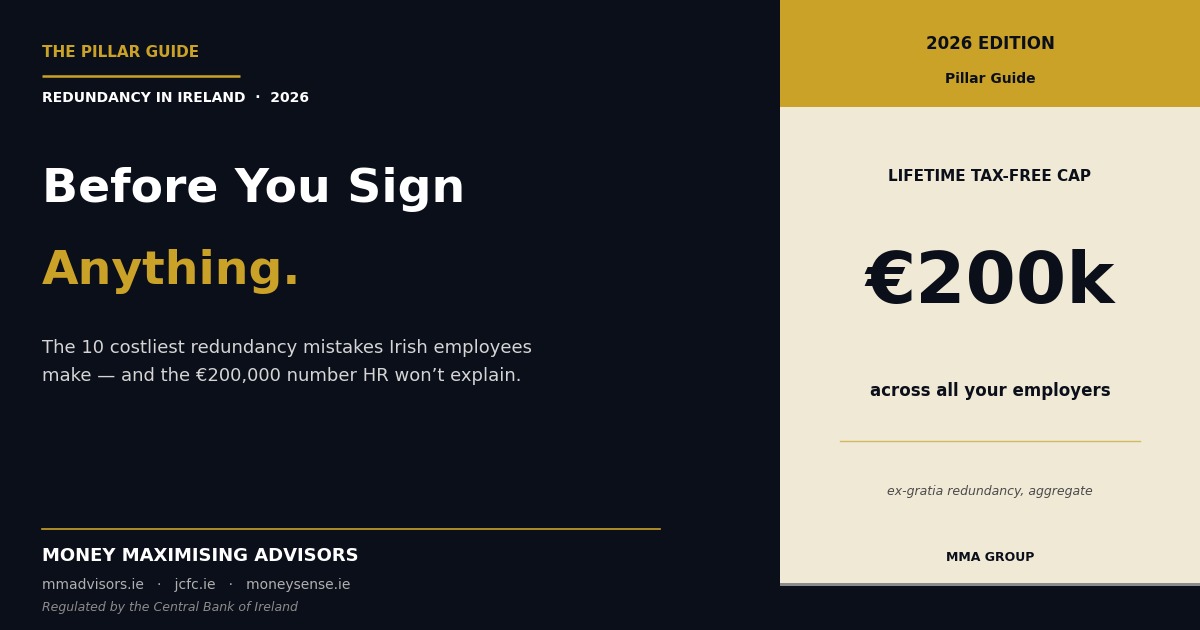
| THE HIDDEN NUMBER €200,000 The lifetime tax-free cap on ex-gratia redundancy payments across every employer you’ll ever have. Most Irish employees have never heard of it, which is exactly why HR departments quietly default to the least generous tax exemption when they process your package. This guide walks through the 10 costliest redundancy mistakes we see in Irish workplaces in 2026, with worked SCSB numbers and a 90-day playbook for what to do the moment the letter arrives. |
Redundancy in Ireland is not just a job loss, it is a major financial event that can quietly shape your finances for a decade or more. Get it right, and the payoff is transformational: a well-negotiated ex-gratia payment, optimised through the Standard Capital Superannuation Benefit and a pension lump-sum strategy, can leave a mid-career professional €30,000–€50,000 better off than the HR default calculation. Get it wrong, and the vast majority do, and you’ll pay income tax at 40% and USC on money that could have been sheltered.
This pillar guide from the Money Maximising Advisors Group — with offices in Galway (mmadvisors.ie), Donegal (jcfc.ie) and Kerry (moneysense.ie) — walks you through statutory redundancy Ireland, redundancy rights Ireland, how the redundancy payment Ireland tax system actually works, and the 10 mistakes we see most often — particularly among Dublin tech and biopharma workers hit by 2025–2026 restructurings at Meta, Google, Intel, LinkedIn, Stripe and others.
For our full Redundancy Advice service, see the primary hub. Related pages: Pensions Advice, Retirement Planning Advice, Approved Retirement Funds (ARF), Income Protection, and Money Management Advice.
The Quick Answer: seven questions Irish employees ask about redundancy
What mistakes should you avoid during redundancy?
Six that consistently cost Irish employees the most money:
(1) signing the exit deal in the same meeting HR presents it;
(2) accepting the Basic Exemption without running the SCSB calculation;
(3) cashing in a pension lump sum immediately, which reduces both the Increased Exemption and SCSB;
(4) missing the 30-day collective consultation window;
(5) cancelling group income protection or life cover before replacing it;
(6) not registering for Jobseeker’s Benefit (you lose valuable PRSI credits).
What should you not do when facing redundancy?
Do not sign anything on the day you’re told. Do not verbally accept a package structure. Do not cancel group benefits until you have individual replacements in force. Do not agree to a pension lump-sum election until you’ve modelled it against SCSB. Do not accept the first ex-gratia offer without negotiation — there is almost always room to move on outplacement support, notice periods and tax structure.
What are your rights if you’re made redundant in Ireland?
Under the Redundancy Payments Acts 1967–2022, if you have 104 weeks of continuous PRSI-insurable service, you are entitled to statutory redundancy: two weeks’ pay per full year of service, plus one bonus week, based on weekly earnings capped at €600. Statutory redundancy is fully tax-free. You also have rights under the Protection of Employment Act 1977 (collective consultation), the Unfair Dismissals Acts 1977–2015, and to a fair, non-discriminatory selection process.
Can I negotiate my redundancy package?
Yes, and you should. Statutory redundancy is fixed by formula, but the ex-gratia (voluntary) top-up is entirely at your employer’s discretion. Common negotiation levers: extra weeks per year of service, extended notice or garden leave, outplacement support, retention of company benefits (health insurance, phone), share-vesting acceleration, and the tax structure of the payment (SCSB vs Basic vs Increased Exemption).
How is statutory redundancy calculated in Ireland?
The formula: (2 weeks × complete years of service) + 1 bonus week, multiplied by your gross weekly pay, capped at €600 per week. Partial years round down, 9 years 8 months = 9 years, not 10. Example: 10 complete years at €600/wk = (20 + 1) × €600 = €12,600 tax-free.
Do I have to accept a redundancy offer?
The statutory element you are legally entitled to whether you accept a specific package or not. For ex-gratia offers, you can refuse and choose to fight the redundancy through the WRC (Workplace Relations Commission) or Labour Court if you believe it was procedurally unfair or discriminatory. However, refusing a genuine redundancy offer where the role has genuinely disappeared is usually not productive — negotiate the terms instead.
What is a fair redundancy process?
Under Irish employment law, a fair redundancy process requires:
(1) a genuine business reason for the role’s elimination;
(2) a fair and non-discriminatory selection matrix (skills, performance, disciplinary record);
(3) consultation with affected employees before the decision is finalised;
(4) for 20+ redundancies, a 30-day collective consultation window under the Protection of Employment Act 1977;
(5) proper notice periods per the Minimum Notice and Terms of Employment Act 1973.
Meet the MMA Group: three offices, one national reach
| TUAM · GALWAY mmadvisors.ie National coverage Flagship group HQ, full mortgage, pension, protection and inheritance advice. | MOUNTCHARLES · DONEGAL jcfc.ie North West Ireland Joe Coyle Financial Consultants, business-owner and family finance specialists. | KILLARNEY · KERRY moneysense.ie South West Ireland Money Sense Financial Services, family-run, 40+ years Irish experience. |
The 10 redundancy mistakes we see most often in 2026
1. Signing the exit deal in the same meeting HR presents it
Employers benefit from speed. You benefit from time. Irish employment law gives you a cooling-off period to seek independent advice on any severance agreement. Take at least 48–72 hours before signing anything, ideally with a Qualified Financial Advisor reviewing the tax structure alongside an employment lawyer reviewing the terms.
2. Accepting the Basic Exemption when SCSB would beat it
HR departments default to the Basic Exemption because it’s administratively easy. It gives you €10,160 flat, plus €765 per year of service. For a Dublin tech worker with 8 years of service and €110,000 salary, that’s €16,280 tax-free, versus a SCSB result of €58,667. The taxable difference at your marginal rate is roughly €17,000 out of pocket, entirely avoidable.
3. Cashing in a pension lump sum before running the SCSB comparison
Both the Increased Exemption and SCSB are reduced euro-for-euro by any tax-free pension lump sum you receive or are entitled to receive. If you take a €30,000 pension lump sum immediately, your SCSB shrinks by €30,000. In many cases it makes sense to waive the future pension lump-sum right to preserve the redundancy exemption, particularly if you have significant remaining pension growth ahead.
4. Missing the 30-day collective consultation window
If your employer is making 20 or more redundancies within any 30-day period, the Protection of Employment Act 1977 requires a formal 30-day consultation with employee representatives before dismissals take effect. During that window, you can raise alternatives, challenge selection criteria, and negotiate improved terms. Employees often waste this window because they don’t know it exists.
5. Cancelling group protection before individual cover is in force
Your employer’s group life insurance, income protection and health cover end when your employment does. If you have any pre-existing conditions or family history that could affect underwriting, apply for individual Life Insurance, Income Protection and health insurance before your last day, not after.
6. Not registering for Jobseeker’s Benefit
Even if you have a new job lined up in 6 weeks, register for Jobseeker’s Benefit immediately. It protects your PRSI record, which affects future State Pension entitlement. There is no downside to registering.
7. Confusing the €200,000 lifetime cap with the per-employer cap
The €200,000 tax-free ceiling is a lifetime aggregate, across every employer you’ve ever received an ex-gratia from. If you took a €90,000 tax-free severance in 2018, your remaining tax-free capacity is €110,000, not the full €200,000. Revenue tracks this.
8. Ignoring the Standard Fund Threshold
The Standard Fund Threshold (€2 million) caps how much of your pension pot can be drawn tax-efficiently over your lifetime. A large redundancy pension contribution can quietly push a senior professional close to the SFT, triggering a 40% chargeable excess tax on drawdown. Model your pension against the SFT before deciding how to structure any redundancy top-up contribution.
9. Not consolidating previous pensions
Redundancy is the ideal moment to pull together pensions from previous employers into a Personal Retirement Bond or Buy-Out Bond. Consolidation cuts admin cost, simplifies retirement modelling and (crucially) gives you visibility on your total lifetime pension exposure against the SFT.
10. Waiving unknown future claim rights
Standard Irish severance agreements often contain a full and final settlement clause that waives all future claims against the employer. That is fine provided you know what you’re waiving. Employment lawyers routinely negotiate carve-outs for unknown future claims (e.g. injury discovered later, pension mis-selling, share-vesting disputes). Always run the wording past a solicitor before signing.
| WHAT COMPETITOR GUIDES USUALLY MISS Most Irish redundancy articles talk about the three tax exemptions in the abstract without noting one crucial detail: the Basic Exemption is never reduced by a pension lump sum, but the Increased Exemption and SCSB both are. In practice this means the sequencing of pension elections (waive now vs take later, contribute now vs later) can be more valuable than the redundancy exemption you pick. For senior professionals with substantial pensions, the analysis is genuinely complex, don’t attempt it in the DocuSign window HR sends you. |
The three tax exemptions on the same package
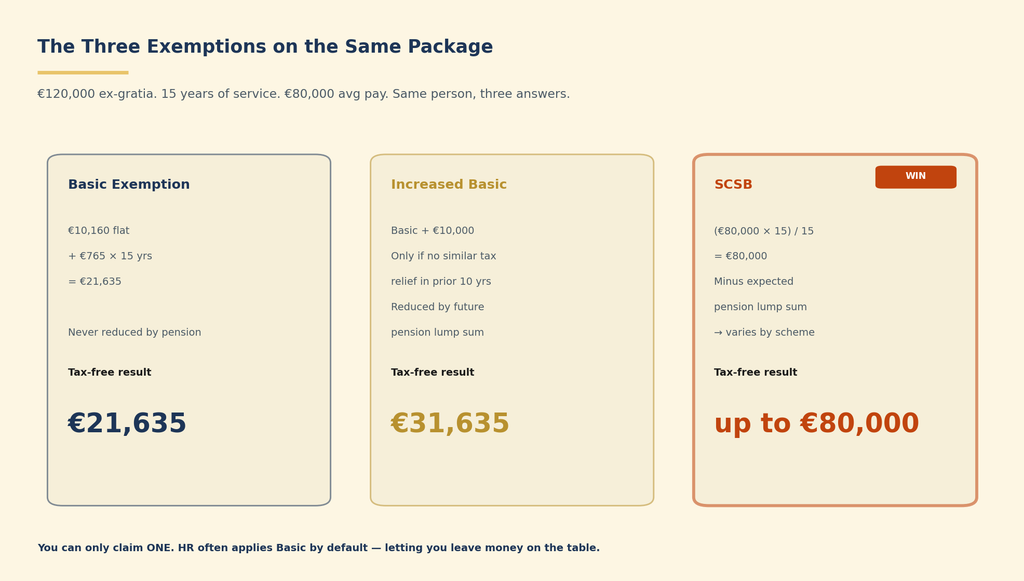
Same person, same package, three exemptions — dramatically different outcomes. You can only claim one.
Revenue allows you to apply the best of three exemptions to shelter your ex-gratia payment from income tax. You can only claim one — and picking the wrong one is the single most expensive redundancy mistake in Ireland.
Basic Exemption
€10,160 flat + €765 per complete year of service. Available to everyone. Never reduced by pension lump sums. This is what HR applies by default. It works best for shorter-service employees with modest ex-gratia payments.
Increased Exemption
Basic Exemption + €10,000, but only if (a) you have not received a tax-free termination lump sum in the previous 10 years, and (b) you’re either not in an occupational pension scheme or you waive the tax-free element of any future pension lump sum. The €10,000 uplift is reduced euro-for-euro by any tax-free pension lump sum you receive. In many cases it turns out to be nil.
Standard Capital Superannuation Benefit (SCSB)
(Average pay over last 3 years × complete years of service) ÷ 15, minus any tax-free pension lump sum. Almost always beats Basic + Increased for senior professionals and long-service employees. Include all taxable income in your average pay calculation: base salary, bonuses, BIK on health insurance, taxable benefits, and any TWSS payments received.
Worked example: 15 years’ service, average annual pay €80,000, no immediate pension lump sum. Basic: €21,635. Increased: €31,635. SCSB: €80,000. Choosing SCSB over Basic saves this employee €23,346 in tax at the 40% higher rate.
Redundancy tax myths still costing Irish employees money
| MYTH “PRSI, USC and Income Tax all apply to my redundancy payment.” | FACT Statutory redundancy is fully tax-free. PRSI never applies to qualifying termination lump sums (Section 123 TCA 1997). USC applies only to the taxable portion of the ex-gratia above your exemption. Get the sequence right. |
| MYTH “Top Slicing Relief will reduce my redundancy tax.” | FACT Top Slicing Relief was abolished in 2014. Any advice guide that still references it is out of date. The three current exemptions (Basic, Increased, SCSB) are all that remain. |
| MYTH “Only Meta and Google workers need to worry about SCSB.” | FACT SCSB benefits any long-service employee with above-average pay. A public-sector manager with 20 years’ service on €70k, a family-firm director with 30 years on €90k, a hospital consultant on €130k, all typically win with SCSB. |
| Ready to talk? Book a free, no-obligation consultation with the Money Maximising Advisors Group. Enquire Now • Book an Appointment • Contact Us |
The 90-day redundancy roadmap
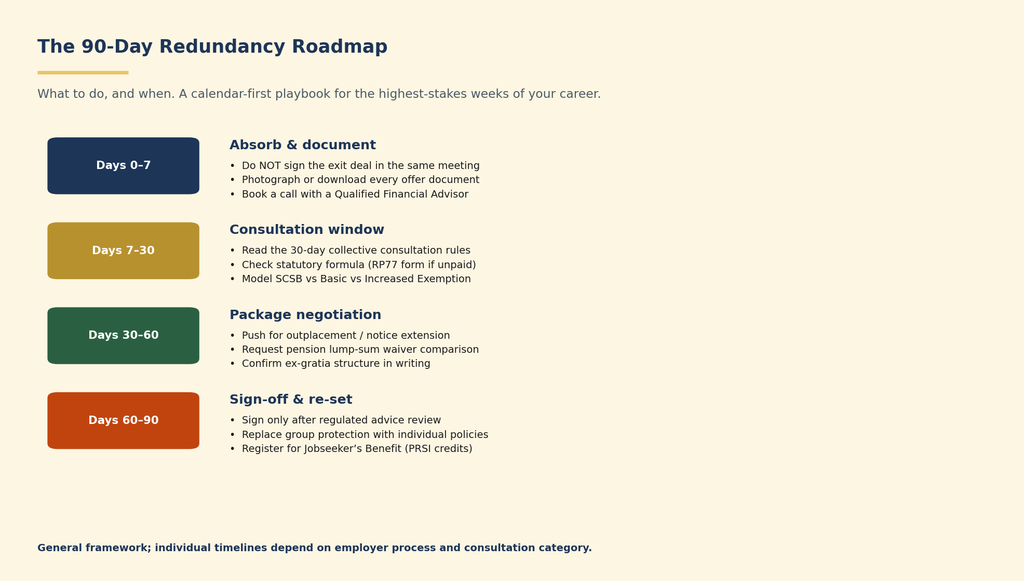
What to do, and when — a calendar-first playbook for the highest-stakes weeks of your career.
Days 0–7: Absorb, document, do not sign
The single most dangerous week. Do not sign the exit deal in the meeting. Do not verbally accept anything. Photograph or download every document you’re given. Book a call with a Qualified Financial Advisor (QFA) and, if the package is complex or your employer is contested, an employment lawyer. Use this week to understand what you’re being offered, not to respond.
Days 7–30: Consultation window and formula check
If you’re part of a collective redundancy (20+ dismissals), the 30-day consultation window is protected by law, use it. Even for individual redundancy, verify your statutory formula. If your employer disputes or withholds statutory, serve Form RP77 and escalate to the WRC within 1 year of dismissal. Model your ex-gratia through all three exemptions.
Days 30–60: Package negotiation
Push for outplacement support (typically 6–12 months of career coaching), extended notice or garden leave, retention of health insurance for 3–6 months, and share-vesting acceleration if applicable. Request the pension lump-sum waiver comparison in writing from your ex-gratia advisor. Confirm the tax structure in writing before agreeing.
Days 60–90: Sign-off and financial reset
Only sign after regulated advice review. Move group protection (life, income, health) to individual policies before your last day. Register for Jobseeker’s Benefit even if a new role is imminent. Consolidate previous pensions. Park the lump sum in a Regular Saver Investment Plan or short-term deposit for 60 days before making any major decisions.
Real-world scenario: a Dublin tech professional, €280k package, €42k saved
A 41-year-old software engineer was made redundant from a Dublin tech multinational in Q1 2026 after 11 years of service, with an average salary (base + bonus + BIK) of €142,000. The offered package: €28,000 statutory + €195,000 ex-gratia + €57,000 tax-free pension lump sum election available. The HR default assumed Basic Exemption. Actual outcome after Money Maximising Advisors review:
- Basic Exemption: €10,160 + (€765 × 11) = €18,575 tax-free → tax on €176,425 = ~€70,570 (40% rate)
- SCSB (as calculated): (€142,000 × 11) / 15 = €104,133. Minus pension lump sum €57,000 = €47,133 net tax-free
- SCSB with pension waiver: (€142,000 × 11) / 15 = €104,133 full — pension lump sum waived, retained inside pension for compound growth
Choosing SCSB with pension waiver, this employee kept €104,133 tax-free instead of €18,575, a €85,558 additional exemption, worth €34,223 in tax saved at 40%, plus USC savings. Their pension pot retained the €57,000 to grow tax-deferred to age 60. Total structural improvement over the HR default: ~€42,000 — achieved with three hours of professional advice.
| Reviewed by Money Maximising Advisors Money Maximising Advisors Limited is regulated by the Central Bank of Ireland and operates as a Multi-Agency Intermediary across the main Irish lenders, insurers and pension providers. Our advisors hold QFA, RPA, CFP and FA designations and every recommendation is documented in a written Statement of Suitability. Verify our authorisation on the Central Bank Register, or learn more about us. |
Related posts
| Related post | Category | Read more |
|---|---|---|
| What Happens to Your Pension After Redundancy in Ireland? A 2026 Guide to Protecting Your Retirement Savings | Pension planning | View → |
| Redundancy Pension in Ireland: A Complete Guide to Protecting Your Financial Future | Redundancy & pension | View → |
| Step-by-Step Redundancy Advice Ireland for Employers | Employer guidance | View → |
| Redundancy in Ireland: Implications and Entitlement | Redundancy basics | View → |
| Understanding Redundancy Payment Options in Ireland | Payment options | View → |
Frequently asked questions about redundancy in Ireland
What is voluntary redundancy in Ireland?
Voluntary redundancy is where an employer invites employees to volunteer for redundancy, usually offering an enhanced ex-gratia payment above statutory. Common terms: 2–6 additional weeks per year of service, sometimes more for senior roles. Voluntary schemes are often the most tax-efficient way to exit — provided you plan the SCSB and pension structure properly before signing.
What is the €200,000 lifetime cap on redundancy?
It’s a lifetime aggregate of all tax-free ex-gratia amounts received across every employer. Statutory redundancy does not count against it. Once you exceed €200,000 across your career, all further ex-gratia (up to any exemption) becomes taxable at marginal rate.
Can I claim Jobseeker’s Benefit after redundancy?
Yes. If you have at least 39 PRSI contributions in the relevant tax year, you can claim Jobseeker’s Benefit for up to 234 days (roughly 9 months). Redundancy payments do not affect eligibility. Even if you have a new job starting in 4–6 weeks, still register, you protect your PRSI credits.
What happens to my company pension when I’m made redundant?
You have three options: leave it in the existing scheme as a preserved benefit; transfer to a new employer’s scheme; or transfer to a Personal Retirement Bond (Buy-Out Bond) or PRSA in your own name. Consolidation via a PRB is usually the best long-term move, but the analysis depends on charges, guarantees and death benefits in the existing scheme.
Can I be selected for redundancy while on maternity or parental leave?
Only in very limited circumstances, and only where the redundancy is genuine and the selection is demonstrably non-discriminatory. The Maternity Protection Acts and the Employment Equality Acts give strong protection here. If you’re on protected leave and being selected for redundancy, speak to a solicitor immediately.
Facing redundancy? Talk to a regulated advisor before you sign
Whether you’ve just received notice or you’re weighing up a voluntary redundancy offer, the Money Maximising Advisors Group can model your tax exemptions, run the SCSB vs pension-lump-sum trade-off, and help you negotiate the best possible net outcome — confidentially and at no direct cost until you engage.
| Ready to talk? Book a free, no-obligation consultation with the Money Maximising Advisors Group. Enquire Now • Book an Appointment • Contact Us |
Important information
This article is for general information only and does not constitute tax, legal or financial advice. Redundancy taxation in Ireland is technical and depends on individual circumstances, you should always take personalised advice from a Qualified Financial Advisor and, where appropriate, a solicitor before signing any redundancy or termination agreement. Statutory formulas, tax exemptions, the €200,000 lifetime cap, the Standard Fund Threshold and Central Bank measures referenced reflect Irish tax and employment law as at June 2026 and are subject to change. Money Maximising Advisors Limited is regulated by the Central Bank of Ireland.