Losing your job in Ireland is stressful. Rent, mortgage payments and bills don’t stop. Many workers assume they can buy “redundancy insurance” to cover the gap. That assumption is wrong. This guide from Money Maximising Advisors explains what really exists, and what actually protects Irish workers.
You will learn what statutory redundancy pays. You will learn why income protection doesn’t cover job loss. And you will learn the four-layer stack that fills the real gap.
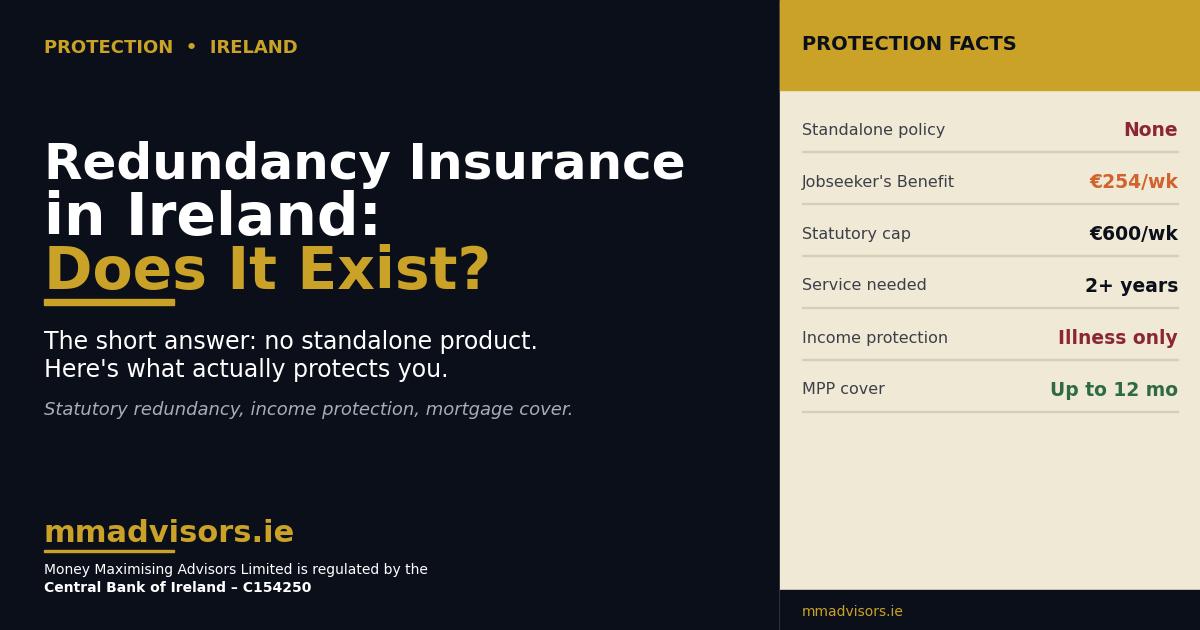
| QUICK ANSWER: No Irish-authorised insurer offers a standalone redundancy insurance policy in 2026. UK-style unemployment cover is not available here. What does protect you: statutory redundancy from your employer (if you have 2+ years’ service), Jobseeker’s Benefit from the State (up to €254/week), income protection insurance (illness only, not job loss), and mortgage payment protection on some products (up to 12 months of mortgage cover after redundancy). |
| This pillar connects Irish workers to the specific protection products we arrange: Income Protection, Mortgage Protection, Serious Illness Cover and Public Sector Salary Protection. |
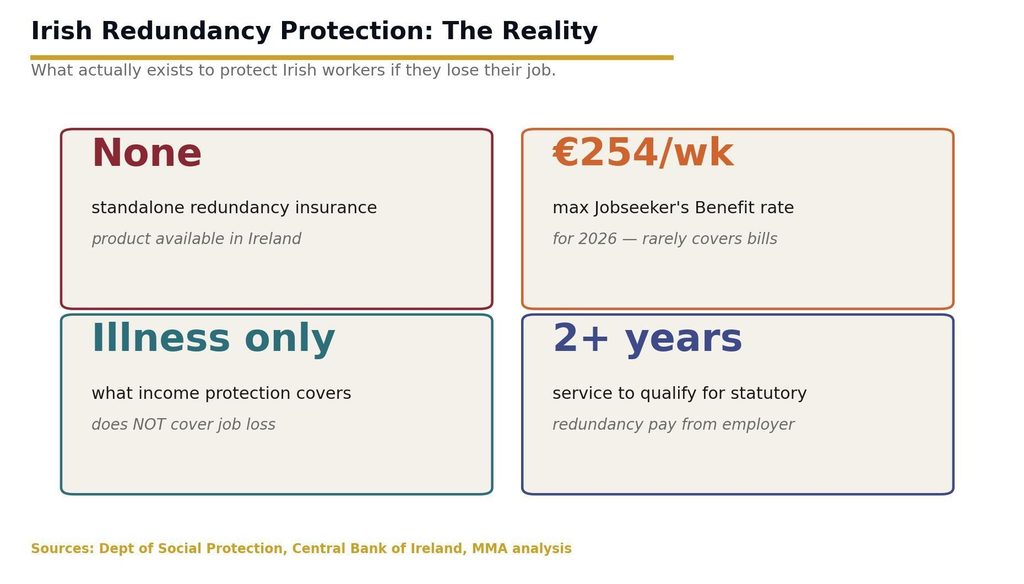
The reality of what actually exists to protect Irish workers if they lose their job.
Does redundancy insurance exist in Ireland?
The short answer is no. There is no Irish-authorised insurer selling a standalone redundancy or unemployment insurance policy in 2026.
Unlike the UK, where redundancy insurance (sometimes called ASU cover) has been widely available for decades, Ireland does not have an equivalent retail product.
Post-Brexit, UK insurers can no longer sell into Ireland without Central Bank of Ireland authorisation. EEA insurers technically could, but none are actively distributing a redundancy product to the Irish public.
The demand for this cover is real. The gap in the market is real. But the product simply does not exist here right now.
What is statutory redundancy in Ireland?
Statutory redundancy is the legal minimum payment your employer must make if you are made redundant. You qualify if you have at least two years’ continuous service with the same employer.
The payment is calculated using a specific formula. It is tax-free.
The formula
Statutory redundancy pays:
- Two weeks’ pay for every full year of service.
- Plus one extra week’s pay as a bonus.
- Weekly pay is capped at €600 for calculation purposes.
Worked example
Meet Ciara. She has worked for a Dublin tech firm for 8 years. Her salary is €55,000, or roughly €1,058 per week.
The €600 cap applies to her weekly figure. Two weeks per year of service equals 16 weeks. Plus the 1-week bonus gives 17 weeks.
Her statutory redundancy: 17 × €600 = €10,200, tax-free.
Many employers pay more than the statutory minimum. This is called an ex-gratia payment. It is negotiated between employer and employee, and has separate tax rules.
What is Jobseeker’s Benefit worth?
Jobseeker’s Benefit is the main State support after redundancy. In 2026, the maximum personal rate is €254 per week, or about €13,200 per year.
You qualify if you have made enough PRSI contributions. Payment continues for up to 9 months. It is means-tested for those without enough PRSI history, that’s called Jobseeker’s Allowance.
For most Irish households, €254 per week does not come close to covering monthly bills. Mortgage or rent alone often exceeds the whole weekly payment.
Statutory protections are a floor. They were never designed to fully replace income during unemployment.
Does income protection cover redundancy?
No. This is the most common misunderstanding we see. Income Protection pays out only if illness or injury stops you working.
If you are made redundant, you are technically unemployed. You are able to work, you just don’t have a job. So income protection will not pay.
Income protection is still one of the most valuable policies you can buy. It covers a genuine risk. But it is not the redundancy solution some people assume it is. Consider it alongside Serious Illness Cover and Life Insurance in a full protection review.
Does mortgage protection cover redundancy?
Some products do. Standard Mortgage Protection is life-only, it pays out if you die during the mortgage term. It doesn’t cover job loss.
A separate product called Mortgage Payment Protection (MPP) does cover redundancy. It pays your mortgage repayments for a fixed period, typically up to 12 months, after involuntary redundancy or extended illness.
MPP has fallen out of favour after high claim rates during 2008–2013. Premiums are relatively expensive. Coverage is time-limited. And exclusions are significant, voluntary redundancy, self-employment periods and pre-existing knowledge of redundancy all block claims.
Still, for some households, particularly those with concentrated income risk, it can bridge a critical gap.
| Not sure what protection stack fits your situation? Book Now for a free 30-minute review, or Enquire Now, we’ll come back within one working day. |
What actually protects you: the four-layer stack
Layer 1: Emergency cash reserve
The most powerful and flexible form of redundancy protection is an emergency fund. Financial planners typically recommend 3–6 months of essential outgoings in an accessible savings account.
An emergency fund has no premiums. No exclusions. No claim process. You can spend it on whatever your family actually needs, not just what a policy specifically covers.
Layer 2: Income Protection
This won’t help with redundancy directly. But it covers the other big income-loss risk: illness or injury that stops you working. Premiums qualify for income tax relief at your marginal rate. See our Income Protection page for full details.
Layer 3: Mortgage Payment Protection
If your primary concern is keeping the roof over your family’s head, MPP may be worth including. It covers your mortgage payments for a fixed period after redundancy or illness. Not cheap, but sometimes exactly what you need.
Layer 4: Serious Illness Cover
A lump-sum payout if you are diagnosed with a specified serious illness. Different from income protection, it covers a different risk. Many households use Serious Illness Cover alongside income protection for full financial resilience.
What to do right after being made redundant
If redundancy has already happened, here’s the immediate playbook:
- Check your statutory entitlement. You should receive at least 2 weeks per year of service plus a 1-week bonus, capped at €600/week.
- Apply for Jobseeker’s Benefit. Contact your local Intreo office as soon as possible. Applications process faster with all documents ready.
- Contact your mortgage lender. Payment breaks and restructured repayments are available on most Irish mortgages during redundancy periods.
- Review your pension. Redundancy is a major pension planning moment, don’t leave a workplace pension dormant.
- Get advice on the lump sum. Ex-gratia payments have specific tax rules. Our Redundancy Advice service maps every option.
Common protection mistakes
- Assuming income protection covers redundancy. It doesn’t. It covers illness only.
- Waiting for a product that doesn’t exist. Build the four-layer stack now instead.
- Skipping the emergency fund. This is the most flexible protection you can have.
- Cancelling protection to save money. Redundancy risk goes up in downturns, so does illness risk.
- Not reviewing after major life changes. Marriage, mortgage, children and job changes all shift your risk profile.
Frequently asked questions
Does redundancy insurance exist in Ireland?
No. No Irish-authorised insurer sells a standalone redundancy insurance policy in 2026. UK-style unemployment cover is not available in the Irish retail market.
Does income protection cover redundancy?
No. Income protection pays out only if illness or injury stops you working. Being made redundant does not qualify for a claim.
How much statutory redundancy will I get?
Two weeks’ pay per year of service plus one bonus week, with weekly pay capped at €600 for calculation purposes. Payment is tax-free. You need at least two years’ continuous service to qualify.
How much is Jobseeker’s Benefit in 2026?
The maximum personal rate is €254 per week. Additional amounts apply if you have qualified adults or children. Payment lasts up to 9 months.
What protects me if I lose my job?
Build a four-layer stack: an emergency cash reserve (3–6 months of essential expenses), income protection (for illness), mortgage payment protection (some products cover redundancy), and serious illness cover. Combined with statutory redundancy and Jobseeker’s Benefit, this creates meaningful resilience.
Is statutory redundancy payment taxable?
Statutory redundancy is fully tax-free. Ex-gratia (voluntary) payments from an employer above the statutory minimum have separate tax rules, with specific exemptions available depending on service length and age.
Reviewed by our protection team
This guide was prepared and reviewed by the protection team at Money Maximising Advisors, using Department of Social Protection rates, Central Bank product data, and current live protection quotes. MMA is regulated by the Central Bank of Ireland (C154250).
Redundancy stack review, free
Whether you have been made redundant, feel it’s coming, or want to build resilience for the future, we’ll map your specific protection stack. Book Now for a free consultation, or Enquire Now.
Important information
Jobseeker’s Benefit and statutory redundancy rates are those in force at time of writing and are subject to change. Product availability and specific terms depend on individual insurer criteria, health status, and occupation. Money Maximising Advisors Limited is regulated by the Central Bank of Ireland (C154250). This article is for general information only and does not constitute financial, tax or legal advice. Speak to a Qualified Financial Advisor before making any protection decision.