
For the first time in over a decade, the rules around how much you can hold in your pension without facing extra tax have changed — and it is good news for savers in Ireland.
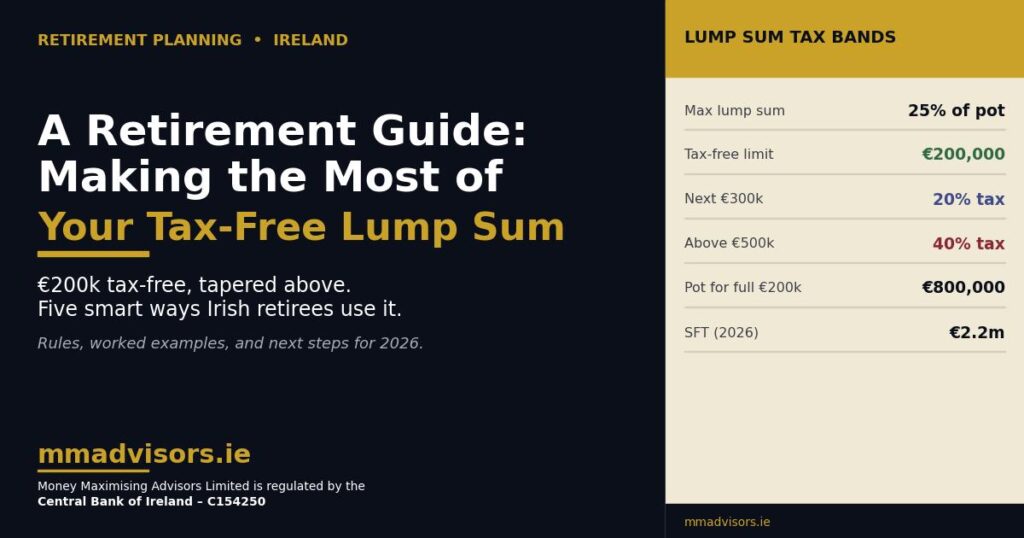
From 1 January 2026, the Standard Fund Threshold (SFT) has increased from €2 million to €2.2 million. This is the first step in a series of planned increases that will bring the limit to €2.8 million by 2029. If you have a large pension fund, are approaching retirement, or are a high earner in the public or private sector, this change is worth understanding carefully.
In this guide, the team at Money Maximising Advisors breaks down exactly what the SFT is, what has changed, who it affects, and what steps you should consider taking in 2026.
What Is the Standard Fund Threshold?
The Standard Fund Threshold is the lifetime limit on the total value of tax-relieved pension benefits an individual can draw in Ireland. It applies across all pension arrangements you hold, including:
- Occupational pension schemes (defined benefit and defined contribution)
- Personal Retirement Savings Accounts (PRSAs)
- Retirement Annuity Contracts (RACs)
- Additional Voluntary Contributions (AVCs)
- Personal Retirement Bonds
The key point: the SFT is not a limit on how much you can save. It is a limit on how much you can draw tax-efficiently. Any pension benefits drawn above the threshold are subject to a Chargeable Excess Tax (CET) of 40% — on top of any income tax owed on drawdown.
Explore more: Saving Pension Plan in Ireland: The 2026 Expert Guide to Building a Secure Retirement.
Why Was the SFT Frozen for So Long?
The SFT was first introduced in 2005, originally set at €5 million. It was reduced to €2.3 million in 2010, and again to €2 million in 2014, where it remained for over a decade.
During this time, salaries rose, investment markets delivered strong returns, and the cost of living increased substantially. The threshold, however, did not move. This meant that many diligent, long-term savers — particularly senior employees and public sector workers — found themselves at risk of an unexpected 40% tax charge, not because they were wealthy, but simply because time and compound growth had pushed their fund above a frozen limit.
A government-commissioned review, led by Donal de Buitléir, concluded that the threshold needed to be updated to reflect economic reality. Budget 2025 announced the changes, and they came into effect from January 2026.
What Has Changed in 2026?
Here is the phased schedule of SFT increases:
| Year | Standard Fund Threshold |
|---|---|
| 2025 | €2,000,000 |
| 2026 | €2,200,000 |
| 2027 | €2,400,000 |
| 2028 | €2,600,000 |
| 2029 | €2,800,000 |
From 2030 onwards, the SFT will be indexed annually in line with average earnings growth, based on CSO data. This means the threshold will no longer be left frozen whilst the economy moves on.
It is important to note that the maximum tax-free lump sum of €500,000 remains unchanged. This cap has not been increased alongside the SFT, so the lump sum rules are a separate consideration in your retirement planning.
What About Chargeable Excess Tax?
The 40% Chargeable Excess Tax rate remains in place for now. Following the de Buitléir review, there had been a recommendation to reduce the CET rate — potentially as low as 10% — but the government has deferred this decision. A review is committed to before 2030, but the 40% rate applies until further legislation is introduced.
This is an important distinction. The threshold has been raised, giving more headroom. But if you exceed the new threshold, the tax consequence remains significant.
Who Does This Affect?
The SFT changes are most relevant to:
- Senior employees in the private sector with long careers and high contributions
- Public sector workers — particularly those in defined benefit schemes, where the pension valuation can be substantial even if it does not feel like it
- Self-employed individuals and company directors who have been contributing to pensions for many years
- Anyone approaching retirement with a fund that was tracking close to the old €2 million limit
- People who have already taken some benefits and have remaining pension assets still to crystallise
If your fund was projected to breach €2 million, the increase to €2.2 million in 2026 — and further increases ahead — may reduce or eliminate a potential tax liability, depending on your circumstances.
Related article: Pension Plan in Ireland: How Much Will My Pension Pay Me If I Retire at 60?.
How Do the Phased Increases Work if You Are Already Drawing Benefits?
When you draw pension benefits, this is known as a Benefit Crystallisation Event (BCE). At each BCE, a portion of your SFT is used. The percentage used is calculated based on the value drawn relative to the threshold at the time.
For example, if you previously used 50% of the SFT, you have 50% of the current €2.2 million remaining — that is, €1.1 million, rather than €1 million under the old rules. This can be meaningful if you have pension assets not yet crystallised.
The timing of your retirement relative to the phased increases matters. If your fund is close to the current threshold, delaying drawdown until a higher threshold applies could reduce your CET exposure. This requires careful analysis on a case-by-case basis — there is no one-size-fits-all answer.
What About Defined Benefit Pension Valuations?
For those in defined benefit (DB) schemes — common in the public sector and in some private sector organisations — the pension is converted to a capital value for SFT purposes using a valuation factor. This is currently set at 20 times the annual pension.
This means a defined benefit pension of €100,000 per annum would be valued at €2 million for SFT purposes — right at the old limit. With the threshold now at €2.2 million and rising, DB members who were previously at risk of a CET charge may find themselves with more comfortable headroom.
Practical Steps to Consider in 2026
If you think the SFT changes may affect you, here are the key actions worth taking:
- Review your total pension value across all arrangements Many people have multiple pension pots from previous employments, PRSAs, and occupational schemes. The SFT applies to the combined value, so a full picture is essential.
- Understand your personal fund threshold (PFT) If your fund was valued above the SFT at certain historical dates (31 December 2005 or 1 January 2014), you may have a higher personal fund threshold locked in. This needs to be documented and tracked correctly.
- Model the timing of your retirement Given the phased increases to 2029, the year in which you choose to take benefits can have a meaningful impact. A financial plan that maps your projected fund value against the rising threshold can identify the optimal window.
- Do not rely on the lump sum cap changing The tax-free lump sum remains at €500,000. Planning around this limit separately from the SFT is important.
- Consider your inheritance tax position Pension assets that remain undrawn at death can have inheritance tax implications. Reviewing your estate planning alongside your SFT position is always worthwhile.
- Get professional pensions advice The SFT is one of the most technically complex areas of Irish pension planning. The interaction between phased threshold increases, existing vested benefits, DB valuations, lump sum limits, and drawdown timing means your situation is genuinely different from anyone else’s.
How Money Maximising Advisors Can Help
At Money Maximising Advisors, we specialise in pension planning for both the public and private sectors across Ireland. Our team of Certified Financial Planners (CFPs) and Qualified Financial Advisors (QFAs) has over 30 years of experience helping clients navigate exactly these kinds of changes.
Whether you are a public sector employee trying to understand how your superannuation is valued, a self-employed individual managing contributions across multiple arrangements, or a senior executive reviewing your retirement timeline — we are here to give you clear, personal, and practical advice.
The 2026 SFT increase is a genuine opportunity to revisit your retirement strategy and ensure you are positioned as tax-efficiently as possible. But acting on it requires the full picture of your pension position and a plan built around your specific circumstances.
Book a free consultation with our team today at mmadvisors.ie or call us on +353 91 393 125.