
If you’ve recently inherited money or property — or you’re expecting to — one of the first questions you’re likely asking is: how much can I actually keep without paying tax? It’s a very common concern, and understandably so. Inheritance tax Ireland rules can feel confusing at first glance, but once you understand the thresholds and exemptions, things become a lot clearer.
At Money Maximising Advisors Limited, we help families across Ireland — including Dublin and Galway — make sense of exactly these situations every day. In this guide, we’ll walk you through everything you need to know about the tax free inheritance Ireland rules in 2026.
What Is Inheritance Tax in Ireland?
In Ireland, inheritance tax is officially known as Capital Acquisitions Tax (CAT). It’s a tax charged on gifts and inheritances you receive above a certain threshold. The current Capital Acquisitions Tax Ireland threshold depends entirely on your relationship to the person who left you the inheritance.
The key point most people miss? You don’t pay tax on everything you inherit — only on the amount that exceeds your tax-free allowance. And depending on who left it to you, that allowance can be quite substantial.
The Three CAT Threshold Groups Explained
The inheritance tax allowance Ireland is split into three groups, known as Group A, Group B, and Group C. These are based on your relationship to the deceased.
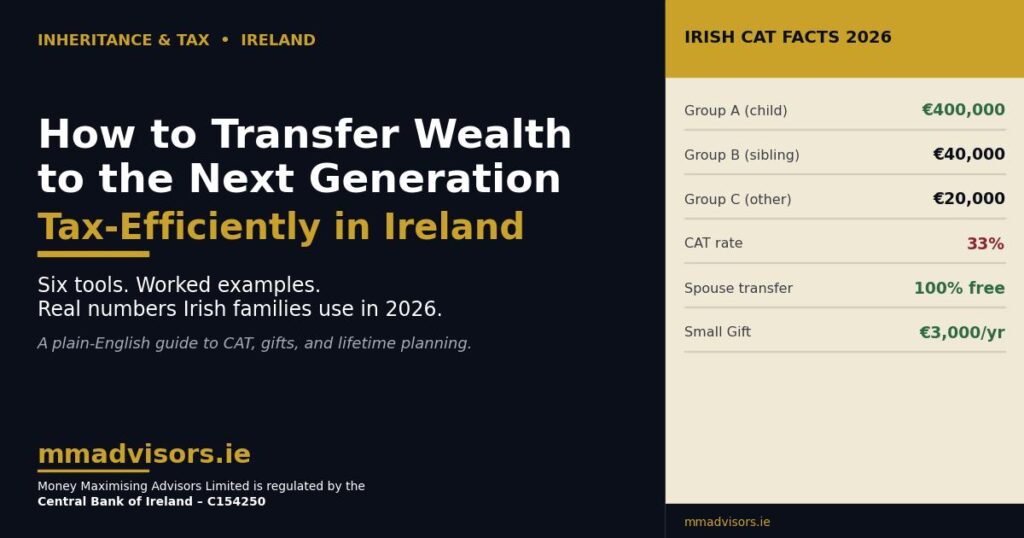
Group A — €400,000 tax-free threshold
This applies to children inheriting from a parent. As of 2026, a child can receive up to €400,000 from a parent completely tax-free. This is by far the most generous CAT threshold Ireland and covers the vast majority of family home inheritances.
Group B — €40,000 tax-free threshold
This covers siblings, nieces, nephews, grandchildren, and other lineal relatives. If you fall into this group, you can receive up to €40,000 tax-free.
Group C — €20,000 tax-free threshold
This is the lowest threshold and applies to anyone who doesn’t fall into Group A or B for example, a friend, a partner who isn’t a spouse, or a more distant relative.
These thresholds are lifetime limits, which means they accumulate across all gifts and inheritances you receive from people in the same group since 5 December 1991.
What Is the Inheritance Tax Rate in Ireland?
Once you exceed your relevant inheritance tax limit Ireland, the standard CAT rate of 33% applies to the excess. So if you’re a child inheriting €500,000 from a parent, you’d pay 33% on the €100,000 above the €400,000 threshold — which comes to €33,000 in tax.
Understanding your inheritance tax rules Ireland position before you receive an inheritance — or well in advance — gives you the best chance to plan and reduce your liability legally.
Are There Additional Exemptions That Can Help?
Yes and this is where good financial planning really pays off. Beyond the core inheritance tax Ireland threshold, there are several exemptions worth knowing about:
- Spousal Exemption: Inheritances between spouses or civil partners are completely exempt from CAT. There is no limit on what a spouse can receive from their partner tax-free.
- Dwelling House Exemption: If you inherit a home and have been living in it for at least three years before the date of inheritance (and don’t own another home), you may be able to inherit it entirely tax-free.
- Agricultural Relief: If you inherit farmland or agricultural assets and qualify as a farmer, you may be eligible to reduce the taxable value by 90%.
- Business Relief: Similar 90% relief can apply to qualifying business assets.
- Small Gift Exemption: Any person can receive up to €3,000 per year from any individual completely tax-free. This is a useful and perfectly legal way to pass on wealth gradually.
For more detail on how these work in practice, have a read of our related guide: Demystifying Inheritance Tax in Ireland: Rules and Calculations
Planning Ahead: How to Reduce Your Tax Liability
The good news is that with the right planning, many Irish families can significantly reduce — or even eliminate — their inheritance tax Ireland liability. Some popular strategies include:
- Using the annual €3,000 small gift exemption to pass on wealth gradually and tax-free
- Taking out a Section 73 insurance policy to pre-fund a future CAT bill (read more: How a Section 73 Policy Can Reduce Inheritance Tax in Ireland)
- Gifting assets to children or family members during your lifetime to reduce what’s in your estate
- Making use of the Dwelling House Exemption where applicable
Want a personalised look at your options? Enquire Now and one of our expert advisors will get back to you.
You might also find these resources helpful as you plan:
- Inheritance Tax Ireland | How To Avoid Legally
- Inheritance Tax Ireland – How to Reduce your Tax Burden
- Gift Tax in Ireland: How Does Gift and Inheritance Tax Work?
Do Spouses Pay Inheritance Tax in Ireland?
No. Transfers between spouses and civil partners are fully exempt from CAT — there is no upper limit. This is one of the most significant exemptions under inheritance tax rules Ireland, and it means married couples can pass their entire estate to each other without any tax liability at all.
It’s worth noting, however, that when the surviving spouse eventually passes away and leaves assets to children or other relatives, those beneficiaries may then have a CAT liability depending on the values involved.
What If You’ve Already Received Gifts in the Past?
Because the CAT threshold Ireland is a lifetime cumulative figure, any gifts you’ve received from people in the same group since December 1991 count towards your threshold. If you’ve already used up a significant portion of your Group A threshold through previous gifts, for example, you may have less tax-free allowance remaining than you think.
This is why getting professional advice early — and keeping track of any gifts you’ve received — is so important.
Book Now to schedule a consultation with one of our specialist tax advisors and get a clear picture of your personal position.
A Quick Summary: Tax Free Inheritance Ireland at a Glance
| Relationship to Deceased | Tax-Free Threshold (2026) |
| Child from parent (Group A) | €400,000 |
| Sibling, niece, nephew, grandchild (Group B) | €40,000 |
| All others, including friends (Group C) | €20,000 |
| Spouse or civil partner | Fully exempt |
CAT rate on excess: 33%
Conclusion
Understanding how much of your inheritance is tax free in Ireland doesn’t have to be overwhelming. The key is knowing which group you fall into, what threshold applies to you, and whether any additional reliefs or exemptions might reduce your bill further.
At Money Maximising Advisors Limited, our experienced team of Certified Financial Planners and Tax Advisors specialises in helping Irish families plan their estates smartly and efficiently — so more of your wealth stays where it belongs: with your loved ones.
Don’t leave your inheritance planning to chance. Contact Us today, or Book an Appointment to speak with one of our qualified advisors at a time that suits you.
Frequently Asked Questions
- How much inheritance can you receive tax free in Ireland?
It depends on your relationship to the person who left you the inheritance. Children can receive up to €400,000 tax-free from a parent, while other relatives and non-relatives have lower thresholds of €40,000 or €20,000. The inheritance tax Ireland threshold is a lifetime cumulative limit.
2. What is the inheritance tax threshold in Ireland for children?
Under Group A of the capital acquisitions tax Ireland threshold rules, a child can inherit up to €400,000 from a parent without paying any CAT. Anything above this is taxed at 33%.
3. Do you pay tax on inheritance in Ireland? Yes, if the inheritance you receive exceeds your tax free inheritance Ireland threshold, you are liable for Capital Acquisitions Tax (CAT) at a rate of 33% on the excess. However, many people — particularly children inheriting from parents — fall within the tax-free limit.
4. What is the Capital Acquisitions Tax rate in Ireland?
The standard Capital Acquisitions Tax Ireland rate is 33%. This applies to any gift or inheritance that exceeds your applicable group threshold.
5. Is inheritance from parents tax free in Ireland?
It can be, yes. Under inheritance tax allowance Ireland rules, a child can receive up to €400,000 from a parent completely tax-free. Additional reliefs such as the Dwelling House Exemption may increase this further depending on your circumstances.
6. Do spouses pay inheritance tax in Ireland?
No. Inheritances between spouses and civil partners are fully exempt from inheritance tax Ireland. There is no upper limit on what a spouse or civil partner can receive tax-free.
Disclaimer: This article provides general information and should not be considered personalised financial or tax advice. Irish tax laws — including inheritance tax Ireland thresholds and CAT rates — are subject to periodic change, and individual circumstances vary significantly. Always consult with a qualified financial advisor or tax professional before making any significant financial or estate planning decisions.