Quick Answer
Landlord insurance cover in Ireland protects the building, your liability as a property owner, the contents you supply and the rent you lose after an insured event. A typical policy combines buildings cover, property owners liability of around three million euro, loss of rent and optional tenant damage cover. It is not required by law, but a buy to let lender will usually insist on it.
Introduction
Landlord insurance cover exists because the standard home insurance policy you held as an owner occupier almost certainly stops protecting the property the moment you rent it out. Letting changes the risk profile, and most household policies either exclude tenanted properties outright or allow the insurer to refuse a claim once it discovers the property was let without being declared. For anyone renting out a property in Ireland, that single fact is why specialist landlord insurance cover matters more than the price on the renewal notice.
This guide sets out exactly what landlord insurance covers, what it does not, what it costs and how it sits alongside your legal obligations in 2026. Money Maximising Advisors arranges property and home insurance for clients across Ireland, so the detail below reflects how these policies work in practice rather than how a brochure describes them.
What does landlord insurance cover? The short version
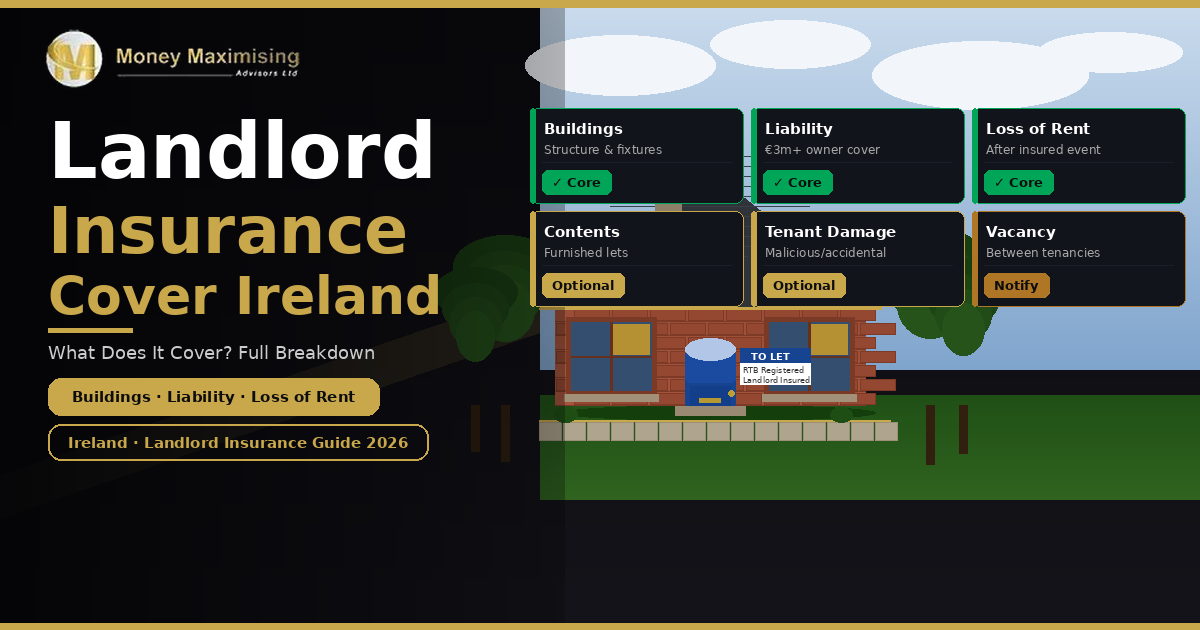
A typical Irish landlord policy brings together four core elements, with a set of optional extras layered on top depending on how the property is let.
| Cover | What it protects | Usually included |
| Buildings | Structure, roof, walls, permanent fixtures | Yes, core |
| Property owners liability | Injury or damage claims brought against you | Yes, core |
| Loss of rent | Rental income lost after an insured event | Yes, usually core |
| Landlord contents | Furniture and appliances you own | Optional, needed for furnished lets |
| Malicious or accidental tenant damage | Deliberate or accidental damage by tenants | Optional on most policies |
| Unoccupied cover | Risk while the property sits empty | Optional, notification required |
| Employers liability | Staff you directly employ at the property | Optional, portfolio landlords only |
The point of the product is that it is built around the risks of letting. A standard household policy is not, which is where the trouble starts.
Is landlord insurance compulsory in Ireland?
No. There is no law in Ireland requiring a landlord to hold insurance. Two practical pressures make it close to unavoidable anyway.
First, if you bought the property on a buy to let mortgage, your lender will almost always require buildings insurance as a condition of the loan. Check the mortgage terms, because lenders frequently specify a minimum level of cover and will want evidence of it annually.
Second, leaving without cover leaves you personally exposed to costs that dwarf any premium. A fire that makes the property uninhabitable, a tenant injured by a defect who brings a personal injury claim, or six months of lost rent while structural repairs are carried out are all costs you would carry yourself. Landlord insurance cover is optional in law and close to essential in reality.
What does landlord insurance cover, section by section
Landlord buildings insurance
This is the foundation of the policy. It protects the structure of the property, the walls, roof, floors and permanent fixtures such as fitted kitchens and bathrooms, against events including fire, storm, flood, escape of water and impact damage.
The sum insured should reflect the full rebuild cost, not the market value and not the price you paid. Those are different numbers, and confusing them is the single most common cause of underinsurance in the Irish market. If your sum insured is too low, an insurer can apply average and reduce the settlement proportionally, even on a small claim. The Society of Chartered Surveyors Ireland publishes a house rebuild calculator that is a sensible starting point, and for unusual or period properties a professional valuation is worth the fee.
Landlord contents insurance
Contents cover protects items you own inside the property, not the tenant’s belongings. For a furnished let that means sofas, beds, white goods, curtains, carpets, blinds and appliances. For an unfurnished let you may need very little beyond carpets and light fittings.
Be clear on the boundary, because it causes real friction after an incident. Landlord contents cover never extends to the tenant’s own possessions. Tenants need to arrange their own contents insurance, and it is worth stating that plainly in the tenancy agreement so nobody discovers it after a burst pipe.
Property owners liability insurance
This is often the most important cover in the whole policy and the one landlords most often overlook. Property owners liability, sometimes called public liability, responds if a tenant, a visitor or a passer by is injured, or their property is damaged, because of something you are legally responsible for as the owner.
A loose stair tread, a defective boiler, a falling roof tile or an unlit communal path can all generate a claim, and personal injury awards plus legal costs run well beyond what most landlords expect. Policies in the Irish market commonly provide a liability limit in the region of three million euro, although you should always confirm the exact figure on your own policy schedule rather than assume it.
Loss of rent insurance
If an insured event such as a fire or a serious escape of water makes the property uninhabitable, loss of rent cover replaces the rental income you lose while repairs are carried out. Many policies also fund alternative accommodation for the tenant where the wording provides for it.
Cover is normally expressed either as a percentage of the buildings and contents sum insured, often between ten and twenty per cent, or as a fixed number of months. This is the cover that turns a disaster into an inconvenience rather than a financial hole, particularly if the property is mortgaged and the repayment continues while the rent stops.
Malicious and accidental damage by tenants
Some policies include tenant damage as standard and many offer it as an option, covering damage that is either deliberate or accidental. Terms vary widely between insurers and exclusions are common, so this is a section of the wording to read properly rather than skim.
Tenant damage cover does not replace the deposit or the Residential Tenancies Board dispute process. It exists for the situations where damage runs well beyond anything a one month deposit would meet.
Landlord insurance cover during empty periods
Most policies restrict or suspend certain elements of cover once a property has been vacant for a set number of consecutive days, commonly thirty. Escape of water, malicious damage and theft are usually the first covers to fall away.
Between tenancies, during a refurbishment, or while a property is being prepared for letting, you may need to notify your insurer and arrange specific vacancy cover. This overlaps directly with unoccupied home insurance Ireland, which is worth understanding before your property sits empty rather than after a claim is declined.
Employers liability
If you directly employ anyone to work at the property, a caretaker, a gardener or a cleaner for a block, you may need employers liability cover. Most single property landlords will not. Portfolio landlords operating at scale often do, and at that point the cover starts to look less like a household policy and more like commercial insurance. Landlords running lettings through a limited company or as a registered trade should also look at business insurance for sole traders and SMEs to make sure the trading entity itself is covered.
What landlord insurance does not cover
Naming the gaps matters as much as listing the cover, and it is where most competitor pages stop short.
The tenant’s belongings. Always the tenant’s own responsibility, never yours.
General wear and tear. Insurance responds to sudden, accidental events. It does not fund the gradual deterioration that comes with any tenancy, and it will not replace a tired carpet.
Rent your tenant simply stops paying. Standard loss of rent cover is tied to an insured event such as a fire. It does not respond to arrears or a tenant refusing to pay. Rent guarantee is a separate and far less common product with strict conditions attached.
Undisclosed risks. If you do not tell the insurer something material, the property type, the tenancy type, a previous claim, a period of vacancy or a HAP arrangement, the insurer may reduce or decline a claim. Non disclosure is the most avoidable reason a landlord claim fails.
Failure to maintain minimum standards. Insurance does not substitute for keeping the property to the legal standard, covered below.
Deliberate acts by you. Obvious, but worth stating.
Apartment landlord insurance Ireland: the block policy trap
This one catches out a large number of apartment landlords. If you own an apartment, the building is usually insured under a block policy arranged by the owners management company, and your annual management fee contributes to it. That block policy typically covers the structure and the common areas.
What it very often does not cover is your own property owners liability as the individual landlord letting your unit, or the contents you have placed inside it. The practical result is an apartment landlord who believes they are fully covered and is in fact personally exposed on the single most expensive type of claim.
Before you conclude you need no cover of your own, get written confirmation from the management company or its broker setting out exactly what the block policy insures and, critically, whether it extends property owners liability to you as a letting landlord. In most cases it does not. You will then need at least a landlord liability and contents policy of your own, which is considerably cheaper than a full buildings policy because the structure is already insured.
Landlord insurance cover and your 2026 legal obligations
Insurance is not a substitute for compliance, and compliance is not a substitute for insurance. They sit side by side, and your insurer will care about both.
The main obligations for an Irish landlord in 2026 include registering every tenancy with the Residential Tenancies Board within one month of it commencing, at a fee of forty euro per tenancy, and renewing that registration annually. Failing to register is an offence, blocks you from using the RTB dispute resolution service and can cost you mortgage interest relief against your rental income.
Your property must also meet the minimum standards in the Housing (Standards for Rented Houses) Regulations 2019, covering heating, ventilation, sanitation, electrical and gas safety, smoke and carbon monoxide alarms, fire safety and a valid BER. Letting a property that does not meet these standards is a criminal offence and local authorities inspect. Since June 2025 the entire country has been a Rent Pressure Zone, so rent setting and rent review rules now apply everywhere rather than in designated areas only.
None of these are insurance requirements. They still matter to your insurer, because a property maintained to standard is a lower risk, a documented tenancy makes any claim far cleaner to handle, and a defect that breaches minimum standards is exactly the sort of thing a liability claim will be built on.
Landlord insurance cost in Ireland: what drives the premium
Premiums vary too much for a single national figure to be meaningful, and any page quoting one is guessing. The factors that actually move your quote are:
- Rebuild cost of the property, which is the largest single driver
- Location, construction type and age of the building
- Whether you are insuring buildings, or liability and contents only, as most apartment landlords are
- Furnished or unfurnished let
- Type of tenancy, single let, HAP, student let or short term let
- Level of liability cover and the loss of rent limit
- Your excess and your claims history
- Whether the property has periods of vacancy
A small modern apartment insured for liability and contents only sits at the lower end of the range. A large older house on a full buildings, contents, liability and loss of rent basis sits considerably higher. For a broader sense of how property premiums are moving in the Irish market, our guide to home insurance cost sets out the current picture and the factors pushing rebuild costs up.
One genuinely useful point that most insurance pages omit: landlord insurance premiums are an allowable expense against your rental income for tax. A registered landlord can deduct the premium when calculating taxable rental profit, alongside mortgage interest, repairs, RTB registration fees, management fees and accountancy costs. That deduction meaningfully reduces the real cost of holding proper cover, which is one more reason not to run the risk of going without it.
Related property cover you may actually need
Landlord insurance is one member of a family of property policies, and the right one depends on how the property is actually used. Getting the category right at the outset matters, because a claim made on the wrong type of policy is a claim an insurer can question.
If the property is not a standard tenanted home, an older building, an unusual construction, a property with a history of flooding or subsidence, or one that has been refused cover elsewhere, you may fall into the territory covered by non standard home insurance Ireland.
If it is a second property you let only occasionally or seasonally rather than on a residential tenancy, holiday home insurance Ireland usually fits better than a landlord policy.
If it will sit empty for an extended period between lettings, during probate or through a refurbishment, unoccupied home insurance Ireland addresses the vacancy risk directly rather than leaving it as an exclusion in your main policy.
Frequently Asked Questions
1. Is landlord insurance a legal requirement in Ireland?
No. It is not required by law. It is, however, usually required by lenders as a condition of a buy to let mortgage, and going without leaves you personally exposed to large repair, liability and lost rent costs.
2. Will my normal home insurance cover the property if I rent it out?
Usually not. Most standard household policies exclude let properties, and an insurer can refuse a claim if it finds the property was rented without being declared. Move to a landlord policy before the tenancy begins, not after.
3. Does landlord insurance cover damage caused by tenants?
It can, either as standard or as an optional extra, covering malicious or accidental damage. Terms and exclusions vary between insurers, so check the wording. It does not cover normal wear and tear.
4. Does landlord insurance cover loss of rent if my tenant stops paying?
Generally no. Standard loss of rent cover applies when an insured event such as a fire makes the property uninhabitable. Rent arrears are dealt with through the deposit and the RTB, or occasionally through a specialist rent guarantee product with strict conditions.
5. Do I need landlord insurance for an apartment if there is a block policy?
Often yes. The block policy usually covers the structure but frequently does not extend property owners liability to you as the individual landlord, nor cover contents you own. Confirm in writing what the block policy includes before deciding.
6. Is landlord insurance tax deductible in Ireland?
Yes. For a registered landlord, the premium is an allowable expense against rental income, alongside other permitted deductions such as mortgage interest and repairs.
7. How do I work out the buildings sum insured?
Use the rebuild cost, not the market value. The Society of Chartered Surveyors Ireland rebuild calculator is a good starting point, and for period or unusual properties a professional valuation is worth the cost.
8. Does landlord insurance cover the property between tenancies?
Only up to a point. Most policies restrict cover after around thirty consecutive days of vacancy, so tell your insurer if the property will be empty for longer and arrange unoccupied cover.
Talk to a broker before you insure a rental property
Landlord insurance cover has more moving parts than a standard home policy, and the gaps are exactly where landlords get caught out: apartment liability, vacancy periods, tenant damage exclusions and the difference between rebuild cost and market value.
Money Maximising Advisors is an independent financial advisory and insurance brokerage based in Galway, regulated by the Central Bank of Ireland, reference C154250. We arrange general insurance across home, motor insurance, commercial and travel insurance, so a landlord with more than one policy can review everything in one conversation. Whether you are letting your first property or reviewing cover across a portfolio, talk to our advisers and we will make sure the policy actually matches the risk you are carrying.