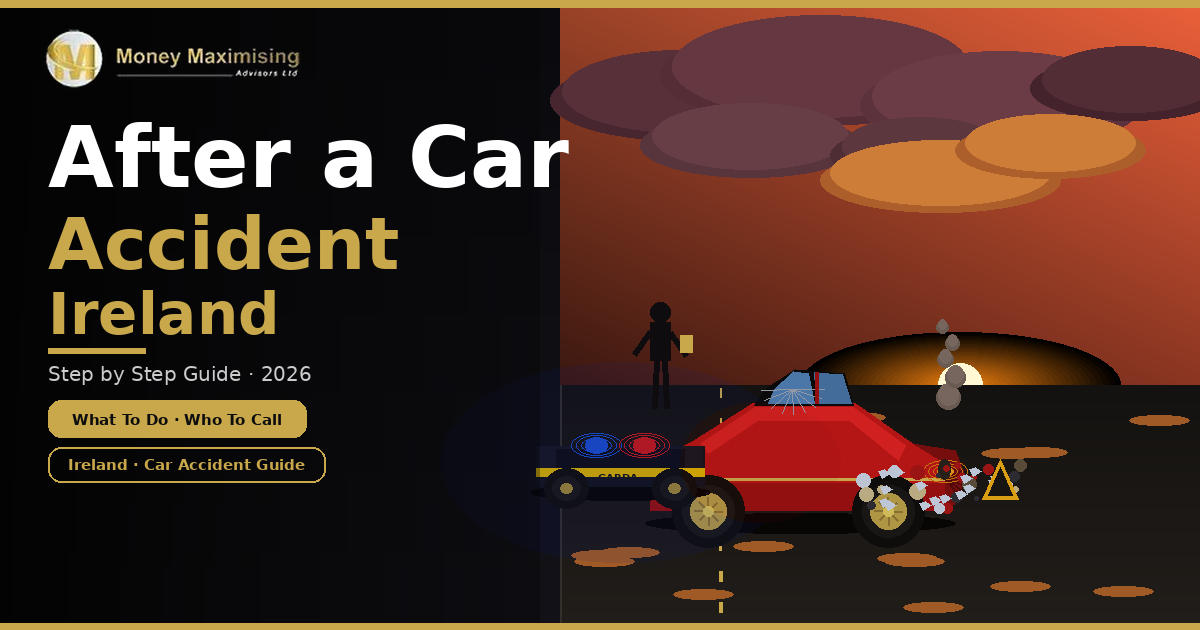
Quick answer: What to do after a car accident in Ireland, in order: stop and stay at the scene, switch off the engine and turn on your hazard lights, check whether anyone is injured, call 999 or 112 if there is any emergency, make the area safe, exchange names, addresses, registration numbers and insurance details, photograph the scene, take witness contact details, report the collision to the Gardai where required, then notify your insurer within the timeframe your policy sets.
If you have had a car accident in Ireland today, that list is the whole job. Knowing what to do after a car accident protects you legally, helps anyone who is injured and makes the insurance process far easier once the adrenaline wears off. Being involved in a collision is stressful for any driver and particularly for a young or newly qualified one, but the sequence never changes: safety first, information second, insurance third.
This guide covers each step in order, including the parts most articles skip. Who recovers your car when it cannot be driven. What to do after a bad car accident involving serious injury. And how much your insurance is likely to increase after a claim in Ireland.
Car accident in Ireland today: the first five minutes
The first few minutes after a collision matter more than anything that follows. Try not to panic and do not argue with the other driver. Concentrate on safety and on establishing the facts.
You should:
- Stop your vehicle and remain at the scene
- Switch off the engine and apply the handbrake
- Turn on your hazard lights
- Check whether anyone has been injured
- Call 999 or 112 if emergency assistance is required
- Take reasonable steps to warn other road users
- Avoid putting yourself or others in further danger
- Exchange the necessary information with the other parties involved
If the vehicles are blocking the road or creating a danger, they should be moved as soon as it is safe and reasonably possible. Garda guidance advises drivers to warn approaching traffic and to remove vehicles that are obstructing the roadway or creating a hazard.
If you are on a motorway, take particular care. Do not place a warning triangle on a motorway. If you can safely leave the vehicle, move behind the crash barrier and away from moving traffic, and wait there rather than standing on the hard shoulder.
Check for injuries and make the scene safe
Before you think about insurance or vehicle damage, check whether anyone needs medical attention.
If another person is injured or appears to need help, you have a responsibility to offer reasonable assistance. If the situation is serious, call 999 or 112 and explain the location and circumstances as clearly as you can. Give a road number, a junction, a townland or anything else that helps the emergency services find you quickly.
Do not put yourself in danger while trying to help someone else. If a vehicle is in a dangerous position, if there is a risk of fire, or if traffic is still passing at speed, move to a safe location and wait for the emergency services.
Avoid moving an injured person unless there is an immediate danger such as fire or a risk that the vehicle could overturn. This matters particularly for young drivers, who may instinctively want to help but have no experience of the aftermath of a serious collision.
When should you call the Gardai after a car accident?
Not every minor collision requires the Gardai to attend the scene.
Garda guidance states that serious incidents, or incidents where an offence may have occurred, should be reported by calling 999 or 112. That includes serious injury, immediate danger, suspected drink or drug driving, no insurance, or a driver who has left the scene.
If you or another person has been injured and there is no Garda at the scene, the collision must be reported to the nearest Garda station.
Where there is property damage only, the requirements differ. If a Garda is in the immediate vicinity, report the collision to them. If no Garda is available, provide the relevant information to the owner or the person responsible for the damaged property. If neither is immediately available, give the information at a Garda station as soon as reasonably possible.
The point is not to assume every accident can simply be settled privately at the roadside. If a Garda does attend, ask for the member’s name, station and any incident or PULSE reference, because your insurer will often ask for it.
What information should you exchange after an accident?
After a collision, obtain the following from the other driver:
- Full name
- Address
- Vehicle registration number
- Details of the vehicle, make, model and colour
- The vehicle owner’s name and address, if different from the driver
- Insurance company and policy number
- A contact phone number
- Names and contact details of any witnesses
Garda guidance states that drivers may be required to provide their name and address, the address where the vehicle is kept, the vehicle owner’s name and address, the registration number and evidence of insurance.
Record the information rather than relying on memory. Photograph the other driver’s insurance disc and licence if they are willing, or write everything down before you leave the scene.
Avoid making assumptions about who was responsible. Stick to factual information about what happened, and note that if you are driving as a named driver on someone else’s car insurance, you should give the policyholder’s details as well as your own.
What evidence should you collect at the scene?
Photographs and notes can decide a disputed claim months later. If it is safe to do so, photograph:
- Both vehicles from several angles
- The damage to each vehicle, close up and wide
- All registration plates
- The final position of the vehicles before anything is moved
- Road markings, traffic signs and any traffic lights
- The surrounding road, junction layout and sight lines
- Weather, road surface and visibility conditions
- Any damage to property, walls, poles or barriers
- Skid marks or debris
Make a written note of the time, the exact location and what happened in your own words while it is fresh. If there are witnesses, take their names and phone numbers, because they will be very difficult to trace afterwards.
Do not put yourself in danger to get a photograph. Safety comes before evidence every time.
Who recovers your car after an accident in Ireland?
This is the question drivers are least prepared for, and the answer depends on the state of the vehicle.
If the car is still roadworthy, you can drive it away, provided the lights, brakes, steering, tyres and mirrors are unaffected and there is no fluid leaking. If you are unsure, do not drive it.
If the car cannot be driven, recovery is normally arranged in one of three ways:
- Through your own insurer. Most comprehensive motor policies include breakdown or accident recovery assistance, or offer it as an optional extra. Call the number on your policy documents or insurance app. Your insurer may direct the vehicle to an approved repairer or an assessment centre, which is usually the smoothest route because it keeps the claim in one place.
- Through a private recovery operator. If you have no recovery cover, you can call a local recovery firm yourself. Keep the receipt, because the cost may be recoverable as part of the claim depending on liability and your policy terms.
- Through the Gardai or the road authority. If a vehicle is obstructing a road or creating a hazard and the driver cannot arrange removal, the Gardai can arrange for it to be removed. On motorways and national routes, incident response is coordinated by the road authority. Storage and release charges can apply where a vehicle is removed this way, so it is far better to arrange recovery yourself if you are able to.
Do not authorise repairs before you have spoken to your insurer. Once a vehicle is repaired or scrapped, the evidence of the damage is gone, and an insurer that has not had the chance to inspect the vehicle can query the claim.
If you drive a specialist vehicle, recovery and repair need extra thought. An electric vehicle involved in a collision may need battery inspection by a manufacturer approved workshop, which is one reason electric car insurance in Ireland is worth reviewing before you need it. A classic car normally needs a marque specialist and an agreed value settlement rather than a market valuation, which is a feature of classic car insurance. A commercial vehicle carrying goods or tools raises separate questions, covered under van insurance.
What to do after a bad car accident
A serious collision follows the same sequence, but the priorities shift heavily toward safety and medical care.
Do not move anyone who is injured unless leaving them in place puts them in greater danger, for example from fire.
Call 999 or 112 immediately and stay on the line. Give the location, the number of vehicles, the number of people involved and whether anyone is trapped or unconscious.
Do not remove a motorcyclist’s helmet. Leave that to the emergency services. Collisions involving motorcyclists carry a much higher injury risk, which is why motorbike insurance is underwritten differently from car cover.
Leave the vehicles where they are if the collision is serious. The Gardai will need to record the scene, and the final positions matter to any investigation.
Get checked medically even if you feel fine. Adrenaline masks injury, and neck, back and head symptoms often appear hours or days later.
Expect a longer process. For serious collisions involving injury, Garda reports may include descriptions of the circumstances, the point of impact, photographs, measurements and witness details. That report can take time to become available, and your insurer may need it before the claim progresses.
Where there is a potential personal injury claim, take professional legal advice. Personal injury claims in Ireland are assessed through the Injuries Resolution Board process, and the procedures and timeframes are separate from your motor insurance claim.
What to do if the accident was not your fault
If you believe the other driver caused the collision, stay calm and avoid confrontation.
Do not try to force an admission of liability at the roadside. It has no legal weight and it usually escalates the situation. Collect the information and the evidence instead.
Your account should describe only what you personally saw. Witness details can matter enormously here, because liability disputes often come down to a third party account.
Report the collision to your own insurer even when you are not at fault. This is the step drivers most often skip, on the assumption that reporting it will cost them money. Notifying your insurer is not the same as making a claim, and failing to notify can breach your policy conditions. Your insurer can then pursue the other party’s insurer directly. The car insurance claims process in Ireland sets out how that works from notification through to settlement.
What to do if the other driver leaves the scene
A driver should not leave the scene of a collision.
If another driver does leave, record as much as you can: registration number, make, model, colour, direction of travel, and any description of the driver. Ask anyone nearby whether they saw it.
Do not chase the vehicle.
If there is immediate danger, serious injury, or the offender is still at the scene, call 999 or 112. For non emergency traffic incidents, the Gardai also operate Traffic Watch reporting. The online reporting system is not intended for emergencies, serious injury collisions or situations where the offender is still present.
What if the other driver has no insurance?
Do not agree to settle privately in cash. It removes your protection entirely if the damage or injury turns out to be worse than it looked.
Record the driver’s and vehicle’s details, report the matter to the Gardai, and notify your own insurer. Driving without insurance is a serious offence in Ireland.
Where the other driver is uninsured or cannot be traced, the Motor Insurers Bureau of Ireland exists to deal with claims in those circumstances, subject to its own conditions and timeframes. Your own insurer or broker will point you to the right route.
If the other driver is visiting from abroad, different arrangements can apply depending on where the vehicle is insured. Drivers coming to Ireland from overseas should understand their own position too, which is covered in our guide to car insurance for international drivers in Ireland.
What should young drivers do after a car accident?
A collision is frightening for a young or newly qualified driver, and the instinct to apologise or accept blame is strong. Resist it.
Follow the same procedure as any other driver: stop, check for injuries, make the area safe, exchange details and photograph everything. Being inexperienced does not mean you should panic or automatically accept responsibility.
If you are unsure what to do, phone a parent, guardian or another experienced driver who can talk you through it calmly. There is nothing wrong with staying at the scene and making that call before you exchange details.
Novice drivers should also remember that specific rules apply for the first two years after receiving a first full licence, including displaying N plates and a lower penalty point threshold. Learner permit holders must be accompanied by a qualified accompanying driver at all times and cannot drive unaccompanied. Our guide to L plate and N plate insurance in Ireland explains how those rules interact with your cover.
An accident does not automatically affect your driving licence, but any driving offence arising from the circumstances of the collision can. Premiums for newer drivers are already the highest in the market, so protecting your record matters more here than anywhere else. See our guide to young driver car insurance in Ireland for how those premiums are calculated.
How to report a car accident to your insurer
Once the immediate situation is dealt with, notify your motor insurance provider in line with your policy terms. Most policies require prompt notification of any incident, whether or not you intend to claim.
Have this ready before you call:
- Date, time and exact location of the accident
- Your policy number
- Vehicle registration details for every vehicle involved
- The other driver’s name, address and insurance details
- Witness names and numbers
- Your photographs
- Garda station, member name and any incident reference
- A short factual description of what happened
Even where the damage looks minor, follow the notification requirements in your policy. Do not arrange repairs or agree a private settlement with the other driver before checking the correct procedure with your insurer or broker.
Keep copies of everything: photographs, emails, letters, estimates and receipts.
What happens after you report the accident?
Once reported, your insurer may request further information: photographs, a written statement, repair estimates, Garda details or witness accounts. An assessor may inspect the vehicle or review photographs before authorising repairs.
The process varies with the severity of the collision, the extent of the damage, whether anyone was injured and whether liability is disputed. A straightforward non fault claim with an admission from the other insurer can settle quickly. A disputed liability claim with injuries takes far longer.
Provide accurate information and keep your documentation. Do not exaggerate damage or injuries, and do not leave out anything relevant. Non disclosure is one of the most common reasons a motor claim runs into trouble.
How much does insurance increase after a claim in Ireland?
There is no single figure, and any site quoting one is guessing. What determines the increase is a combination of factors:
Whether the claim is fault or non fault. A claim where the other party’s insurer accepts full liability and recovers the costs usually has far less effect than a fault claim. It can still be recorded on your history and asked about at renewal.
What happens to your no claims bonus. A fault claim normally reduces your bonus, often stepping it back by two years, unless you hold no claims bonus protection. Because the bonus can be worth a substantial discount once fully earned, losing it is frequently the largest part of the increase. Our guide to the no claims bonus in Ireland explains how the steps work and what protection does and does not do.
The size and type of the claim. A small windscreen or glass claim is usually treated differently from a large personal injury settlement.
Your age, licence history and the rest of your profile. The same claim affects a driver with two years of experience very differently from one with twenty five.
How long the claim stays on your record. Insurers typically ask about incidents in the last five years, whether or not a claim was paid, so a claim continues to influence quotes well beyond the renewal immediately after it.
One practical point. If the repair cost is close to your excess, it can be worth paying for the repair yourself rather than claiming, once you have notified the insurer of the incident. Notify, then decide. Our guide to car insurance cost in Ireland sets out the other factors that move premiums, and reviewing the market at renewal rather than accepting the invitation is the single most effective response to a post claim increase.
What if you are injured in a car accident?
Some injuries are obvious immediately. Others, particularly soft tissue neck and back injuries, appear over the following days.
Seek medical attention and keep records of every appointment and treatment. Note when symptoms first appeared and how they developed, because that timeline matters if a claim follows.
Do not assume an injury is insignificant because you felt fine at the scene.
If another person has been injured and no Garda was present, the collision must be reported to the nearest Garda station. Where a personal injury claim may arise, take professional legal advice, because the procedures and time limits are separate from the motor insurance process.
Common mistakes to avoid after a car accident
Leaving the scene. Drivers involved in a collision must stop and remain for a reasonable time. Leaving is an offence.
Arguing with the other driver. A roadside disagreement resolves nothing and can escalate. Collect facts instead.
Admitting fault immediately. Liability is not decided at the roadside. Record what happened and let the process establish responsibility.
Failing to collect evidence. Photographs, witness details and accurate notes decide disputed claims.
Ignoring an injury. Pain, dizziness, headaches or stiffness after a collision need medical attention.
Agreeing a cash settlement. It leaves you with no protection if the damage or injury proves worse than it looked.
Posting about it on social media. Keep the details private while the circumstances are being dealt with.
Delaying notification. Report within the timeframe your policy requires, even if you do not intend to claim.
Car accident checklist for drivers in Ireland
Keep a copy of this in the glovebox. It is worth its weight for a young driver.
- Stop and remain at the scene
- Switch off the engine, hazard lights on
- Check for injuries
- Call 999 or 112 if there is any emergency
- Exchange driver, vehicle and insurance details
- Photograph the vehicles, the scene and the conditions
- Collect witness names and numbers
- Report to the Gardai where required and note the reference
- Arrange recovery if the car cannot be driven safely
- Notify your insurer within the policy timeframe
- Keep all photographs, documents and correspondence
- Seek medical attention if you have any symptoms
- Do not admit liability or agree private compensation
Need help after a car accident in Ireland?
Understanding what to do after a car accident makes a stressful situation far easier to manage. From reporting the collision and documenting the damage to understanding what a claim will do to your premium, the right guidance helps you take the correct steps in the right order.
Money Maximising Advisors is an independent financial advisory and insurance brokerage based in Galway, regulated by the Central Bank of Ireland, reference C154250. Whether you are an experienced driver, a young driver or dealing with your first accident in Ireland, our team can explain your options across motor insurance and the wider general insurance market. If you insure more than one vehicle in the household, it is also worth reviewing whether multi car insurance reduces the impact of a claim across your policies.
Contact Money Maximising Advisors today to discuss your circumstances and find out how we can help.
Frequently Asked Questions
1. What should I do immediately after a car accident in Ireland?
Stop, stay at the scene and turn on your hazard lights. Check for injuries and call 999 or 112 if anyone needs help. Exchange details with the other driver, photograph the scene, then notify your insurer.
2. What information should I collect at the scene of a car accident?
The other driver’s name, address, phone number, vehicle registration, make, model and insurance details. Photograph both vehicles, the damage, the plates, the road layout and the conditions before anything moves. Take witness names and numbers.
3. Should I admit fault at the scene of a car accident?
No. Liability is not decided at the roadside, and an admission carries no legal weight while complicating your claim. Exchange details, record the facts and give an accurate account when you report it.
4. Do I have to report a car accident to the Gardaí?
It depends. Report serious collisions and suspected offences by calling 999 or 112. If anyone is injured and no Garda attends, report it at the nearest Garda station. Property damage only collisions differ.
5. Who recovers your car after an accident in Ireland?
If it is roadworthy you can drive it away. If not, call your insurer, as most comprehensive policies include accident recovery. Otherwise use a private recovery firm and keep the receipt. Storage charges apply if the Gardaí arrange removal.
6. How do I file a car accident claim in Ireland?
Call your insurer with your policy number, the accident details, the other driver’s information, your photographs and any Garda reference. They will open the claim, may send an assessor and will name an approved repairer.
7. What happens if a car accident is not my fault?
Collect the other driver’s details, photograph the scene and get witness information. Notify your own insurer anyway, because notifying is not claiming and they can then pursue the other driver’s insurer directly.
8. What happens if the other driver has no insurance?
Do not agree a cash settlement. Record their details, report it to the Gardaí and tell your insurer. Where a driver is uninsured or untraced, the Motor Insurers Bureau of Ireland handles claims.
9. What should I do if I am injured in a car accident?
Get medical attention and keep records of every appointment. Note when symptoms started, as neck and back injuries often appear a day or two later. Take legal advice if a personal injury claim may arise.
10. How much does insurance increase after a claim in Ireland?
There is no fixed figure. It depends on whether the claim is fault or non fault, what happens to your no claims bonus, and the size of the claim. Insurers usually ask about incidents in the last five years.