Few drivers think about car insurance claims until they are standing at the side of the road after a collision, unsure what to do next. Yet how a claim is handled and whether you should make one at all can shape what you pay for cover for years afterwards. Car insurance claims in Ireland have also changed shape over the last five years in ways most motorists have not been told about. Injury claims, the traditional villain of the Irish premium story, have fallen sharply in both volume and value.
Yet premiums have kept climbing. The reason sits in a quieter part of the market: the cost of repairing cars. This guide sets out what the official data shows, how a claim actually works, what it means for your no-claims bonus, and what to expect in 2026 and beyond.
Money Maximising Advisors reviews claims and cover for clients across Ireland, and the pattern below is one we see every week in real renewal quotes.
Quick answer: what is happening to car insurance claims in Ireland?
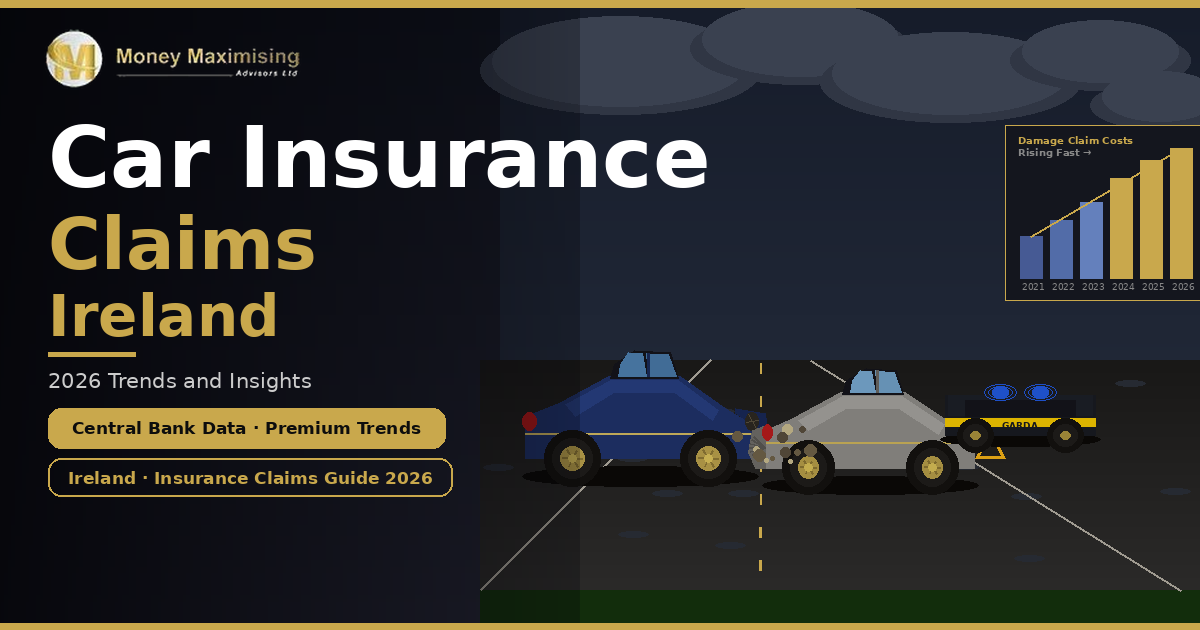
Injury claims are down and cheaper to settle since the Personal Injuries Guidelines arrived in 2021. Damage claims are up and far more expensive to settle because modern cars cost more to repair. In 2024 damage claims accounted for 54 percent of all settled claim costs, compared with an average of 29 percent between 2015 and 2021. That switch is now the single biggest driver of motor premiums in Ireland.
What is a car insurance claim?
A car insurance claim is a formal request you make to your insurer to cover a loss repair costs, medical expenses, or compensation to a third party following an incident covered by your policy. In return, the insurer either pays for the repair directly, arranges it through an approved repairer, or settles a cash amount, minus any excess you owe.
Motor insurance claims in Ireland generally fall into a few categories:
- Collision and comprehensive claims: damage to your own vehicle from an accident, the most common type of claim.
- Third-party claims: where another driver is at fault and their insurer pays, or where you are liable and your insurer pays the other party.
- Personal injury claims: compensation for injuries suffered in a road traffic accident. These are less frequent than damage claims but far more costly to settle.
- Theft, fire and windscreen claims: losses covered under comprehensive policies, often with their own excess rules.
- Uninsured or untraced driver claims: handled through the Motor Insurers’ Bureau of Ireland (MIBI) when the other party has no cover or cannot be identified.
Understanding which type of claim you are making matters, because each follows a slightly different route and has a different impact on your premium.
Motor insurance claims Ireland: the headline numbers
The Central Bank of Ireland publishes the National Claims Information Database (NCID), which gathers data from every insurer selling private motor cover in the State. Its most recent full-year report covers 2024, with mid-year data extending into 2025.
| Measure | Latest figure | Direction |
| Total gross written premium | €1.46bn in 2024 | Growing |
| Average written premium per policy | €623 in 2024, rising to €655 in H1 2025 | Up 9%, then up 4% |
| Expected cost of claims per policy | €397 in 2024 | Up 3%, highest since 2014 |
| Damage claim cost per policy | €192 | Rising fast |
| Injury claim cost per policy | €205 | Stable, below the €257 average from 2015–2019 |
| Total cost of claims settled | €792m in 2024 | Rising |
| Damage share of settled claim costs | 54 percent | Up from a 29% average |
| Insurer operating profit | 4% of total income in 2024 | Down from 8% in 2023 |
Two things jump out. First, injury costs per policy are genuinely lower than they were before the pandemic. Second, insurer operating profit fell to 4 percent in 2024, against a long-run average of 5 percent since 2010. The premium rises are not simply landing in profit.
Why damage claims are now the main event
The average cost of a damage claim rose 18 percent in a single year between 2023 and 2024, while the number of damage claims rose 6 percent. Several forces are stacked on top of each other:
Cars carry more technology. A bumper is no longer a bumper. It houses parking sensors, radar units and camera mounts that all need recalibration after a repair.
Parts and labour inflation. Body shop labour rates and imported parts prices have both risen well ahead of general inflation.
Higher vehicle values. The used car market never fully returned to its pre pandemic level, so total loss settlements cost insurers more.
Electric and hybrid vehicles. Battery pack damage frequently turns a moderate collision into a write off, because the pack alone can exceed a large share of the vehicle value.
None of these are Irish problems specifically. They are global. What is specific to Ireland is that they are landing at the same time as the legal cost debate, which means motorists hear about injury claims while paying for repair claims.
Injury claims: what the award data shows
The Injuries Resolution Board, formerly PIAB, is the State body that assesses personal injury claims. Its most recent figures show a market that has settled into a new normal.
- The Board received 20,077 claim applications in 2025, down 4 percent on 2024 and roughly 35 percent below 2019 levels.
- Motor liability applications specifically fell 3 percent.
- The Board paid out €213m in compensation in 2025, up from €168m, but the rise came from making 10,032 awards rather than from bigger individual awards.
- The median award was €14,020, up 7 percent on the year but still around 24 percent below the 2020 median of €18,459.
- The Board estimated more than €88m in savings last year through claims that avoided litigation.
The 2021 Personal Injuries Guidelines are doing the work here. Claims settled under the Guidelines have come in materially below equivalent claims settled under the old Book of Quantum: roughly 33 percent lower for claims settled directly before the Board became involved, 8 percent lower for claims resolved through the Board itself, and 26 percent lower for claims settled directly after a Board assessment.
The 16.7% uplift that did not happen
In December 2024 the Judicial Council proposed raising all Personal Injuries Guidelines award brackets by 16.7 percent to reflect inflation since 2021. The Minister for Justice did not bring a resolution seeking Oireachtas approval, so the increase never commenced. The 2021 brackets still apply in 2026. A Judicial Council (Amendment) Bill published in January 2026 proposes moving the review cycle from three years to five and creating a mechanism for revised guidelines to be reconsidered if the Oireachtas does not approve them. For motorists, the practical effect is that injury award levels are frozen for now, which is one reason damage costs, not injury costs, are the dominant premium driver.
How claims get settled, and why the route matters
The settlement channel a claim travels through has an enormous effect on cost and time. Central Bank data for 2024 shows:
| Settlement channel | Share of injury claims | Average time to settle |
| Direct with the insurer | 48 percent | 1.8 years |
| Injuries Resolution Board | 16 percent | 2.7 years |
| Litigation | 36 percent | 5 years |
Litigation is the slowest and most expensive path, and it does not deliver materially larger awards. A Society of Actuaries in Ireland report published in June 2026 found Irish insurers still pay around 50 percent more than their UK counterparts on personal injury claims, at €205 per policy against €135, with legal costs named as a key driver of the difference. This is why the Government’s insurance reform work keeps returning to legal cost inflation.
How the car insurance claims process works in Ireland
While every insurer has its own paperwork, the core steps are broadly the same across the market. Here is what the process typically looks like from the moment an incident occurs.
Step 1. Make the scene safe and gather evidence.
Check that everyone is unhurt, move to safety where possible, and switch on hazard lights. Photograph both vehicles, the damage, the road layout and any relevant signage, and note the time, location and weather. Note dashcam footage immediately if you have it. Exchange names, registration numbers, and insurance details with the other driver, and take witness contact details. Do not accept or assign blame at the roadside.
Step 2. Report the accident to the Gardaí where required
You should contact An Garda Síochána if anyone is injured, if there is significant damage, or if the other driver leaves the scene or is uninsured. A Garda report can become important evidence later, and a Garda PULSE number is often requested by insurers.
Step 3. Notify your insurer promptly.
Contact your insurer or broker as soon as you are able, ideally within 24 hours. Most policies require notification within a set window. Notifying is not the same as claiming, but early notification protects your position.
Step 4. Complete the claim form and submit documentation.
Your insurer will issue a claim form. Complete it accurately and attach your evidence, photos, receipts, the Garda report, and any medical or towing details. Accuracy matters; inconsistencies can slow the claim or raise questions about validity.
Step 5. Assessment and repair.
For a damage claim, an assessor or loss adjuster may inspect the vehicle. If repair costs exceed the car’s open market value, the insurer may declare it a total loss and pay that value instead. You can challenge a settlement with evidence of comparable listings. If an injury is involved, the claim must go to the Injuries Resolution Board before any court proceedings can be issued, other than in limited categories.
Step 6. Settlement.
The insurer makes a settlement offer based on your cover and the assessment. You can accept it, or negotiate if you believe it undervalues your loss. Under the Central Bank’s Consumer Protection Code, your insurer must keep you informed of progress within 10 working days and notify you of a claim decision within 5 working days of making it and must explain in writing, with appeal options, if a claim is declined.
Should you claim, or pay for it yourself?
For minor damage, it is worth doing the math before you claim. Two figures decide it: your excess and the likely increase to your future premiums.
Claim if: the repair cost is well above your excess, another party is clearly at fault, or an injury is involved. For any incident involving another party or personal injury, you should always claim the potential liabilities are too large to absorb yourself.
Think twice if: the repair sits close to your excess, you have a no-claims discount you would rather keep intact, or the incident is minor and single vehicle. Remember that a claim stays on your record for five years in most quoting systems, and that even a notified but withdrawn incident can be asked about at renewal. Answer those questions honestly, non-disclosure is the fastest way to have a future claim declined.
The bodies that govern car insurance claims
Several organisations shape how claims are handled in Ireland, and knowing who does what helps you navigate a dispute or an injury claim.
The Injuries Resolution Board (formerly the Personal Injuries Assessment Board, or PIAB) assesses personal injury claims without the need for litigation. Most road traffic injury claims must go through the Board first. It offers a faster, lower-cost alternative to court, and you can reject its assessment and pursue legal action if you disagree.
The Motor Insurers’ Bureau of Ireland (MIBI) compensates victims of uninsured and untraced (hit-and-run) drivers, funded by a levy on all insurers. If you are hit by an uninsured driver, this is where a claim ultimately lands.
The Central Bank of Ireland regulates insurers and publishes the National Claims Information Database (NCID), the definitive source of data on Irish motor claims and premiums. And the Personal Injuries Guidelines, drawn up by the Judicial Council, set the benchmark award values that both the Board and the courts apply to injury claims.
How a claim affects your premium and no-claims bonus
This is the question most drivers actually care about. Making a claim particularly a fault claim usually increases your premium at renewal and can reduce or wipe out your no-claims bonus (NCB).
A no claims bonus (NCB) is the discount you build up for each consecutive year you drive without making a claim. Make a fault claim and most insurers apply a step-back: you lose several years of accumulated bonus at once. No-claims bonus protection is an optional add-on that lets you make one or more claims within a period without losing your discount. It does not stop your base premium from rising, but it preserves the discount that sits on top of it.
Not every claim hits your record equally. A non-fault claim where the other party’s insurer pays, or a windscreen claim under many policies, may have little or no effect. A fault claim or an injury claim has the biggest impact.
Car insurance claims trends in Ireland (2025–2026)
The claims landscape is shifting, and it is directly affecting what drivers pay. Recent Central Bank data paints a clear picture of the forces at work.
Motor premiums are rising again. The average written premium reached around €655, with premiums up almost one-fifth since 2022. Insurers attribute much of this to the soaring cost of repairing cars: damage claims costs rose 8% in the first half of 2025 compared with a year earlier, and are up a striking 155% on pre-Covid levels, driven by expensive sensors, cameras and electronics built into modern vehicles.
Injury claims, by contrast, have moved the other way. Since the Personal Injuries Guidelines took effect, injury claim costs have fallen down around 24% versus pre-pandemic levels as standardised award values took hold. In the first half of 2025, roughly 85% of injury claims were settled in line with the Guidelines. The average claims cost to insurers now sits near €310.
Even so, Ireland remains an outlier internationally. Analysis from the actuarial profession has repeatedly found that Irish third-party motor injury claims still cost insurers more than 50% above equivalent UK levels, a gap that continues to keep Irish premiums high relative to peers.
One trend to watch is award inflation. In January 2025 the Judicial Council approved an update to the Personal Injuries Guidelines proposing an average increase of about 16.7% across injury categories with the maximum general-damages award rising from €550,000 to €642,000. Changes of this kind, once implemented, can push claims costs, and therefore premiums, back up.
Future trends shaping car insurance claims
Beyond the near-term figures, several longer-term shifts will reshape how claims are made and priced in Ireland.
Technology and evidence. Dashcams and telematics (“black box”) policies are making fault far easier to establish, speeding up settlements and rewarding safer drivers with lower premiums. An Garda Síochána has been developing an online portal for the public to submit dashcam footage, which could change how liability disputes are resolved.
Repair complexity. As advanced driver-assistance systems (ADAS) and electric vehicles become the norm, even minor bumps can require expensive recalibration and specialist parts, a key reason damage claims keep climbing.
Climate and seasonal claims. More frequent storms and flooding are driving weather-related claims, particularly in exposed and rural areas, while urban congestion continues to generate higher claim frequency in cities like Dublin.
Autonomous vehicles. Looking further ahead, self-driving technology raises new questions about whether liability sits with the driver or the manufacturer, a shift that will eventually redraw the claims model entirely.
Tips to keep your premiums down
- Protect and preserve your no-claims bonus, and consider NCB protection if you drive high mileage.
- Weigh small claims carefully against your excess before submitting them.
- Consider a dashcam or telematics policy to strengthen your evidence and reward safe driving.
- Shop around and compare quotes at every renewal rather than letting the policy auto-renew.
- Keep your details accurate, mileage, address and named drivers all affect your price.
Frequently asked questions (FAQs)
1. How long do I have to make a car insurance claim in Ireland?
Your policy will set a notification deadline, commonly 24 to 48 hours or as soon as reasonably possible. For personal injury, the general statutory limitation period is two years from the date of the accident or the date of knowledge, which is separate from your insurer’s notification rule.
2. Will my premium go up after a claim?
Usually yes, where you are at fault. You may also lose part or all of your no-claims discount unless it is protected. A claim where another party is fully at fault and their insurer pays should have far less effect, though some insurers still rate for claim frequency.
3. What is the average car insurance claim payout Ireland drivers receive?
The average car insurance claim payout Ireland injury claimants receive from the Injuries Resolution Board had a median value of €14,020 in 2025. Damage claim settlements vary widely with vehicle value and repair cost. Averages are a poor guide to any individual claim.
4. How long does a car insurance claim take to settle in Ireland?
Damage claims are typically settled in weeks. Injury claims took an average of 1.8 years when settled directly with an insurer, 2.7 years through the Injuries Resolution Board, and around 5 years through litigation.
5. What happens if the other driver has no insurance?
The Motor Insurers’ Bureau of Ireland (MIBI) exists to compensate victims of uninsured and unidentified drivers. Report the incident to the Gardaí and to your own insurer immediately, as a Garda report is normally required.
6. Does no-claims bonus protection stop my premium from rising?
No. It protects your accumulated no-claims discount from being reduced after a claim, but it does not prevent the underlying base premium from increasing at renewal.
7. What is happening to motor premiums in 2026?
The Insurance Compensation Fund levy halved from 2 percent to 1 percent of premium on 1 January 2026, delivering a small automatic saving. The Motor Insurance Transparency Code began rolling out in March 2026 to make renewal pricing clearer. Central Statistics Office data suggests motor insurance prices peaked around April 2025 and have eased by roughly 3 percent since, though the claims cost pressure from vehicle repair has not gone away.
Talk to a broker before you claim
The decision to claim is easier to get right with someone who knows how the Irish market prices claims history. Money Maximising Advisors is an independent financial advisory and insurance brokerage based in Galway, regulated by the Central Bank of Ireland, reference C154250. If you are approaching renewal, weighing up whether to make a car insurance claim, or unhappy with a settlement offer, we are happy to talk it through. Speak to our advisers.