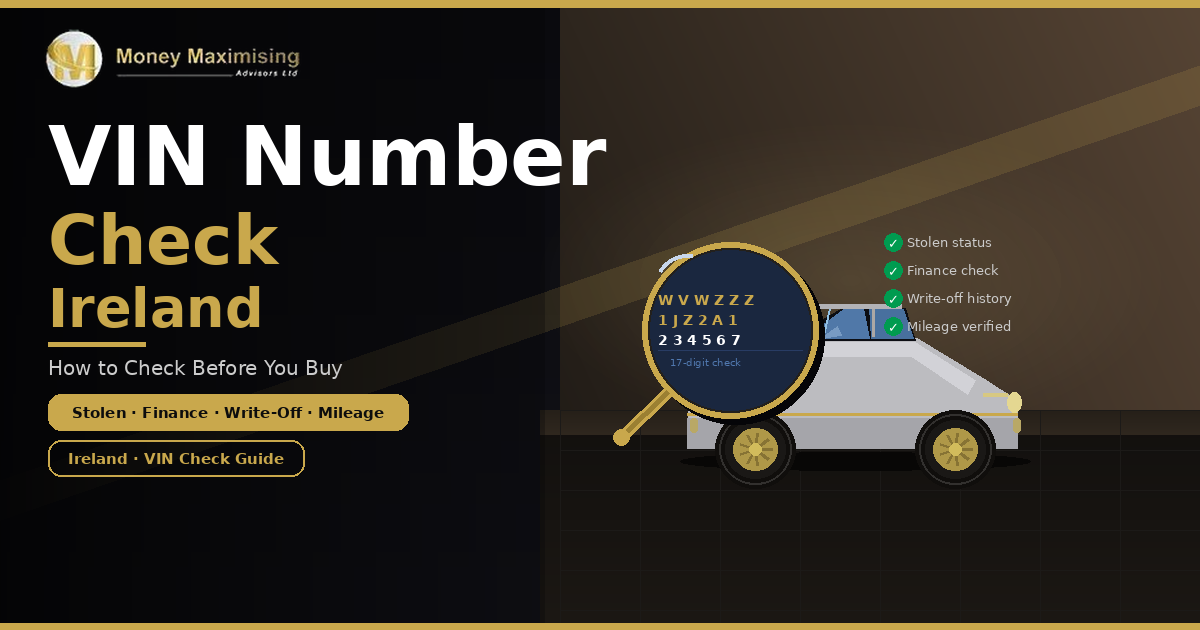
A VIN number check Ireland buyers can rely on runs in three steps: find the 17-character number stamped on the vehicle, compare it to field E of the Vehicle Registration Certificate, then run a paid history report and compare the VIN it returns to both. If any of the three disagree, walk away.
That third comparison is the one most people skip, and it is the one that catches a cloned car. This guide covers what the check shows, what free tools miss, where to find VIN number and chassis number Ireland vehicles carry on each body type, and what to do when the numbers do not match.
What a VIN number check in Ireland actually is
Worth being precise about this, because it is described wrongly nearly everywhere online.
Irish vehicle history reports are run using the registration number, not the VIN. Cartell, Motorcheck and MyVehicle all take the reg as the input. The report then returns the VIN held on the official record. That returned number is your third data point, to be compared against the number stamped on the vehicle and the number printed on the VRC.
This matters because a registration can be changed, transferred or reassigned. A VIN cannot. Checking a reg alone tells you the history of a record. Comparing all three tells you whether that record belongs to the car in front of you.
Guides written for the American market tell you to input the VIN directly. That is not how the Irish services work, and following that advice usually ends with someone deciding the check is broken.
What a VIN number check shows
A paid report should return:
| What it covers | Why it matters |
| Outstanding finance | If the car is under a live PCP or HP agreement, the finance company owns it, not the seller |
| Write-off and insurance loss records | Whether the vehicle has been declared a total loss, and under which category |
| Mileage records | NCT readings and National Mileage Register entries, which is how odometer rollback surfaces as a mileage discrepancy |
| Previous owners | How many keepers, and how long each held it |
| Stolen vehicle status | Whether the vehicle is recorded as stolen |
| Import history | Whether it came in from the UK, and when |
| Current market value | A sense check on the asking price |
Outstanding finance is the one that costs people the most. Buying a car with a live agreement on it means the finance company can repossess it, and the money is gone.
Free VIN check versus a paid report
A free VIN check decodes the number. It returns make, model, engine, body style and factory specification, because all of that is encoded in the 17 characters themselves.
A free check will not tell you about finance, write-offs, mileage or previous owners. None of that lives in the VIN. It lives in databases that cost money to access.
The one genuinely free and genuinely useful check is the manufacturer’s recall checker, covered further down.
For a used purchase, a paid VIN number check Ireland buyers can actually act on is not optional. It costs a fraction of one month of the loan you would be servicing on a car you no longer have.
The three-way match, step by step
- Find the number on the vehicle. Check every location it appears, not one. Locations by vehicle type are below.
- Compare it to the VRC. Field E on the Vehicle Registration Certificate, beside make, model and owner details.
- Run the report on the registration number and compare the VIN it returns to the two you already have.
One rule governs the whole process: if a sticker and a stamped number disagree, the stamped number is the real one. Stickers and riveted plates can be replaced. Metal stamped at the factory cannot be altered without leaving evidence.
Where to find VIN number and chassis number on Irish vehicles
In Irish paperwork the VIN is usually called the chassis number. Same code, different word. Locations move around by body type, and the awkward ones are the vehicles that need checking most.
Cars
- Base of the windscreen, driver’s side. A cut-out in the trim, readable from outside the car. The check to use when you are standing beside a car you do not own yet.
- Driver’s door pillar or door shut. Usually on a plate or sticker with tyre pressures, weights and paint code.
- Stamped into the structure. Engine bay bulkhead or suspension turret, floorpan near the front seats (sometimes under a lift-up carpet flap), or boot floor beside the spare wheel well.
- Manufacturer’s plate under the bonnet. Carries the number with type-approval details and weight ratings.
Vans and commercials
Door pillar and bulkhead first. On larger commercials the number is stamped into the chassis rail, usually on the offside rail behind the front wheel arch and often under road dirt. Converted and bodied vans carry the base vehicle’s VIN plus a separate converter plate. The base number is the one Revenue and insurers work from, though the conversion affects how the vehicle is rated for van insurance in Ireland and wider commercial insurance.
Motorbikes
The steering head, also called the headstock. The vertical tube at the front of the frame that the forks pass through, below the handlebars. Some machines carry a second plate on the frame near the seat. The engine number is separate and sits on the crankcase. Quoting the engine number when asked for a chassis number is the most common error on bike paperwork, and it matters when arranging motorbike insurance.
Trailers and horseboxes
On a plate on the A-frame or drawbar near the coupling, sometimes also stamped into the chassis rail. Irish-built trailers carry a code issued under a WMI assigned by the National Standards Authority of Ireland. An unmarked trailer is hard to insure and hard to prove ownership of after a theft.
Classics and pre-1981 vehicles
Expect a shorter, manufacturer-specific code on a bulkhead or scuttle plate, stamped into a chassis rail near the front suspension mount, or on a plate riveted to the inner wing. A short code on an old car is normal and not a warning sign. What matters is that it matches the VRC and shows no sign of re-stamping. It also establishes year of manufacture, which is what an agreed value is built on for classic car insurance.
Where the number appears on paperwork
| Document | Issued by | Where it sits |
| Vehicle Registration Certificate (VRC) | Department of Transport | Field E |
| Certificate of Conformity (e-CoC) | Manufacturer | Required before an import can be registered |
| Insurance certificate or schedule | Your insurer | Printed with the vehicle details |
| Finance agreement (PCP or HP) | Finance company | Identifies the vehicle they hold an interest in |
A UK vehicle shows the same code on the V5C. EU imports show it on the equivalent national document.
How to read the 17 characters
| Characters | Section | What it tells you |
| 1 to 3 | World Manufacturer Identifier (WMI) | Who built it and where |
| 4 to 9 | Vehicle Descriptor Section (VDS) | Model, body style, engine, restraint system |
| 10 to 17 | Vehicle Identifier Section (VIS) | Plant and serial number, sometimes model year |
The code never contains I, O or Q, excluded so they cannot be confused with 1 and 0. The 17-character format became standard in 1981.
Two cautions, because most decoders online are built for the American market:
The 9th-character check digit is a North American requirement, not a European one. A European-built VIN that fails a check-digit calculator has not necessarily been tampered with.
Character 10 is only a reliable model-year code on North American VINs. European manufacturers use it inconsistently. Date the vehicle from the VRC. This is also why two online decoders can disagree about the same code, and why a manufacturer’s own checker beats a generic one.
The recall check the NCT does not do
Passing the NCT tells you nothing about whether an open recall exists. The test does not identify recall campaigns. This catches out buyers who assume a fresh certificate means the car is clear.
Recalls are issued against specific vehicles rather than every car of a given make and model, which is exactly why the check is done by VIN:
- The manufacturer’s own recall checker. Most brands run one. Enter the 17 characters and it returns any open campaign. Free.
- The RSA’s recall listings. As Ireland’s Automotive Market Surveillance Authority, the RSA publishes current campaigns by manufacturer, including how many vehicles in the State are affected.
On a second-hand car the previous owner may or may not have had the work done. An authorised dealer can confirm it against the VIN.
When the numbers do not match
A mismatch points at one of two things, and both are reasons to stop.
Cloning. A stolen vehicle given the identity of a legitimate, similar car. If it is later seized you lose the car and the money, with no compensation.
A cut and shut. Two crash-damaged vehicles welded into one. Structurally compromised and dangerous in an impact.
What to do:
- Buying privately and the numbers disagree: walk away, and do not accept an explanation. An insurer can decline cover on a vehicle whose identity cannot be established.
- Your own car, number damaged or illegible: the vehicle cannot be matched to the national vehicle file, so it will not pass the NCT. A Garda certificate confirming the vehicle corresponds to the national record is the usual route to resolving it.
- A wrong character on the VRC: a clerical correction rather than a Garda matter. Contact the Department of Transport with the VRC and photographs of the stamped number.
Checking a VIN when you import
Bringing a vehicle in puts you on a fixed timetable. Book the NCTS appointment within 7 days of the vehicle entering the State and complete registration within 30 days of arrival. Late registration triggers an additional VRT charge. The vehicle needs an electronic Certificate of Conformity before it can be registered.
At the inspection you are asked to point out the chassis number so the inspector can verify it against your documentation. On an unfamiliar import that is not always obvious, so find it before you go rather than in the car park with a torch.
The VIN does not change when the vehicle is re-registered here. Only the registration number does. Once VRT is paid you get an Irish registration number, plates must be displayed within 3 days, and a Form RF100 for motor tax. Motor tax requires insurance already in place, so cover sits in the middle of the import process rather than at the end. If you have recently moved here, our guide to car insurance for international drivers in Ireland covers the licence side of the same move.
What your broker needs the number for
For a standard Irish-registered car, a quote usually runs off the registration and the VIN sits in the background. It becomes central in four situations, and all four are places a broker is more use than a comparison form.
Vehicles with no Irish reg yet. A newly landed import still needs cover to be moved legally, and not every insurer will write a policy against a chassis number alone. Worth confirming before the car arrives rather than after.
Imports where the specification differs. An import often will not return correct details from a reg lookup, and the real engine, trim and safety equipment may differ from the Irish-market version of the same model. The VIN is how the actual specification gets confirmed. Failing to disclose that a vehicle is an import is a non-disclosure issue that can affect whether a claim is paid.
Modified, classic and non-standard vehicles. Where an engineer’s report or specialist valuation is involved, the number ties that report to the specific vehicle.
Total loss and theft claims. The VIN is the identifier in the claim record and any recovery. See our guide to making a car insurance claim in Ireland.
Specification drives price on standard vehicles too, which is one reason two apparently identical cars quote differently. See car insurance costs in Ireland, or, for EVs where battery and trim variants matter more than most, electric car insurance.
Frequently asked questions
How do I do a VIN number check in Ireland?
Find the number on the vehicle, compare it to field E of the VRC, then run a history report with Cartell, Motorcheck or MyVehicle using the registration number. The report returns the VIN on record, giving you a third number to compare. All three should match.
Can I check a VIN number for free in Ireland?
Manufacturer recall checkers are free. Free VIN decoders return make, model and specification. Finance, write-off and mileage data are paid services only.
Do I check with the VIN or the registration number?
Irish history reports take the registration number as the input and return the VIN on record. You use the VIN to verify that the report belongs to the car in front of you.
Is a VIN number the same as a chassis number in Ireland?
Yes. Irish paperwork, NCT centres and Revenue mostly say chassis number, while manufacturers and international standards say VIN. The engine number is a different identifier and is not interchangeable with either.
Where is the chassis number on a motorbike?
Stamped into the steering head, the vertical tube at the front of the frame that the forks pass through. Some bikes carry a second plate near the seat. The engine number on the crankcase is separate.
My classic car has fewer than 17 characters. Is that a problem?
No. The 17-character format became standard in 1981, so older vehicles carry shorter manufacturer-specific codes. It should still match the VRC and show no sign of re-stamping.
Does a fresh NCT mean there are no open recalls?
No. The NCT does not check recall campaigns. Use the manufacturer’s VIN recall checker or the RSA listings separately.
Does the VIN change when a car is imported and registered here?
No. The vehicle gets a new Irish registration number. The VIN stays as it was assigned at the factory.
Before you arrange cover
Run the VIN number check Ireland buyers should always run before the money moves, not after. If the vehicle is an import, a conversion, a classic or anything non-standard, have the number in front of you when you call. It shortens the conversation considerably.
MM Advisors places cover across motor insurance and the wider general insurance range, including vehicles a comparison form will not quote.