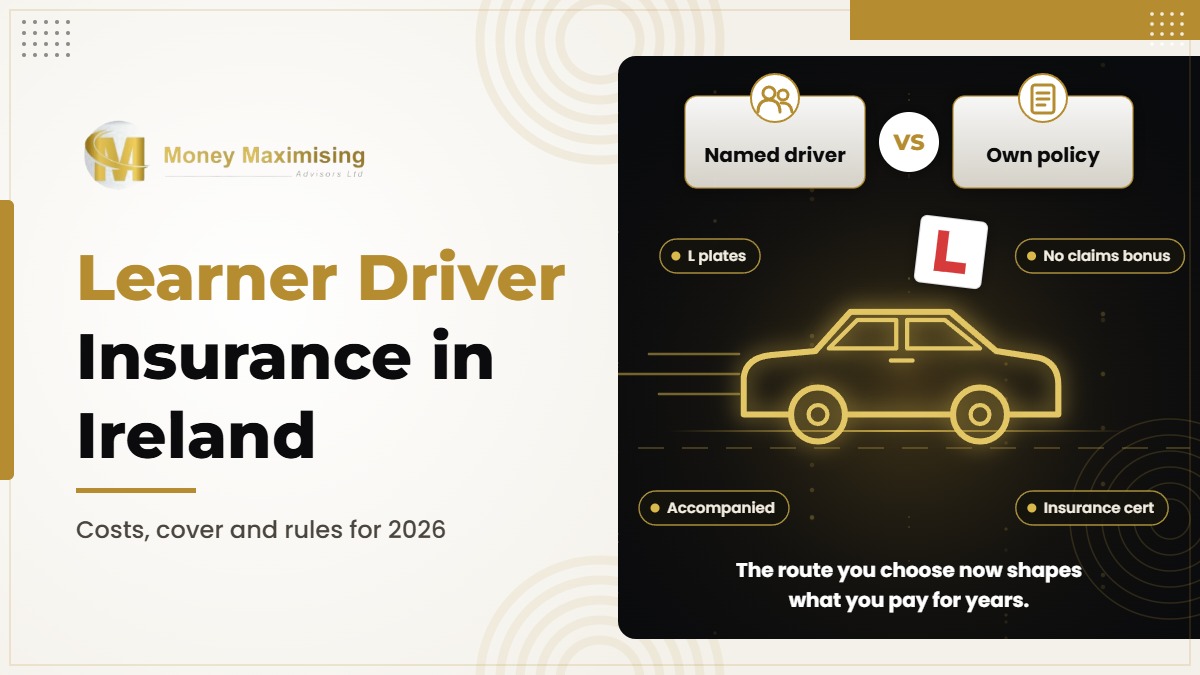
If you are learning to drive, learner driver insurance in Ireland is not optional and it is not an afterthought. A learner permit lets you drive legally, but only in a vehicle you are properly insured to drive, and the arrangement you choose now affects what you pay for the next five years.
This guide covers both routes, what actually moves the premium, how to find the cheapest cover without invalidating it, the insurance certificate you now need on test day, and what changes the moment you pass.
In this guide
- What is learner driver insurance?
- Insurance on a parent’s car
- Named driver or your own policy
- How to get the cheapest cover
- How much it costs
- Choosing the right first car
- Named driver experience
- Temporary and short term cover
- Insurance and the driving test
- After you pass
- Long term and multiple permits
- Northern Ireland
- Mistakes that cost money
- Frequently asked questions
What is learner driver insurance in Ireland?
It is ordinary motor insurance written for a driver who holds a learner permit rather than a full licence. There is no separate product category, but there is separate underwriting, because insurers treat learner permit holders as a higher risk and some will not quote for them at all.
A learner permit allows you to drive on Irish roads provided you meet the conditions that apply to learner drivers:
- ✓You must display L plates.
- ✓You must be accompanied by a qualified accompanying driver who has held a full licence in the same category for at least two years.
- ✓You cannot drive on motorways.
Remember
Insurance sits alongside those rules, not instead of them. Being insured does not make unaccompanied driving legal, and driving unaccompanied can affect a claim as well as your licence.
Insurance for learner drivers on a parent’s car in Ireland
Being added to a parent’s policy as a named driver is the most common route, and for most learners it is the cheapest starting point.
Named driver or your own policy: which is better?
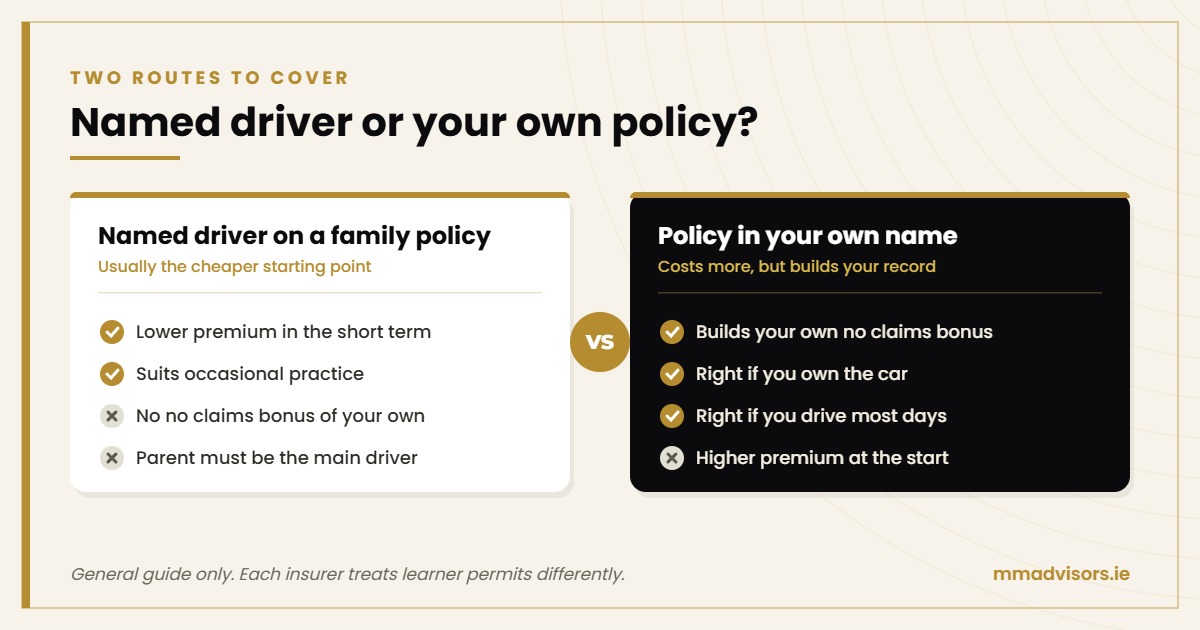
Named driver on a family car is better if you are practising occasionally, the car genuinely belongs to and is mainly driven by a parent, and you want to keep costs down in the short term.
Your own policy is better if you have bought your own car, you are the main driver of it, you drive most days, or you want to start building a no claims bonus immediately rather than starting from zero after you pass.
The usual mistake
Staying a named driver too long. Three years of named driving leaves you with experience but no bonus of your own. Where a household has more than one vehicle, multi car insurance can sometimes bring the family’s total cost down while the learner is on a policy of their own.
How to get the cheapest car insurance in Ireland for learner drivers
There is no single cheapest insurer for learner drivers, because each one prices learner permits differently. What there is, is a reliable order of operations.
Check insurance before you buy the car
This is the largest lever and the one most people pull too late. A car that is cheap to buy can be expensive to insure, and the difference between two similar cars can be larger than any discount you will negotiate.
Compare properly
Underwriting criteria vary enormously for learners. The same driver and car can produce quotes that differ by multiples. A broker that places business with several insurers covers more of the market in one conversation than you can comfortably cover yourself.
Declare named driver experience
If you have been insured as a named driver on a family policy, say so and have the dates. Some insurers take it into account, some do not, but it never hurts and it occasionally helps a lot.
Consider the excess
A higher voluntary excess reduces the premium, but only accept one you could actually pay.
Look at the whole policy
Excesses, driving restrictions, permitted use, breakdown cover and what happens when you pass all matter. The cheapest policy that excludes the thing you need is not cheap.
Do not misstate anything
Address, main driver, car use, modifications, previous refusals. Non disclosure is the most common reason a young driver’s claim fails, and the premium saved is trivial next to an unpaid claim.
Our guide to car insurance cost in Ireland covers the factors that move premiums across all driver types.
How much does learner driver insurance cost in Ireland?
There is no meaningful average, and any page quoting one figure for every learner is guessing. Premiums for learner drivers sit at the top of the Irish market because limited experience is the strongest predictor of claims.
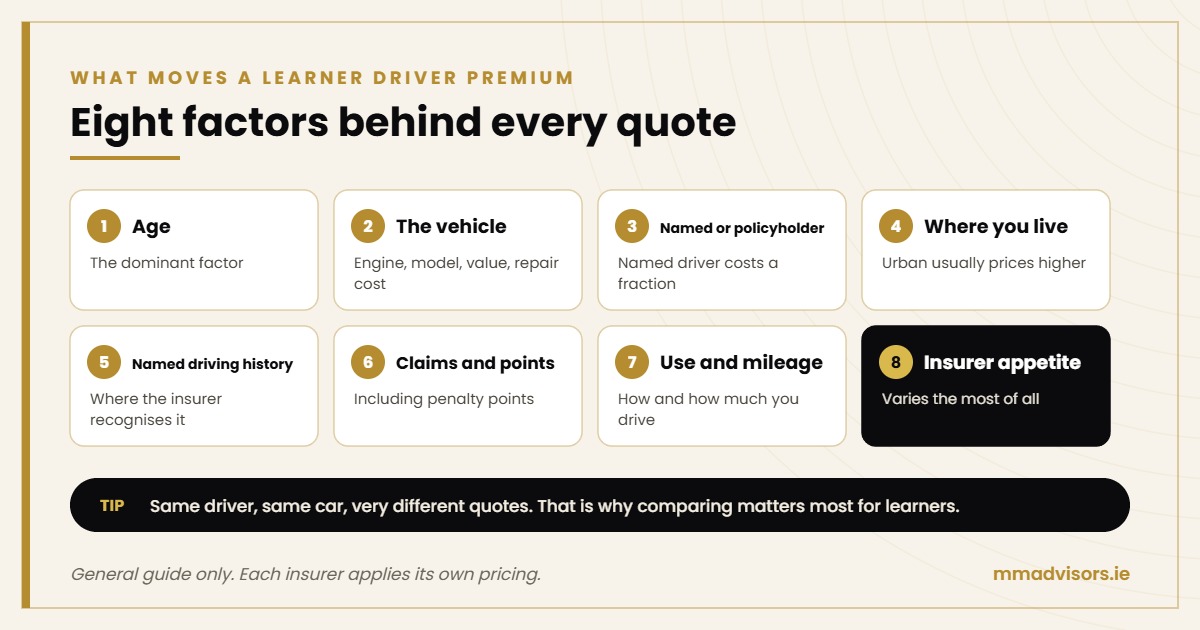
What actually determines your quote
- ✓Age. The dominant factor. A 17 year old and a 35 year old learner are priced very differently.
- ✓The vehicle. Engine size, model, value, age and repair cost.
- ✓Named driver or policyholder. Being added to a family policy costs a fraction of a standalone one.
- ✓Where you live. Urban addresses generally price higher than rural ones.
- ✓Previous named driving experience, where the insurer recognises it.
- ✓Claims and driving history, including any penalty points.
- ✓How the car is used and annual mileage.
- ✓The insurer’s own appetite for learner permit business, which varies more than any other factor on this list.
Why quotes differ so much
Because that last point is so variable, two insurers can quote wildly different prices for an identical driver and car. That is not an error, it is underwriting appetite, and it is why comparing is worth more for learners than for any other group.
Choosing the right first car
Decide the car with the insurance quote in front of you, not after the deposit is paid.
Smaller engines and lower value cars are usually cheaper to insure, but there is no universal rule, and insurance groupings do not always match intuition. A modest looking car with expensive parts can price higher than a plainer one with a larger engine.
Also worth knowing
- ✓Modifications, including alloys and spoilers, must be declared and can increase the premium or make cover harder to place.
- ✓Imported vehicles can be more expensive and harder to insure.
- ✓Very old cars can be cheap to buy and awkward to insure.
- ✓Electric vehicles have their own pricing dynamics, with higher repair and battery costs balanced against lower running costs, covered in our guide to electric car insurance in Ireland.
Get two or three quotes on any car you are seriously considering before you commit.
Does named driver experience count towards your own policy?
It can, and it is worth claiming, but do not assume it.
Some insurers recognise time spent as a named driver when assessing a new policy in your own name. The treatment varies between providers. None of it converts into a no claims bonus, which only accrues to a policyholder, but it can affect how you are rated.
Keep the evidence
Policy numbers, the dates you were added and removed, the insurer’s name and a letter confirming your named driver history. Ask for that letter before the policy lapses, because it is much harder to obtain afterwards.
A learner who spent two years driving safely on a family policy presents differently from one with no recorded driving at all. Mention it on every quote.
Temporary and short term learner driver insurance
Short term and temporary motor cover is far less available in Ireland than in the UK, and it is harder again for learner permit holders. Day and week long learner policies of the kind advertised across the Irish Sea are not a standard feature of the Irish market.
If you need cover for a limited period, the realistic options are being added to an existing policy as a named driver for the duration, or taking an annual policy and cancelling it, which usually involves short period rates and a cancellation charge rather than a clean pro rata refund.
Check before you rely on it, and never drive a car on the assumption that someone else’s policy covers any driver. Most do not.
Insurance and the driving test
Test day has a documentation requirement that catches people out.
The rule from 9 March 2026
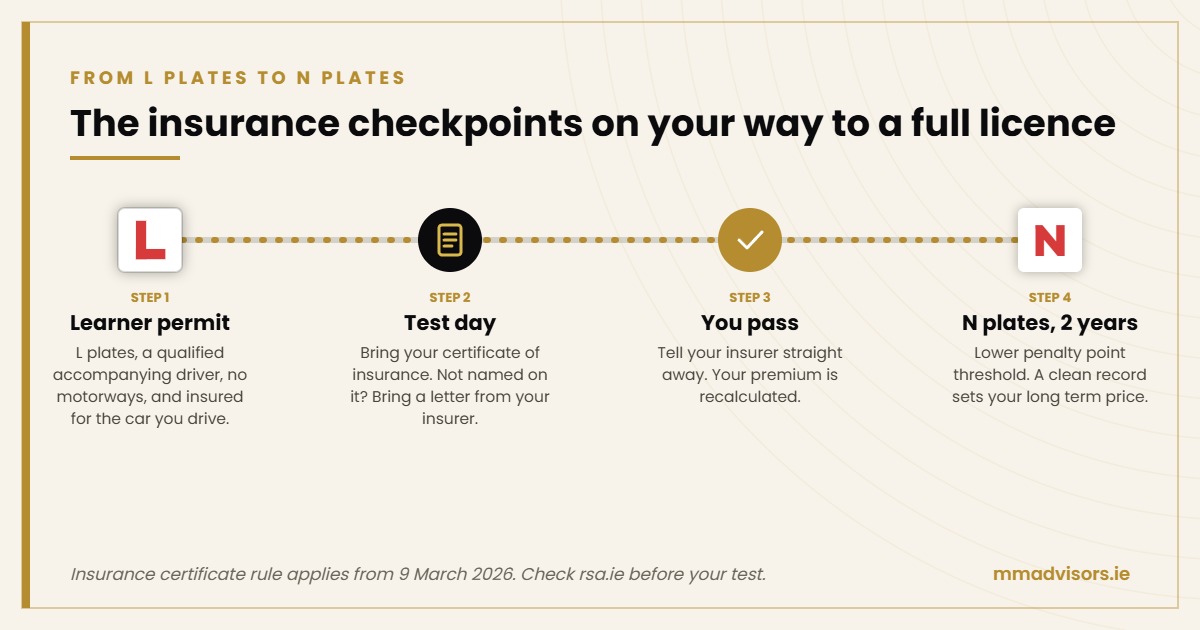
Under the RSA driving test terms and conditions, you must present a valid certificate of motor insurance showing you are insured to drive the vehicle you bring for the test. If you are not named on the certificate, you must also bring an email or a letter on your insurer’s headed paper confirming you are insured to drive that vehicle.
Practical steps
- ✓Check the certificate weeks before the test, not the night before.
- ✓If you are a named driver, make sure your name appears on the certificate itself, not just on the schedule.
- ✓If it does not, request written confirmation from the insurer and allow time for it to arrive.
- ✓If you are using an instructor’s car, confirm the arrangement with the instructor in advance.
- ✓Bring the physical original or a physical copy, plus a backup. Check rsa.ie shortly before your test for the latest position on digital certificates.
A test cancelled over paperwork costs you the fee and months of waiting. This is the cheapest problem on this page to avoid.
What happens after you pass the driving test?
Tell your insurer. Your licence status has changed and the policy should reflect it.
What changes
- ✓The premium is recalculated. It often falls, but not always immediately, because passing a test does not create driving experience.
- ✓L plates come off and N plates go on for the first two years after your first full licence.
- ✓Novice drivers face a lower penalty point disqualification threshold than fully experienced drivers, so points are far more costly in that period.
- ✓If you move from named driver to policyholder, your own no claims bonus starts accruing from that point.
The first two years are where the long term price is set. A clean record through the novice period is worth more than any discount you will find shopping around. Our guides to young driver car insurance in Ireland and the no claims bonus in Ireland cover what happens next, and car insurance claims in Ireland explains what a claim in those first years does to the premium.
Long term learner permits and multiple permits
Some people stay on a learner permit far longer than planned, whether through test waiting times, no access to a car, or needing more time.
A long permit history is relevant to insurers. They may consider how long you have held it alongside the rest of your circumstances, and an applicant on a third or fourth permit is assessed differently from a first time applicant.
New rules from 1 November 2026
According to the RSA guidance on multiple learner permits, you can no longer get a third or fourth permit simply by applying for a driving test. To be eligible for a further permit you must have taken a driving test within the previous two years. A third permit lasts two years and a fourth lasts one year. There is no fifth permit: after four permits or seven years, you must restart the learning process, including a new theory test and the full set of EDT lessons.
If you have been on a permit for several years, check both your licence position and your insurance arrangement rather than assuming renewal is automatic.
Learner driver insurance in Northern Ireland
Northern Ireland is a separate jurisdiction with separate rules, and a policy arranged in the Republic is not interchangeable with one arranged in the North.
Northern Ireland follows the UK system, including provisional licences rather than learner permits, different plate requirements, the R plate restriction for the first year after passing, and a short term insurance market that offers products not generally available here.
If you are learning in Northern Ireland, or you hold a permit in one jurisdiction and drive in the other, confirm the position with your insurer before you drive. If you learned or held a licence abroad, our guide to car insurance for international drivers in Ireland covers how overseas experience is treated.
Mistakes that cost learner drivers money
Talk to a broker before you insure a learner driver
Learner driver insurance looks simple until the quotes arrive and three insurers give three very different answers for the same driver and the same car. Understanding why takes knowing how each one treats learner permits, named driver history and vehicle type.
Money Maximising Advisors is an independent financial advisory and insurance brokerage based in Galway, regulated by the Central Bank of Ireland, reference C154250. We arrange L plate and N plate insurance in Ireland for learner and newly qualified drivers, and we can look at the full picture across motor insurance and the wider general insurance market.
Learner and N plate drivers
Find Out Which Route Costs Less for You
Have your age, permit history, vehicle details, named driver history and any claims to hand.