Quick Answer:
Convicted driver insurance in Ireland is not a separate product. It is ordinary motor insurance priced for a driver whose record includes a motoring conviction or penalty points. A conviction makes cover more expensive and narrows the number of insurers willing to quote, but it very rarely makes you uninsurable. You must answer every question your insurer asks honestly and with reasonable care. If three insurers refuse you in writing, Insurance Ireland’s Declined Cases Agreement obliges the market to provide a quotation.
Why this is harder than it needs to be
Most drivers in this position get two things wrong before they even start comparing.
The first is treating penalty points and convictions as the same thing. They are not, and insurers ask about them separately. The second is assuming the disclosure rules work the way they did a decade ago. Irish law changed in 2021, and the change is significantly in the consumer’s favour.
Get those two things straight and the process becomes ordinary shopping around, with fewer doors open than usual. Get them wrong and you can end up either overpaying badly or holding a policy that will not respond when you need it.
This guide covers which offences actually move the price, what the law now requires you to declare, how long a conviction realistically follows you, what to do when you are refused, and how to bring the cost down. If you would rather have someone place the risk for you, our motor insurance team works with convicted drivers regularly.
Penalty points are not convictions
This distinction matters more than almost anything else in this article.
Under the Road Traffic Act 2002, penalty points are recorded on your licence record in one of two ways. Either you were served with a fixed charge notice and chose to pay it, or you were convicted in court of an offence carrying points. Paying a fixed charge notice is not a criminal conviction. Going to court and losing is.
| Fixed charge notice paid | Court conviction | |
| Criminal conviction recorded | No | Yes |
| Penalty points applied | Yes, the lower figure | Yes, the higher figure |
| Insurer question it answers | Do you have penalty points | Have you been convicted of a motoring offence |
| Typical premium effect | Modest, depends on number and type | Larger, depends on offence and recency |
Almost every motoring offence carries fewer points on payment of the fixed charge than on conviction in court. Letting an ordinary fixed charge matter proceed to court usually costs you more points and gives you a conviction you would not otherwise have had.
Some practical numbers worth knowing:
- Points take effect 28 days after the date of the notice you are sent, not on the day of the offence and not on the day you pay
- Points stay on your record for three years from that date
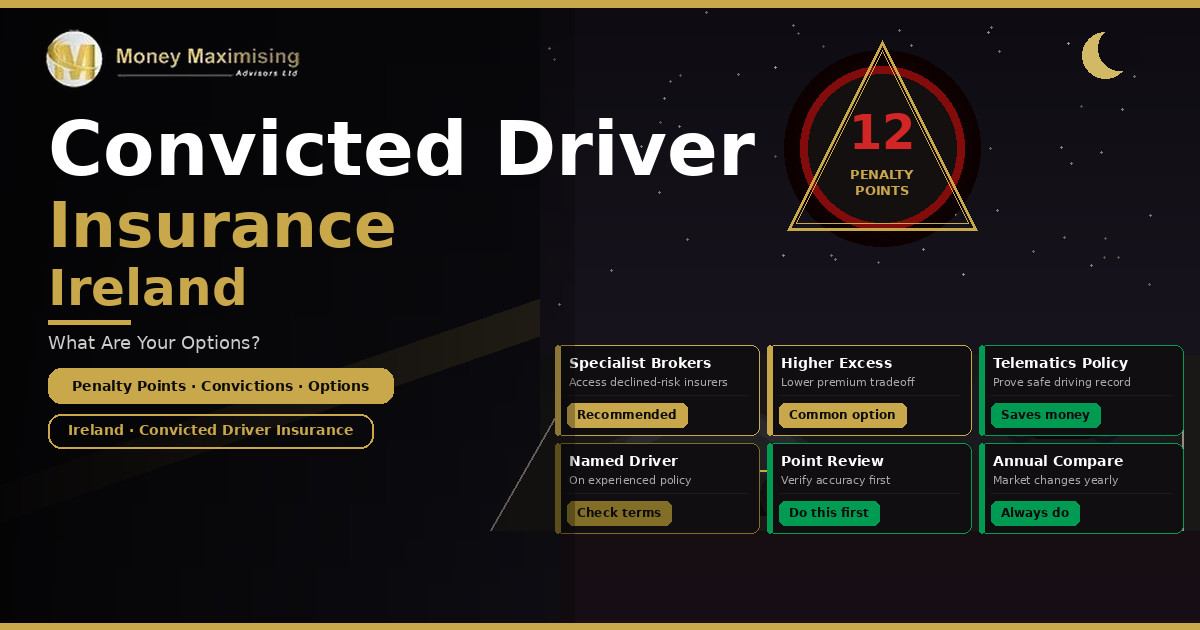
- Twelve points in any three year period means an automatic six month disqualification
- For learner permit holders, and for drivers in the first two years of their first full licence, the threshold is seven points, not twelve
- Time spent disqualified, or without a valid licence, does not count toward the three years
Points reach your licence record either through a fixed charge notice issued by An Garda Siochana or through the courts, and the Road Safety Authority publishes the current points value for every offence. You cannot check your total online. You request it from the National Driver Licence Service (NDLS) using the Driver Statement Form, and there is no fee. Do that before you request quotes rather than relying on memory, because an inaccurate points total on a proposal form is a common reason a premium gets revised upward after you have accepted it.
For newly qualified drivers the seven point threshold is the one that catches people out. Three separate three point offences reaches it. Our guide to L plate and N plate insurance in Ireland covers the novice period in more detail.
Which convictions affect your premium, and by how much
Insurers do not price convictions as a single category. They price the offence, the recency and the pattern.
| Offence | Typical underwriting view | Effect on availability |
| Single speeding offence, fixed charge paid | Minor. Often absorbed with no meaningful change | All insurers still quote |
| Repeated speeding, or several point offences | Pattern of risk rather than a one off | Most still quote, higher price |
| Mobile phone, seatbelt, no L plates and similar | Minor individually, cumulative in number | All insurers still quote |
| Careless driving conviction | Moderate to serious, particularly if recent | Some insurers decline |
| Dangerous driving conviction | Serious | Panel narrows considerably |
| Driving without insurance | Serious, and treated separately from driving standard offences | Panel narrows considerably |
| Drink or drug driving conviction | Most serious category in Irish motor underwriting | Small number of insurers, often with conditions |
| Driving while disqualified | Most serious category | Very limited market |
Two honest points about that table.
First, it is directional, not a price list. Two drivers with the same conviction can receive quotes that differ by a wide margin, because the conviction is only one input into the insurer’s risk assessment. Your age, how long you have held a full driving licence, your claims history, annual mileage, occupation, the vehicle you drive and your address all feed the same premium calculation, and an underwriter weighs them together rather than in isolation. The general drivers of Irish motor pricing are covered in our guide to car insurance costs in Ireland.
Second, an insurer declining to quote is a commercial decision, not a judgement that you are uninsurable. Different insurers set different appetite. The one that says no to a drink driving conviction from four years ago is sitting beside one that will write it at a price.
What the law actually requires you to declare
This is where most articles on this subject are years out of date.
Before September 2021, Irish consumers owed a duty of utmost good faith. You had to volunteer anything material, whether or not you were asked, and an insurer could avoid the policy if you failed to. That is no longer the law.
The Consumer Insurance Contracts Act 2019 replaced it. Your duty now is to answer the specific questions the insurer asks you, honestly and with reasonable care. You are not required to volunteer additional information beyond what is asked. In return, insurers must ask questions that are specific, plain and intelligible, and if they fail to follow up on an obviously incomplete answer they are generally treated as having waived the point.
The remedies also changed, and they are now proportionate rather than all or nothing.
| Type of misrepresentation | What the insurer can do |
| Innocent, where you answered honestly and with reasonable care | The insurer must pay the claim and cannot avoid the contract on that ground |
| Negligent | The remedy reflects what the insurer would have done had it known the full facts. This is a compensatory and proportionate test, so it may mean a reduced claim payment or amended terms rather than nothing |
| Fraudulent | The insurer can refuse the claim and avoid the contract |
What this means in practice for a convicted driver:
- Answer every question asked. Do not leave a conviction question blank hoping it will not be revisited.
- Answer the question that was asked, accurately. If the form asks about convictions in the last five years, that is the question.
- If a question is genuinely ambiguous, ask the insurer or broker to clarify in writing and keep the reply.
- Do not assume a small omission destroys your cover. It might reduce a claim rather than void the policy. But do not rely on that either, because deliberate concealment sits in the fraudulent category and there the insurer’s position is strong.
The protection here is real, and it is a good reason to be straightforward rather than clever. Declaring a conviction costs you money. Concealing one costs you the cover, at the exact moment you need it. Our overview of how car insurance claims are handled in Ireland sets out what an insurer reviews once a claim is notified.
The driver number requirement
Separately, since 31 March 2025 no Irish insurer or broker can legally issue or renew a motor policy without the driver number of every driver on it. It is a nine digit number in section 4(d) of your licence or learner permit. Have it to hand before you start requesting quotes, along with the numbers of anyone you intend to add as a named driver.
How long a conviction follows you
There is no single expiry date, because two separate clocks run.
| What | How long it lasts | Notes |
| Penalty points on your licence record | Three years from the appropriate date | Time disqualified or without a valid licence does not count |
| Conviction as an insurer question | Usually five years, sometimes longer for serious offences | The window is set by the insurer’s question, not by law |
| Practical pricing effect | Reduces year by year as the offence ages | Recency matters more than existence |
| A disqualification period itself | As ordered by the court | Creates a gap in cover, which is its own pricing problem |
The last row is worth expanding, because it catches people out. A disqualification does not only produce a conviction. It produces a period with no policy in your own name, and that gap has its own consequences. In Ireland a no claims bonus generally expires after roughly two years without cover in your own name, so a long disqualification can wipe out a bonus that took years to build. Our guide to how the no claims bonus works in Ireland explains the expiry rule and how to evidence a bonus when you return.
The practical takeaway: the year immediately after the offence carries the highest premium. Year three is usually noticeably better. Do not accept a renewal quote unquestioned in year two or three on the assumption that nothing has changed, because the thing that has changed is you.
What cover is available after a conviction
You retain access to the same three levels of cover as any other driver. What changes is who will quote and at what price.
| Cover level | What it does | Realistic view for a convicted driver |
| Third party only | Covers injury and damage you cause to others. Nothing for your own car | Widely assumed to be cheapest. Frequently is not |
| Third party, fire and theft | As above, plus fire and theft of your own vehicle | Often the practical middle option |
| Comprehensive | As above, plus damage to your own car | Sometimes prices below third party only, because it attracts a lower risk customer profile |
The counterintuitive point is genuine and worth testing every time. Third party only policies in Ireland can attract a higher risk pool, and pricing sometimes reflects that. Never assume downward. Price all three.
What to do if you are refused
This is the section most guides leave out, and it is the one that matters most if you are actually stuck.
Insurers are entitled to refuse cover. They must give you a reason if you ask for one. But you are not left without options, because all Irish motor insurers adhere to the Declined Cases Agreement, administered by Insurance Ireland.
How it works:
- Approach at least three insurers and keep a careful record of the order. The order matters, because the first insurer approached is generally the one required to quote.
- Get each refusal in writing. A letter or an email is fine. A phone call is not. Each refusal letter is valid for six months from its date.
- Email the Declined Cases Committee at Insurance Ireland with the three written refusals.
- The Committee obtains a quotation for you. The only ground on which the market can still refuse is where providing cover would be contrary to the public interest.
Two additional points. If you have held a policy with an insurer within the previous three years, that insurer is obliged to provide you with a quotation, subject to the same three refusals condition. And the Committee also considers whether a quoted price is so high as to amount to a refusal in substance.
The Declined Cases route is a backstop, not a shopping strategy. The quotation it produces is unlikely to be competitive. Exhaust the broker market first.
If you think you have been treated unfairly
Refusal and complaint are two different things. An insurer is entitled to decline a risk. It is not entitled to handle your application or your claim unfairly, and the Central Bank of Ireland requires regulated firms to act honestly, fairly and professionally in your best interests.
If you believe an insurer has fallen short of that, raise a formal complaint with the firm first. If you are not satisfied with the outcome, you can refer the matter to the Financial Services and Pensions Ombudsman, which can investigate and make binding findings. The Competition and Consumer Protection Commission also publishes guidance on complaining about an Irish motor insurance provider.
Practical ways to reduce the cost
- Use a broker rather than comparison forms alone. Many insurers who will write convicted risk do not appear on price comparison sites, and appetite for specific offences is not published anywhere. This is the one situation where broker access genuinely changes the outcome rather than just the convenience.
- Fix the paperwork before you quote. Correct licence details, an accurate points total from the NDLS, and evidence of any no claims bonus. Wrong details are a common reason an online system produces no price at all, and people misread that as a refusal.
- Reconsider the car. Engine size, value and insurance group all move the price, and they move it further when the driver is already rated up. If you are changing vehicle anyway, check the rating basis first. Our guide to electric car insurance in Ireland covers how EVs are priced differently from equivalent petrol or diesel models.
- Price all three cover levels. See above. The assumption that third party is cheapest costs Irish drivers money every year.
- Raise the voluntary excess if the household can genuinely absorb it.
- Ask whether a telematics policy is available. Black box cover is far less common in Ireland than in the UK and is not offered by every insurer, but where it exists it prices partly on how you drive now rather than only on what your record says about how you drove then. That is a useful distinction for a driver with an ageing conviction.
- Review the driver line up. Adding an experienced second driver occasionally helps, though it is not reliable and must reflect real usage. Our guide to named driver car insurance in Ireland explains when it works and when it becomes fronting.
- Re quote every single year. Convictions age. Renewal quotes do not automatically reflect that. This is the single highest return action in this list.
- Review the whole household. Where several policies sit with one broker, reviewing your general insurance arrangements together often finds room that a single motor policy will not.
Situations that need extra care
Younger drivers with convictions. The combination of limited experience and an offence prices very steeply, and the seven point novice threshold means a disqualification arrives faster. See our guide to young driver car insurance in Ireland.
Drivers with foreign licences and overseas convictions. Evidencing driving history from abroad is already slower, and a conviction adds another layer of verification. Start earlier than you think you need to. Our guide to car insurance for international drivers in Ireland covers what insurers accept, and you can begin an international driving experience quote directly.
Older drivers with a single historic offence. Do not let one old conviction anchor you to a renewal. Rating for experienced drivers works differently, and car insurance for over 50s in Ireland is often assessed on a separate basis.
Anyone driving a van rather than a car. Private car cover does not apply. You need a van insurance quote on the correct commercial basis, and conviction appetite differs again in that market.
Common mistakes to avoid
- Accepting the first quotation. Spread between insurers is at its widest exactly when a driver is non standard.
- Assuming penalty points must be disclosed as convictions, or that a paid fixed charge notice gives you a criminal record.
- Leaving a question blank rather than answering it. Under the 2019 Act your duty is to answer what is asked.
- Guessing your points total instead of requesting a Driver Statement from the NDLS.
- Treating three refusals as the end of the road rather than the trigger for the Declined Cases Agreement.
- Letting cover lapse during a disqualification without understanding what it does to your no claims bonus.
- Assuming third party only is cheapest.
A simple decision framework
- Do you have a conviction, penalty points, or both? Establish this properly. Request your Driver Statement from the NDLS.
- How old is the offence? If it is approaching its third anniversary, re quoting shortly afterwards is likely to be worth more than anything else you do.
- Have you priced all three cover levels with at least three insurers? If not, do that before concluding anything about cost.
- Have you been refused by three insurers in writing? If yes, you have a route under the Declined Cases Agreement. If the refusals were verbal, go back and get them in writing.
- Is the remaining obstacle price rather than availability? That is a broker conversation, not a comparison site one.
Key Takeaways
- Convicted driver insurance in Ireland is standard motor cover, priced for your record. It is not a separate product.
- Penalty points and court convictions are different things and are asked about separately.
- Since September 2021 your duty is to answer the insurer’s specific questions honestly and with reasonable care, not to volunteer everything.
- Remedies for getting something wrong are proportionate. An innocent misrepresentation does not void your policy.
- Points last three years from the date they take effect. Twelve means a six month ban, or seven for learner and novice drivers.
- Price third party, third party fire and theft, and comprehensive every time. Third party is frequently not the cheapest.
- Three written refusals give you a route under the Declined Cases Agreement. You are not uninsurable.
Talk to MM Advisors About Cover After a Conviction
A conviction changes your price. It should not change whether you can drive.
The drivers who end up worst off in this situation are usually not the ones with the most serious offences. They are the ones who accepted the first renewal quote they were given, never re quoted as the offence aged, or answered an application form badly out of worry about what to declare.
Money Maximising Advisors Ltd (MM Advisors), regulated by the Central Bank of Ireland, reference C154250, is an insurance broker. That means we approach insurers on your behalf, including those you cannot reach through a comparison site, and we can present your record accurately rather than leaving it to a form to interpret.
If you have a conviction, penalty points, or a recent disqualification, we can review your position and tell you honestly what the market looks like for your circumstances.
Get a motor insurance quote or contact our team to talk it through.
Other cover we arrange
We also advise on home insurance, including what drives home insurance costs in Ireland, with a home insurance quote available online.
For property owners we arrange landlord insurance in Ireland and a dedicated rental property quote.
For business owners we cover commercial insurance and business insurance for sole traders and SMEs, with a sole trader quote form.
We also arrange travel insurance, with a travel insurance quote, and you can request a quote for any product from one place.
Frequently Asked Questions
1. Can I get car insurance with a driving conviction in Ireland?
Yes. A conviction narrows the number of insurers willing to quote and raises the price, but it rarely makes cover unobtainable. If three insurers refuse you in writing, the Declined Cases Agreement operated by Insurance Ireland requires the market to provide a quotation.
2. Are penalty points the same as a conviction?
No. Points are added either when you pay a fixed charge notice or when you are convicted in court. Paying a fixed charge notice is not a criminal conviction, though the points still appear on your record and insurers still ask about them.
3. What do I legally have to tell my insurer?
Under the Consumer Insurance Contracts Act 2019 you must answer the specific questions the insurer asks honestly and with reasonable care. You are not required to volunteer information beyond what is asked, and insurers must ask questions in plain, specific language.
4. What happens if I get something wrong on the form?
It depends on how it happened. An innocent misrepresentation, where you answered honestly and carefully, does not entitle the insurer to avoid the policy and the claim must be paid. A negligent one attracts a proportionate remedy. A fraudulent one allows the insurer to refuse the claim and void the contract.
5. How long does a conviction affect my car insurance in Ireland?
Penalty points remain on your licence record for three years from the date they take effect. Insurers typically ask about convictions over a five year window, and the pricing effect fades as the offence ages, with the first year after the offence the most expensive.
6. How many penalty points before I lose my licence?
Twelve points in any three year period brings an automatic six month disqualification. For learner permit holders, and for drivers in the first two years of their first full licence, the threshold is seven points.
7. What do I do if every insurer refuses me?
Approach at least three insurers, note the order, and get each refusal in writing. Refusal letters are valid for six months. Then contact the Declined Cases Committee at Insurance Ireland, which will obtain a quotation for you.
8. Can a broker help if I have a conviction?
Often, yes. Several insurers that write convicted risk do not appear on comparison sites, and appetite for specific offences is not published. A broker can place the risk with insurers you cannot reach directly and can present the application properly.