
Quick answer
Unoccupied property insurance in Ireland comes at two levels. FLEE cover protects against fire, lightning, explosion and earthquake only. Full cover adds storm, flood, escape of water, theft, malicious damage, subsidence and more. The difference matters enormously, because escape of water and theft are the two likeliest claims on an empty building and FLEE cover excludes both. Which level you are offered depends on the property, why it is empty and how long it will stay that way.
Most people arranging unoccupied property insurance ask what it costs before they ask what it covers. That is the wrong order. Two quotes for the same empty house can differ by a few hundred euro and cover completely different things, and the cheaper one frequently excludes the exact event that is most likely to happen.
This guide sets out both cover levels line by line, explains the conditions attached, and covers the four situations that most often leave a property unoccupied. For the mechanics of the product itself, our guide to unoccupied home insurance Ireland explains how these policies are structured and when they apply.
What is unoccupied property insurance?
It is cover written specifically for a building that nobody is living in. Standard household policies are priced on the assumption that somebody is there, and most restrict or suspend significant parts of the cover once a property has been empty for a set number of consecutive days, commonly thirty and sometimes sixty.
The policy does not cancel itself when that happens. It narrows, usually without telling you, and the covers that fall away first are the ones that matter most in an empty building.
Unoccupied property insurance replaces that narrowing cover with a policy built for the actual risk.
What does unoccupied property insurance cover? FLEE cover and full cover
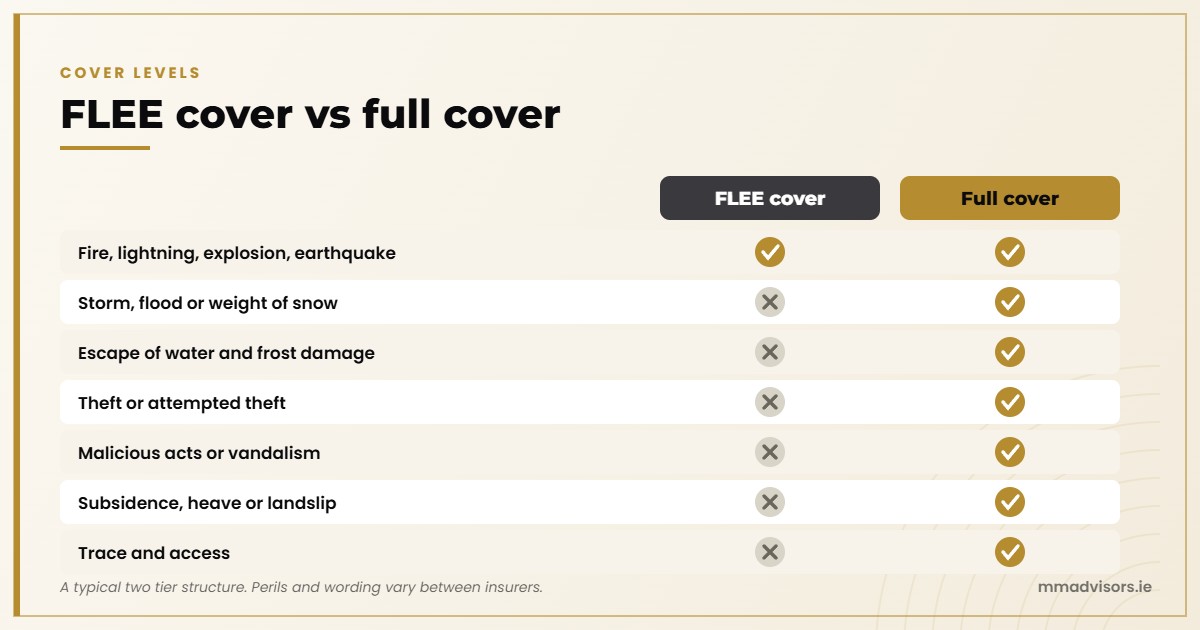
FLEE stands for fire, lightning, explosion and earthquake. It is the restricted tier, and it is what many insurers will offer where a property is higher risk, in poor condition, undergoing works, or likely to be empty for a long time.
Full cover is the broader tier and covers most of what a standard household policy would, subject to the conditions set out further down.
The table below reflects a typical two tier structure in the Irish market. Exact perils, limits and wording vary between insurers, so always read the schedule you are actually being offered rather than assuming this applies to your policy.
| Cover | FLEE cover | Full cover |
|---|---|---|
| Fire and resultant smoke damage, lightning, explosion or earthquake | Yes | Yes |
| Storm, flood or weight of snow | No | Yes |
| Escape of water from and frost damage to fixed water tanks, apparatus or pipes | No | Yes |
| Escape of oil from a domestic fixed oil fired heating installation, and smoke damage from a fault in any fixed domestic heating installation | No | Yes |
| Collision by any vehicle or animal | No | Yes |
| Theft or attempted theft | No | Yes |
| Malicious acts or vandalism | No | Yes |
| Subsidence, heave or landslip | No | Yes |
| Falling trees, telegraph poles, solar panels, wind turbines or lamp posts | No | Yes |
| Trace and access | No | Yes |
| Replacement locks | No | Yes |
| Fire brigade charges | Yes | Yes |
| Loss of rent or alternative accommodation | Yes | Yes |
| Garden plants and shrubs | Yes | Yes |
| Legal protection | Yes | Yes |
| Home emergency assistance | Yes | Yes |
Where contents cover is included:
| Cover | FLEE cover | Full cover |
|---|---|---|
| Contents temporarily removed from the home | Yes | Yes |
| Contents at university, college or boarding school | Yes | Yes |
| Household removals | Yes | Yes |
| Tenants liability | Yes | Yes |
| Guests, visitors and domestic staff personal effects | Yes | Yes |
Why FLEE cover is narrower than the table suggests
Look at the bottom half of that first table and FLEE cover appears generous. Fire brigade charges, loss of rent, legal protection, home emergency assistance and garden plants all show as included.
They are, but only following loss or damage caused by FLEE perils.
That is the single most misunderstood thing about restricted cover. The ancillary benefits are not standalone. Loss of rent is covered if the house becomes uninhabitable after a fire. It is not covered if the house becomes uninhabitable after a burst pipe, because escape of water is not a FLEE peril, so nothing that follows from it is covered either.
The same logic runs through the contents extensions. They sit inside the policy, but they respond only when the triggering event was fire, lightning, explosion or earthquake.
So the practical reading of FLEE cover is narrower than the table first suggests. It protects against the building burning down or blowing up. It does not protect against most of what actually happens to empty houses.
What actually goes wrong in an empty property
Set the two tiers against the claims that genuinely occur in vacant buildings.
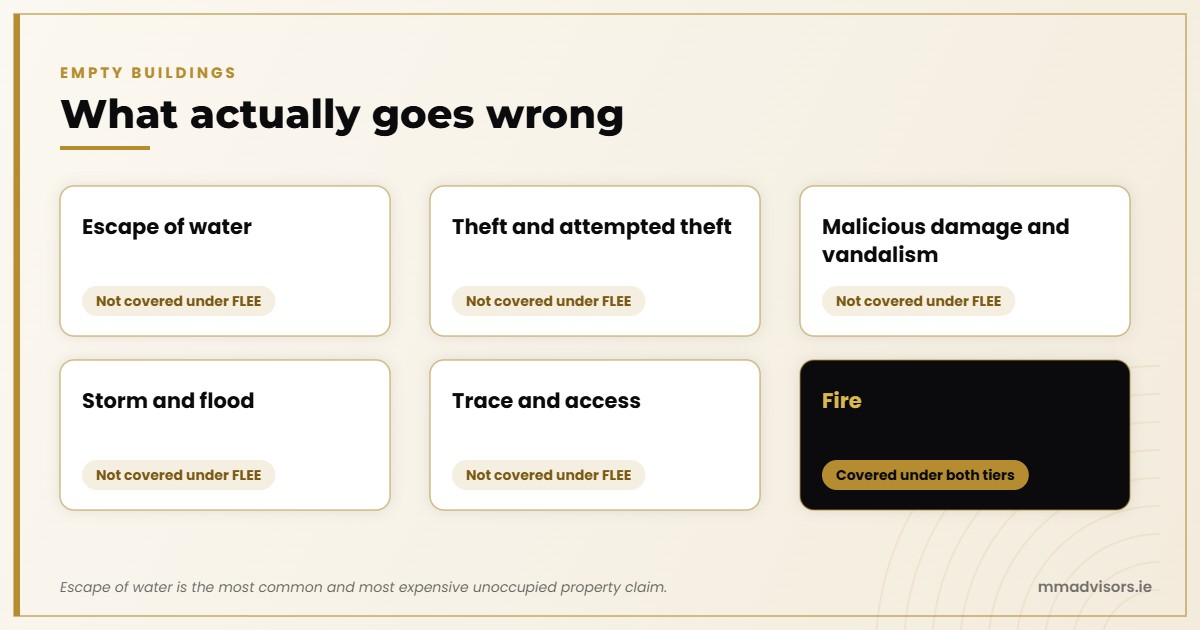
Escape of water. The most common and most expensive unoccupied property claim by a wide margin. A joint fails in an unheated house in January, and nobody finds it for six weeks. The same failure in an occupied house is a mopping up job. In an empty one it takes out ceilings, floors, wiring and plaster throughout. Not covered under FLEE.
Theft and attempted theft. Empty properties are targeted, particularly where the emptiness is visible from the road. Copper, boilers, radiators, fittings, tools left by contractors. Not covered under FLEE.
Malicious damage and vandalism. A vacant house attracts attention, and the longer it stays vacant the more it attracts. Not covered under FLEE.
Storm and flood. A slipped tile on an occupied house gets fixed. On an empty one, water enters through the gap all winter. Irish storm frequency and rainfall intensity are both rising, which our guide to protecting your home against global warming covers in more detail. Not covered under FLEE.
Trace and access. The cost of finding and getting at a leak, which often means lifting floors or opening walls before any repair begins. It can run into thousands on its own. Not covered under FLEE.
Fire. Genuinely covered under both tiers, and genuinely catastrophic. This is what FLEE cover is for.
Fire is the risk FLEE cover handles well. Everything else on that list, which is most of what happens, it does not touch. That is why establishing which tier you have been offered, in writing, matters more than the premium.
Which cover level will you be offered?
This is usually the insurer’s decision rather than yours. The factors that move it:
- How long the property will be empty. Short, defined periods attract fuller cover. Open ended vacancy attracts restrictions.
- Why it is empty. A tidy family home in probate is a different proposition from a repossessed property that has been vacant for three years.
- Condition. Roof, wiring, plumbing and general state of repair. A well maintained house gets better terms.
- Whether work is going on. Renovation, and particularly hot works such as welding or torch on roofing, pushes toward restricted cover.
- Location and security. Isolated properties, and those with no alarm or poor locks, are rated accordingly.
- Claims history on the address. Previous claims follow the property, not just the owner.
- Whether contents remain. Furnished vacant properties raise both the exposure and the attraction to thieves.
Offered FLEE cover when you expected full cover?
If you are offered FLEE cover and you expected full cover, ask what would need to change to move up a tier. Sometimes it is fixable: draining the system down, fitting an alarm, agreeing a documented inspection schedule, or committing to a defined end date for the vacancy.
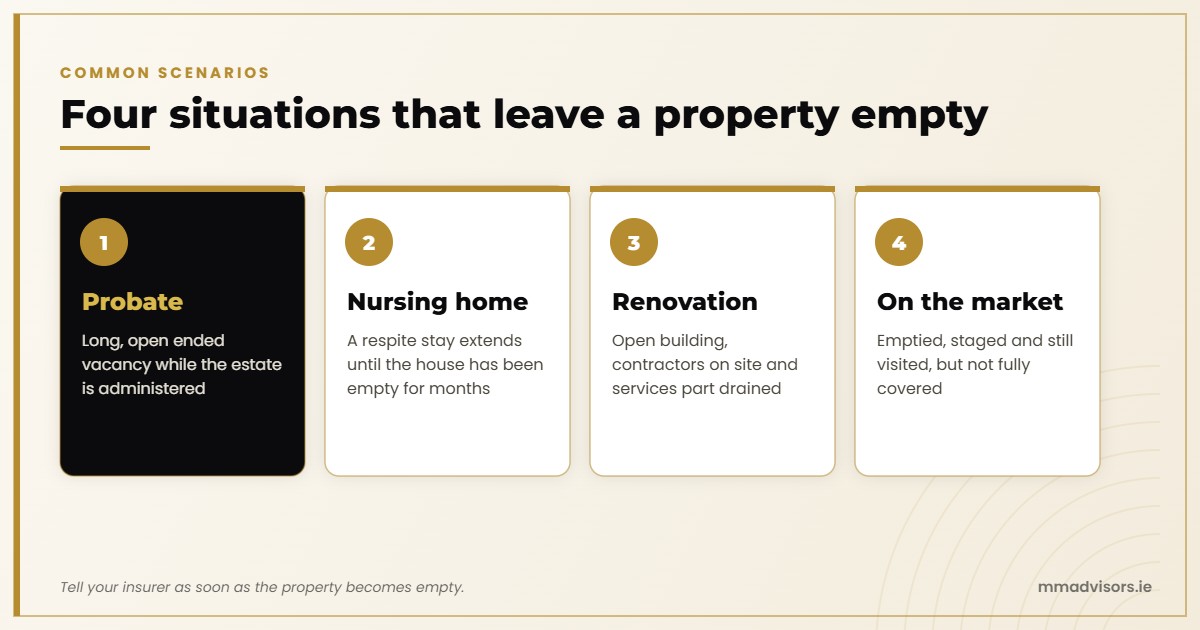
Four situations that leave a property unoccupied
Who insures a house in probate?
The property sits empty while the estate is administered, which in Ireland is rarely quick and can run well past a year where the estate is complex.
Cover is normally arranged in the name of the representatives of the late owner, often written as “the Reps of the Late [Name]”, because the original policyholder has died and the executors or administrators hold the property for the estate.
What makes these risks distinctive: the vacancy is long and open ended, responsibility is diffuse because executors are often dealing with things from another county or country, the contents are usually still in the house, and the property is frequently older with services that have not been reviewed in decades.
Tell the existing insurer about the death immediately. Do not assume the policy runs on because the premium is paid to the year end.
Is a house insured when the owner moves into a nursing home?
This one creeps up, because nobody decides the house is now unoccupied. A respite stay extends, then extends again, and eighteen months later the property has been empty throughout on a household policy that stopped covering most of it after the first month.
Notify the insurer as soon as it is clear the absence is not short term. The unoccupancy clock starts when the property became empty, not when the family accepted the move was permanent.
Confirm who can act on the policy. Where an enduring power of attorney is registered, the attorney can usually deal with the insurer, so have the documentation ready.
If the family is weighing up letting the property, that is a different arrangement entirely and needs landlord insurance in Ireland rather than unoccupied cover. Letting also affects the position under the Nursing Home Support Scheme, so take advice on Fair Deal before a tenant moves in.
Can you insure a property while it is being renovated?
The purchase completes, the mortgage requires buildings cover from drawdown, and nobody will live there for months. From the insurer’s point of view this is a vacant property undergoing works.
Renovation pushes the risk up on several axes at once. The building is open, with scaffolding, windows out and roof work. Contractors are on site. Materials and tools are a theft target. Water and heating systems are often part drained or mid replacement. And the type of work matters, with hot works sitting well above redecorating.
Expect restricted cover during the works. Describe the scope honestly, because understating it is the fastest route to a declined claim. Check the contractor carries their own public liability and see the certificate rather than taking their word for it. Then tell the insurer when the works finish and the property becomes occupied.
Older properties, unusual construction, or anything previously refused cover may not fit standard underwriting at all, in which case it needs placing as non standard home insurance in Ireland.
Does an empty house on the market still need insurance?
The house has been emptied and listed. The owner still owns it and still visits to show viewers around, so mentally it is still insured, which it is, but not for everything they assume.
Tell the insurer when it goes on the market, not when the sale falls through nine months later. Decide whether contents cover is still needed if furniture has been left for staging. Keep the alarm active and the inspection schedule running. And confirm cover stays in place up to and including the day of closing, rather than cancelling when contracts are signed.
How long before a property counts as unoccupied?
Most Irish household policies define it as a set number of consecutive days with nobody living there, commonly thirty and sometimes sixty.
Three things people get wrong:
- Visiting is not occupying. Calling in weekly to collect post does not reset the clock. Occupancy generally means somebody living and sleeping there.
- The clock runs from when the property became empty, not from when you noticed or accepted it.
- Furnished does not mean occupied. A house full of furniture with nobody in it is unoccupied.
Check your own wording for the exact definition and the exact number, and if you cannot find it, ask your broker to point at the clause.
What conditions apply to unoccupied property insurance?
Full cover in particular comes with obligations, and failing them gives the insurer a defence on a claim. Expect some combination of:
- Documented inspections at set intervals, often every seven or fourteen days, with a record kept of who attended and when
- Either the water system drained down, or the heating maintained at a minimum temperature through the colder months
- The property kept locked and secure, with specified locks and the alarm set where one exists
- Letterbox cleared and post not left visible, since accumulated post advertises vacancy
- The property maintained in good repair, with defects fixed rather than noted
- Prompt notification of any change in circumstances
- No work beyond a stated value without telling the insurer first
The inspection condition is the one most often breached. If the policy requires a visit every fourteen days and nobody has been near the place in four months, that is a problem regardless of what caused the damage.
What information will the insurer ask for?
- Why the property is unoccupied and the circumstances behind it
- How long it has been empty, and how long it is expected to remain so
- Who owns it, and in whose name the policy should be issued
- Who holds keys, who inspects it and how often
- Whether the water is drained or the heating maintained
- What security is in place
- Whether contents remain in the property
- The condition of the roof, wiring and plumbing
- Whether any work is planned or under way, and of what kind
- Whether the property has ever flooded or been refused cover
Answer all of it accurately. Non disclosure is the most common reason an unoccupied property claim fails, and every one of these answers is straightforward to verify after a loss.
Seven mistakes that cost unoccupied property owners money
- Assuming the existing policy carries on unchanged. It usually does not, and it rarely announces the change.
- Not establishing which cover tier you have. “Insured” means two very different things depending on the answer, and the gap is mostly escape of water and theft.
- Letting the sum insured drift. A rebuild figure set years ago is very likely too low now, and underinsurance lets the insurer reduce a settlement proportionally, including on a partial claim. Our guide to home insurance cost in Ireland covers how rebuild costs have moved.
- Ignoring the inspection condition. It is in the policy whether anybody is doing it or not.
- Leaving the heating off through winter without draining down. The classic unoccupied claim, and usually a breach of condition as well as a loss.
- Not telling the insurer when circumstances change again. A tenant moving in, works finishing, a sale closing. Each one changes the policy that should be in place.
- Treating unoccupied as uninsurable. It is not. It needs arranging deliberately rather than inheriting whatever the old policy does.
Get unoccupied property insurance advice from a broker
Every vacant property is a slightly different underwriting conversation, and online forms are built for houses with people in them. A probate property with contents still in place, a renovation with contractors on site, and a staged house on the market are three different risks, and not every insurer will look at all three.
Money Maximising Advisors is an independent financial advisory and insurance brokerage based in Galway, regulated by the Central Bank of Ireland, reference C154250. We place unoccupied property risks across our panel, including those standard household underwriting declines, and we review the wider home insurance and general insurance position at the same time.
If you are dealing with a property in probate, a family home that is now empty, a renovation, or a house on the market, get a home insurance quote or contact our team and we will tell you which cover level is realistically available and what it would take to improve it.
Important: This article is general information only and does not constitute financial, legal or tax advice. The cover level comparison illustrates a typical structure in the Irish market. Perils, limits, exclusions and conditions vary between insurers and are subject to individual underwriting, so always rely on the policy schedule and wording you are offered. Probate procedure, enduring powers of attorney and the Nursing Home Support Scheme are summarised at a general level only. Confirm your own position with your solicitor, the Probate Office, the HSE and your insurer or broker.
Frequently Asked Questions
1. What is unoccupied property insurance?
Cover written for a building nobody is living in. Standard household policies restrict or suspend major parts of their cover once a property has been empty for a set period, commonly thirty consecutive days.
2. What does FLEE cover mean?
FLEE stands for fire, lightning, explosion and earthquake. It is the restricted tier of unoccupied cover and excludes storm, flood, escape of water, theft, malicious damage and subsidence.
3. What is the difference between FLEE cover and full cover?
Full cover adds storm, flood, escape of water, theft, malicious damage, subsidence, falling trees, trace and access, and replacement locks. FLEE covers fire, lightning, explosion and earthquake only.
4. Does unoccupied property insurance cover burst pipes?
Only under full cover. Escape of water and frost damage to fixed tanks, apparatus and pipes are excluded from FLEE cover, despite being the most common claim on an empty property.
5. Does FLEE cover include theft?
No. Theft and attempted theft are excluded from FLEE cover entirely. If the property is at any real risk of theft, full cover is the only tier that responds to it.
6. How long can a property be empty before insurance is affected?
Most Irish policies restrict cover after a set number of consecutive days, commonly thirty and sometimes sixty. Visiting does not count as occupying, and the clock starts when it became empty.
7. Who insures a house after the owner dies?
The executors or administrators arrange cover for the estate, normally in the name of the representatives of the late owner. Tell the existing insurer about the death immediately, not at renewal.
8. Is a house insured while the owner is in a nursing home?
Only briefly under a standard policy. Once the absence passes the unoccupancy threshold the cover narrows sharply, and the property needs unoccupied cover arranged deliberately.
9. Can I insure a property while it is being renovated?
Yes, though cover is often restricted to FLEE perils during the works. Describe the scope honestly, check the contractor’s own liability cover, and notify the insurer when the property becomes occupied.
10. What conditions apply to unoccupied property cover?
Typically documented inspections at set intervals, the water drained or heating maintained at a minimum temperature, the property kept secure and in repair, and prompt notification of any change.
11. Does unoccupied property insurance cover contents?
It can, but it is not automatic and limits are often lower than on a household policy. Where contents remain in the property, have the position confirmed in writing before relying on it.
12. Why is my property only being offered FLEE cover?
Usually the length of the vacancy, the condition of the building, ongoing works, security, or claims history on the address. Ask what would need to change to qualify for full cover.
Sources
- Citizens Information, probate and administering an estate
- Courts Service Probate Office, applying for a grant
- HSE, Nursing Home Support Scheme and the Fair Deal financial assessment
- Decision Support Service, enduring powers of attorney
- Society of Chartered Surveyors Ireland, house rebuild calculator