Your no claims bonus is quietly one of the most valuable things on your car insurance policy. Build it up over several claim-free years and it can knock more than half off your premium, but make one wrong move, from a small claim to letting your cover lapse, and years of savings can vanish overnight. With Irish motor premiums rising again, understanding how a no claims bonus works, and how to protect it, is money in your pocket.
This guide explains exactly how the no claims bonus Ireland operates: the discount ladder, the four ways drivers lose their bonus, the difference between step-back and full protection, the rules for transferring it between insurers or from abroad, and the expiry trap that catches thousands of drivers out. Money Maximising Advisors arranges car insurance for clients across Ireland, and bonus questions come up at almost every renewal.
Quick answer: what is a no claims bonus?
A no claims bonus, also called a no claims discount, is a percentage reduction on your motor premium earned for each consecutive year you hold a policy in your own name without making a claim. In Ireland it typically starts around 20 percent after one year and rises to somewhere between 50 and 60 percent after five or six years, at which point most insurers cap it. It belongs to you, not to your car, and it expires if you go roughly two years without cover in your own name.
What is a no claims bonus?
A no claims bonus (NCB), often called a no claims discount (NCD); the two mean the same thing, is a percentage reduction on your motor premium earned for every full year you hold a policy in your own name without making a claim. Each claim-free year adds another step to your bonus, and the discount grows accordingly.
The key phrase is “in your own name.” The bonus is tied to you as the policyholder, not to your car, and it rewards your personal claims record. It is applied as a percentage reduction on the base premium your insurer calculates for you, so it sits on top of, and depends on, that underlying price. For context, the Central Bank of Ireland recorded an average private motor premium of €655 in the first half of 2025. On a premium at that level, the difference between a maximum bonus and no bonus at all is comfortably several hundred euro a year, every year.
How does a no claims bonus discount ladder work in Ireland?
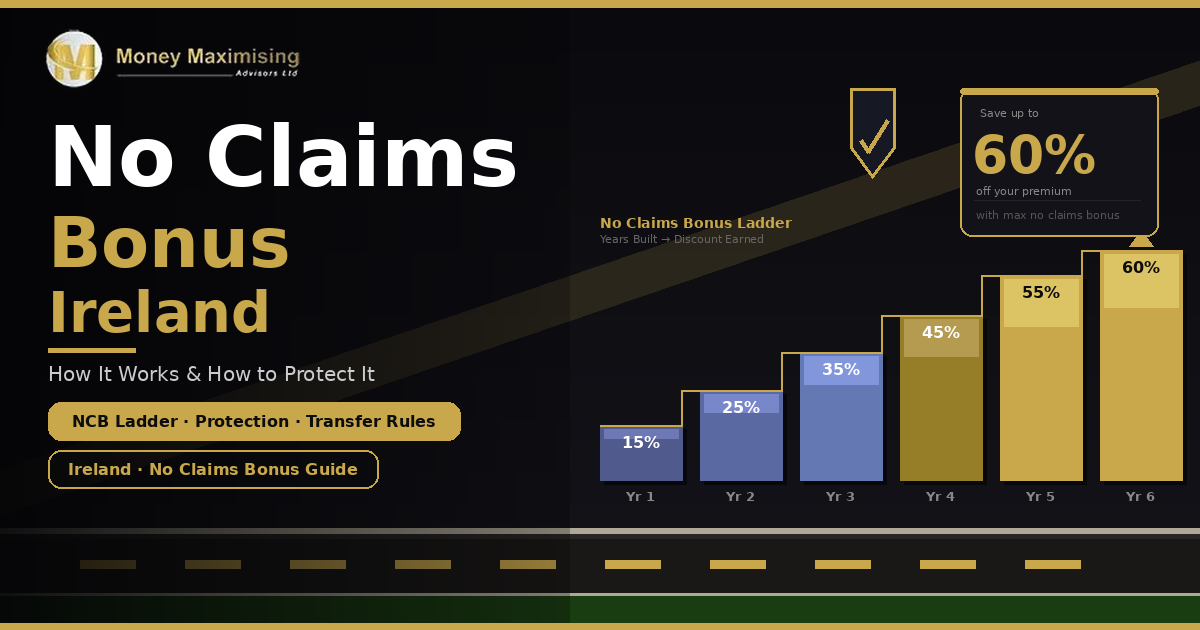
The more consecutive claim-free years you accumulate, the larger your discount, up to a maximum that most insurers cap at around five or six years. Every insurer sets its own scale, so the figures below are indicative rather than a quote, the shape, however, is broadly consistent across the Irish market.
| Claim-free years in your own name | Typical discount |
| 1 year | 10–20% |
| 2 years | 20–30% |
| 3 years | 30–40% |
| 4 years | 40–50% |
| 5+ years | 50% and above (insurer-dependent, up to ~55–60%) |
Two points are worth pausing on.
The discount applies to a base premium the insurer calculates for you. A 50 percent bonus on a high base premium can still cost more than a 20 percent bonus on a low one. This is why comparing headline discount percentages between insurers is meaningless. Compare the final price.
Most insurers stop rewarding you after five or six years. Year seven and year twelve usually attract the same discount. What continues to help beyond that point is the overall length of your claims free record, which insurers use in underwriting even after the published ladder tops out.
For context, the Central Bank of Ireland recorded an average private motor premium of €655 in the first half of 2025. On a premium of that order, the difference between a maximum bonus and no bonus at all is comfortably several hundred euro a year, every year.
Named driving experience Ireland: not the same as your own bonus
Here is the point that trips up more drivers than almost anything else: being a named driver on someone else’s policy does not build your own no claims bonus. Only holding a policy in your own name does that.
What named driving does build is a separate named driving experience discount. Most major Irish insurers offer this when you eventually take out your own policy, provided you have at least one consecutive year of claims-free named driving and have not held your own policy in the last two years. Aviva, for example, states it can apply a discount of up to 50 percent for named driving experience based on these criteria. Other insurers set their own thresholds, and some do not offer it at all.
Three things to understand about named driving experience:
It is generally worth less than the equivalent own-name bonus and is accepted by fewer insurers when you switch.
It usually requires a letter from the original insurer listing the years of named driving and confirming no claims arose during that period.
The clock only really starts on your own record when you take out your own policy, which is why there is a strong case for doing that as early as possible. This matters most for young driver car insurance Ireland, where the difference compounds year after year.
One firm warning: if a young person is genuinely the main user of a car, they must be listed as the main driver. Listing a parent as the main driver to reduce the price is called fronting. It is a misrepresentation, and it can leave a claim unpaid at the worst possible moment.
The four ways Irish drivers lose their no claims bonus
1. Making a claim where you are at fault
The obvious one. An at-fault claim, where you were responsible, or where the other party cannot be pursued, typically reduces or wipes your bonus at the next renewal. A non-fault claim, where another driver was liable and their insurer covers the cost, usually leaves your bonus intact, provided the third party accepts liability and your insurer recovers its outlay. A car insurance claims decision is therefore never just about the repair cost: it is also about the discount you would lose and how many years it would take to rebuild.
Windscreen and glass claims are commonly excluded from the no claims bonus calculation altogether, especially when you use the insurer’s approved repairer. Always confirm this with your own insurer before booking the repair.
2. The two-year rule
This catches out more drivers than claims do. If you go without a motor policy in your own name for roughly two years, most Irish insurers treat your bonus as expired and you restart at zero. The usual causes are emigration, a period of illness, selling a car without replacing it quickly, or moving to a company vehicle for a few years. If you are approaching that threshold, ask insurers directly about reduced discounts for a lapsed bonus rather than accepting a zero-rated quote.
3. Years spent only as a named driver
Named drivers do not build a no claims bonus. This is the single biggest misconception in the Irish market, and it costs young drivers thousands. As set out above, named driving builds a separate experience discount, valuable, but not transferable as an NCB record.
4. Paperwork
When you switch insurers you need a no claims bonus certificate from the previous insurer. A renewal notice is generally not accepted. A cancellation letter is only accepted where it carries the same details a certificate would, your name, policy number, vehicle registration and the number of claims-free years. Request the certificate when the policy ends, not two years later when the insurer’s records are harder to retrieve. Keep your own copy of every certificate.
No claims bonus protection: step-back and full protection explained
Protection is an optional add-on that shields your hard-earned discount if you do need to make a claim. The two forms are often confused.
Step back bonus protection
Step-back protection softens the blow rather than removing it. Instead of losing your entire bonus after a claim, your discount steps back by a set number of years. A driver with five years might fall to three or four rather than to zero. Some insurers include a basic form of step-back as standard in the policy; others charge for it.
Full no claims bonus protection
Full protection lets you make one or more claims within a defined period, subject to the policy terms, while keeping your discount percentage completely intact. Terms vary considerably between insurers.
| Protection type | Rough annual cost | What happens after a claim |
| Step-back | ~€30–€50 | Discount drops by 1–2 years, not to zero |
| Full | ~€50–€80 | Discount percentage fully preserved |
The nuance most articles skip.
Protecting your bonus protects the discount percentage. It does not oblige the insurer to charge you the same total premium. A claim on your record can and often does change the base premium the discount is applied to, and it will be disclosed when you shop around. Protection softens the blow significantly, it does not make a claim entirely free of consequence.
No claims bonus certificate: the paperwork that makes it portable
Whether you are buying protection, switching insurer, or transferring your record from abroad, the document you need is a no claims bonus certificate, an official statement from your previous insurer showing the number of claims-free years in your name and the absence of outstanding claims. A renewal notice is not a substitute. Request it proactively at the end of any policy, even if you think you will stay with the same insurer.
Transfer no claims bonus to Ireland: bringing a record from abroad
If you are returning to Ireland after working abroad, a claims-free record earned in your own name will often be recognised. According to Citizens Information, Irish motor insurers will generally take account of no claims history from the EEA, the UK, Switzerland, Australia, New Zealand, Japan, Canada, South Africa and the United States, subject to proof.
What you will need:
- A no claims bonus statement or equivalent from the overseas insurer, showing the policy was in your own name and the number of claims-free years.
- A letter setting out the dates and type of cover held.
- An English translation where the documents are not in English.
- Documents are typically required to be dated within the last two years.
The practical advice is simple: get the paperwork before you leave the country you were insured in. Chasing an overseas insurer after your policy has lapsed and you have moved is slow at best. Individual insurers also set their own acceptance criteria, so a document one insurer accepts may not satisfy another. If you are returning with several years of clean driving history, it is worth working through a broker who can identify which insurer will give you the most credit.
Is no claims bonus protection worth buying?
A rough working rule. Take your current premium and estimate what you would pay if your discount fell to zero. If losing your bonus would cost you, say, €350 a year and it takes four or five years to rebuild, the exposure over that period is well over €1,000. Against that, protection costing a modest annual amount is usually rational once your bonus reaches four years or more.
It is generally less compelling when your bonus is small, because there is little to lose, and when your premium is low in absolute terms. It is more compelling if you drive high mileage, park on street in a busy urban area, or hold a maximum bonus you would take years to rebuild. The key is to run the numbers on your own policy rather than buying it by default.
The 2-year expiry rule: how drivers lose their bonus
This is the single most common way people throw away years of savings. In Ireland, a no claims bonus generally expires after two years without a policy in your own name. Once that window passes, the bonus resets to zero and you start building again from scratch.
The lapse is rarely deliberate. It usually happens when someone:
- Emigrates or travels for an extended period and doesn’t keep a policy going.
- Takes a career break or stops driving temporarily.
- Sells a car and becomes a named driver on a partner’s policy instead of holding their own.
- Simply let’s cover lapse without realising the clock is ticking.
If you know you will be off the road for a while, it is worth talking to a broker about how to preserve your record, because rebuilding five years of bonus from zero is an expensive mistake.
How to protect your no claims bonus: a checklist
- Hold a policy in your own name continuously, don’t let it lapse past the two-year limit.
- Think twice before claiming for minor damage; compare the cost against your excess and lost discount.
- Buy no claims bonus protection once you have four or more years built up.
- Always request the official NCB certificate when you switch insurers.
- If you’re going abroad or returning, sort out your claims-history letter early.
- Use approved repairers for windscreen and glass work so those claims don’t count against you.
No claims bonus myths, busted
“My partner and I can share one bonus.” No. A no claims bonus belongs to one policyholder and can only be used on one policy at a time.
“Being a named driver builds my bonus.” No, it builds named driving experience, which earns an introductory discount, but is not the same as accumulated own-name NCB years.
“A windscreen claim will cost me my bonus.” Usually not, particularly if you use an approved repairer, but always confirm with your own insurer before booking.
“My bonus lasts forever once I have earned it.” No, it typically expires approximately two years after your last own-name policy ends.
“Protection means my premium cannot go up.” No, protection preserves your discount percentage, but the underlying base premium can still rise after a claim.
One bonus, one policy at a time
A no claims bonus can normally only be used on one policy at a time. If your household runs two cars, you cannot apply the same bonus to both, which is one reason multi car insurance Ireland arrangements are worth pricing. Similar logic applies where a household has a second vehicle used for work, since that will usually need van insurance rather than a private policy.
Owners of a second, occasionally used vehicle should also ask how a limited mileage or classic car insurance Ireland policy interacts with their main policy bonus, since the rules differ between insurers. Riders should check the same point, because a motor bonus and a bike record are usually tracked separately under motorbike insurance Ireland.
Frequently asked questions
How does a no claims bonus work in Ireland?
You earn one year of no claims bonus for each full year you hold a car insurance policy in your own name without making a claim. Each claim-free year increases your discount percentage, up to a maximum most insurers cap at around five or six years.
How many years of no claims bonus can you have in Ireland?
You can accumulate more years than the published ladder shows, but most Irish insurers stop increasing the discount after five or six claims-free years. The top discount is typically in the region of 50 to 60 percent, and varies by insurer.
How long does a no claims bonus last if I stop driving?
Roughly two years. If you go more than two years without a policy in your own name, the bonus usually expires and resets to zero.
Can I transfer my no claims bonus to another insurer?
Yes. Your bonus is portable, you need to provide an official no claims bonus certificate from your previous insurer as proof. A renewal notice is generally not accepted.
Can I transfer my no claims bonus from the UK or abroad?
Usually yes. Many Irish insurers accept claims-free records from the UK, EU/EEA and other countries, provided you supply an English-language claims-history letter, typically dated within the last two years.
Do named drivers build a no claims bonus?
No. A named driver builds named driving experience, which can earn an introductory discount on a future own-name policy, but it is not the same as accumulated no claims bonus years.
Is no claims bonus protection worth it?
It is generally worth considering once you hold roughly four or more years, when the discount you would lose is large relative to the cost of the add-on. Remember that it protects the discount percentage, not the underlying premium.
Does a windscreen claim affect my no claims bonus?
Usually not. Windscreen and glass claims are often excluded from the calculation, especially when you use the insurer’s approved repairer, but check your own policy wording before booking.
Get a second opinion before you renew
Bonus rules, named driving experience thresholds and protection terms differ from insurer to insurer, and the differences only become visible when you compare actual quotations rather than headline discounts. Money Maximising Advisors is an independent financial advisory and insurance brokerage based in Galway, regulated by the Central Bank of Ireland, reference C154250. If your renewal has arrived, if you are returning to Ireland with an overseas record, or if you are weighing up whether to claim, speak to our advisers and we will work through it with you.