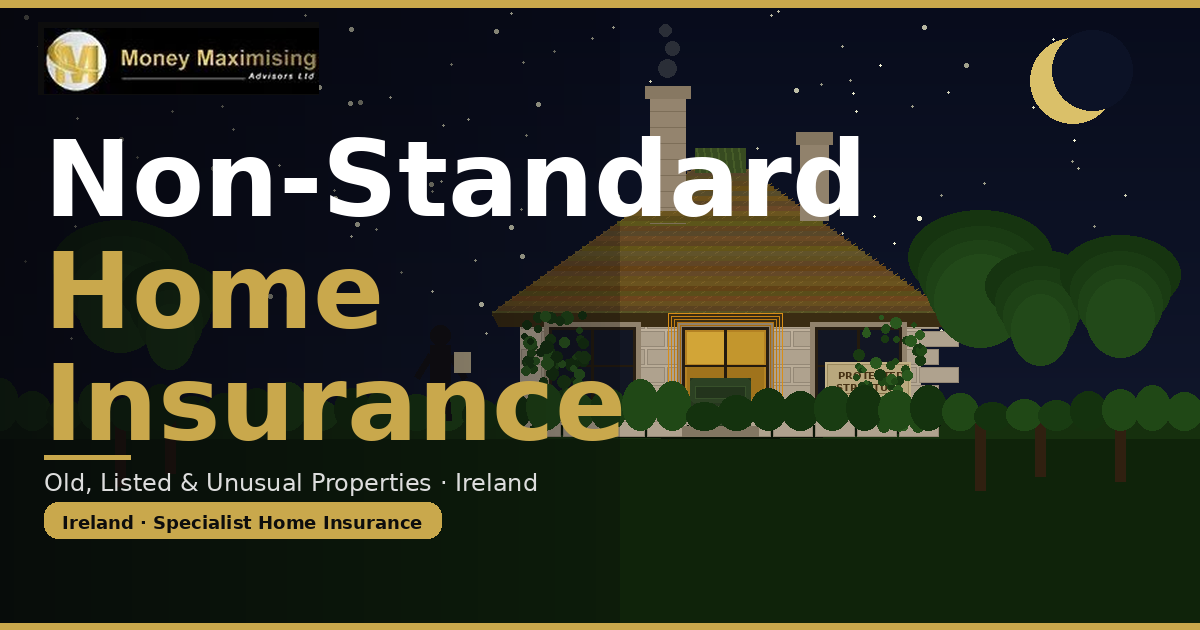
If your property has a thatched roof, a protected structure listing, subsidence history or an unusual construction type, a mainstream insurer may refuse to quote you at all. This is where non standard home insurance Ireland comes in. It is specialist cover designed for homes that fall outside the criteria mainstream insurers accept automatically, including old, listed and unusual properties across Ireland. This guide explains what qualifies as non standard, why insurers decline certain homes, what specialist cover typically includes and how to improve your chances of getting accepted at a fair price.
What Is Non Standard Home Insurance in Ireland?
Standard home insurance policies in Ireland are written around a narrow set of assumptions. The insurer expects a modern brick or block built house with a pitched tiled or slate roof, no history of subsidence or flooding, no unusual business use and an owner with a clean claims record. Any property that falls outside these assumptions is classed as non standard.
Non standard does not mean uninsurable. It means the property needs a specialist underwriter who understands the specific risk, rather than a general insurer working from a standard rate card. In Ireland, non standard home insurance is typically arranged through a broker with access to a panel of specialist insurers, since these policies are rarely available directly to the public.
Which Properties Are Classed as Non Standard
Listed and Protected Structures
Homes on the Record of Protected Structures face legal restrictions on repairs and renovations. Any rebuild after a fire or storm must use approved materials and methods, which usually costs significantly more than a standard rebuild. Insurers price this in, and many mainstream providers will not quote at all.
Thatched Cottages
Thatch is one of the most common triggers for non standard classification in Ireland. Fire risk is the primary concern, since thatch burns quickly and a chimney fire can spread through the roof structure within minutes. Specialist thatched property insurers usually require details of chimney maintenance, spark arrestors and the age of the thatch itself.
Timber Frame, Log Cabin and Eco Homes
Timber frame construction, log cabins and other modern methods of construction such as SIPs or steel frame can also fall outside standard criteria, even though many are certified and well insulated. Insurers assess fire spread risk and the availability of like-for-like rebuild materials.
Flat Roof Properties
Most standard insurers cap the percentage of flat roof a property can have, often around 20 to 25 percent of total roof area. Homes with a higher proportion of flat roofing, common in extensions and some period conversions, often need specialist cover due to a higher risk of water ingress.
Homes With Pyrite or Mica History
Properties affected by pyrite or mica related structural issues, a significant concern in parts of the Irish market, require underwriters familiar with these specific defects and any remediation works already carried out.
Properties With Subsidence or a Claims History
A previous subsidence claim, a history of frequent claims, or a non renewal by a previous insurer will usually move a property into the non standard category, even once the underlying issue has been resolved.
Self-Build and Renovation Projects
Homes under active construction or major renovation carry different risks than a finished, occupied property. Course of construction cover is a specific type of non standard policy that reflects this.
Unoccupied Properties
A property left empty for more than 30 to 45 consecutive days typically falls outside a standard policy’s terms. For full detail on this specific category, including emigrant properties, inherited homes and properties for sale, see our guide to unoccupied home insurance Ireland.
Why Insurers Decline Non Standard Properties
Insurers price risk using historical claims data across large groups of similar properties. When a property does not fit an existing category, an underwriter cannot rely on that data, so many mainstream insurers simply decline rather than take on an unknown risk. Specialist non standard insurers exist precisely to fill this gap. They employ underwriters who assess each property individually rather than relying purely on automated rating systems.
Duty of Disclosure
Irish insurance law places a legal duty on you to disclose all material facts when applying for cover, and this duty is especially important with non standard properties. Material facts include construction type, roof type, any history of subsidence, flooding or claims, and any known structural issues such as pyrite. Failing to disclose accurately can result in a claim being refused or a policy being cancelled entirely, even years after it was taken out.
Get covered today
Speak with an advisor or get an instant quote online
Get Quote NowMon – Fri · 9am – 5pm
What Documentation Do Insurers Typically Ask For
Specialist non standard insurers generally request more supporting evidence than a standard application. This can include:
- A structural survey or engineer’s report, particularly for older or listed properties
- Evidence of any remediation works, such as pyrite or subsidence repairs
- Details of roof construction, including the percentage of flat roof
- Fire protection measures, especially for thatched properties
- A claims history letter from previous insurers
Having this documentation ready before you apply speeds up the process considerably and often improves the terms you are offered.
Non Standard vs Standard Home Insurance: Key Differences
| Factor | Standard Home Insurance | Non Standard Home Insurance |
| Eligible properties | Modern construction, pitched roof, no adverse history | Listed, thatched, timber frame, flat roof, claims history |
| Underwriting | Largely automated rating | Individual assessment by a specialist underwriter |
| Availability | Direct from most insurers | Mostly through specialist brokers |
| Premium | Lower, standardised rates | Higher, reflecting individual risk |
| Documentation | Minimal | Surveys, remediation evidence, claims history often required |
How Much Does Non Standard Home Insurance Cost in Ireland
Non standard home insurance premiums are almost always higher than standard cover, since the underlying risk is genuinely higher or less predictable. The increase depends heavily on the specific factor involved. A timber frame home in good condition with no adverse history may only attract a modest loading, while a thatched property with limited fire protection or a home with an unresolved subsidence issue can see premiums rise substantially. There is no single figure that applies across the market, which is why getting an individual quote through a broker with access to specialist insurers is the only reliable way to understand your actual cost.
How to Improve Your Chances of Cover and Reduce Premiums
- Commission a structural survey before you apply, particularly for older or listed properties
- Complete any recommended remediation works, such as pyrite testing or subsidence repairs, and keep the documentation
- Install monitored fire and intruder alarms where relevant, especially for thatched properties
- Maintain a full claims history record from previous insurers rather than relying on memory
- Use a broker with access to a panel of specialist insurers rather than applying directly to a single mainstream provider
Frequently Asked Questions
Q1. What qualifies as a non standard construction home in Ireland?
Any property built with materials or methods outside a mainstream insurer’s standard criteria, including thatch, timber frame, flat roof beyond a set percentage, and listed or protected structures.
Q2. Can I get insurance after being refused by a standard insurer?
Yes. A decline from a mainstream insurer does not mean a property is uninsurable. Specialist non standard insurers routinely cover properties that mainstream providers reject.
Q3. Is non standard home insurance only for old houses?
No. Modern timber frame homes, log cabins and eco-builds can also be classed as non standard, alongside older cottages and listed buildings.
Q4. Do I need a broker for non standard cover?
In most cases, yes. Specialist non standard policies are rarely sold direct to the public and are typically accessed through a broker with the right insurer relationships.
Talk to a Specialist Broker
Every non standard property is different, and getting the right cover starts with an accurate assessment of your specific risk. Money Maximising Advisors works with a panel of insurers across the Irish market to place cover for listed buildings, thatched cottages, timber frame homes and other non standard properties. Get in touch to discuss your property and get a tailored quote.